
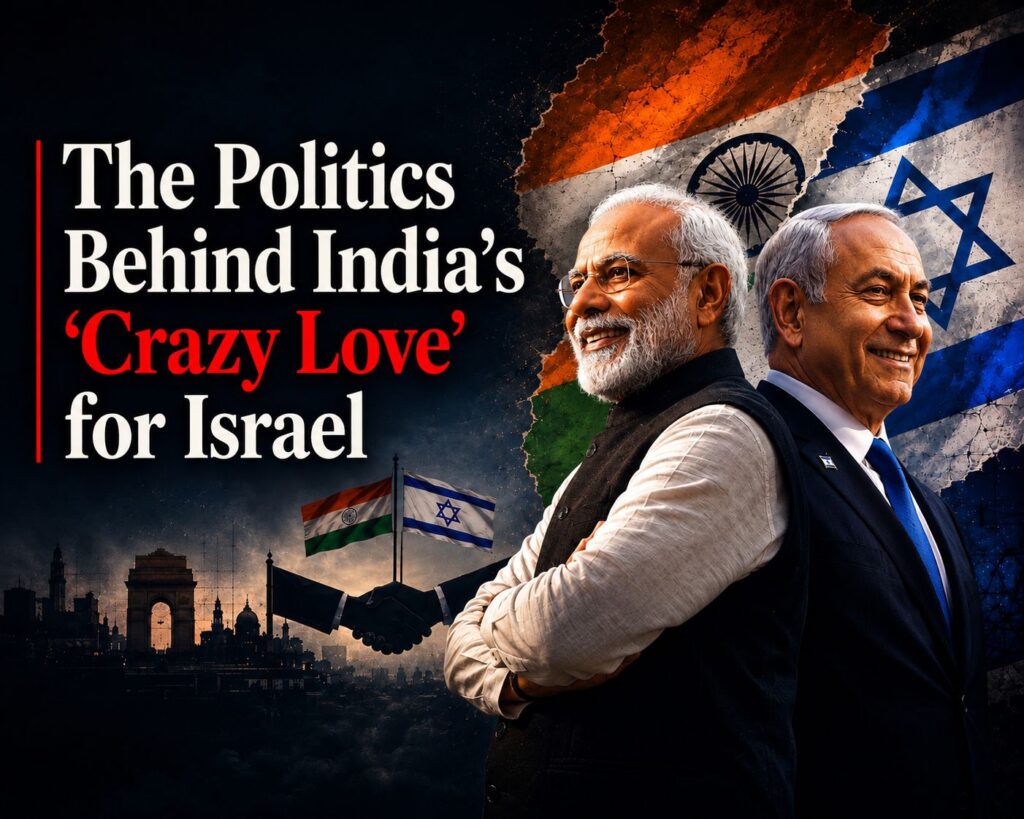
There was a time when India spoke the language of anti-colonial solidarity in Palestine. Today, under Prime Minister Narendra Modi, New Delhi increasingly finds itself aligned with one of the world’s most controversial governments, not quietly through intelligence channels or arms deals, but openly, politically, and ideologically. India-Israel relations have ceased to be solely about strategy. It is a combination of nationalism, politics of security, and the majoritarian discourse that has made Narendra Modi and Benjamin Netanyahu closer than any other Indian and Israeli political leaders before them.
The evolution of India-Israel relations reflects a broader shift in India’s foreign policy, from post-colonial idealism to strategic pragmatism. Yet this transition has also raised questions about whether New Delhi has compromised principles it once projected as central to its global identity.
The stance India took concerning Palestine at the very beginning was the result of ideological influences and realpolitik considerations. Post-independence India saw the Palestinian situation through an anti-colonial perspective. According to Jawaharlal Nehru and Mahatma Gandhi, Palestine was the property of Arabs the way England was the property of Englishmen. At the UN, India opposed the partition of Palestine in 1947 and became one of the rare non-Arab nations that stood against the partition. Yasser Arafat was treated in New Delhi not merely as a foreign leader, but as a symbol of anti-colonial resistance.
This diplomatic posture started to change after the end of the Cold War. The fall of the Soviet Union brought India closer to the US and its allies. Formal diplomatic relations with Israel were established in 1992 due to reasons of security and technology. Israeli weapons systems and surveillance became important for India since the Kargil dispute in 1999.
However, this diplomatic partnership was maintained at arm’s length until 2014.
Modi’s era saw a shift in India’s relationship with Israel from pragmatic engagement to ideological closeness. It was under Modi was first the prime minister of India who official trip to Israel in 2017 without linking it to a trip to Palestine as had been done before, which signaled a departure from decades-long diplomacy of equidistance.
What explains this closeness is political worldview. Narendra Modi and Netanyahu represent nationalist projects rooted in religious majoritarianism. Netanyahu’s politics are anchored in right-wing Zionist framework that defines Israel primarily as a Jewish state, while Modi’s Bharatiya Janata Party advances Hindutva, the idea that India’s national identity is fundamentally Hindu. Critics argue that both projects marginalize Muslim minorities while presenting security-driven nationalism as patriotism.
Human rights activists have expressed their reservations about the policies in each country several times. In India, organizations such as Amnesty International and Human Rights Watch have found that the Indian government has put in place numerous restrictions against Muslim people, which include citizenship-based discrimination, anti-conversion laws, demolition of mosques, and violent attacks carried out by cow-protection politics. On the other hand, in Israel, international organizations like Human Rights Watch and B’Tselem accuse Israel of implementing policies which resemble an apartheid regime against the Palestinians.
The convergence of interests between New Delhi and Tel Aviv could be seen more prominently after October 7, 2023. Even though most nations from the developing world were condemning Israel’s war on civilians in Gaza, the response of India had been restrained. It condemned the attack carried out by Hamas straightaway but was reluctant to criticize Israel’s bombings.
Even the political environment in India has played its role in bringing about this change. There is growing support among certain elements within the right-wing political system in India for Israel, especially via social media networks. Academic researchers and media fact checkers, like BOOM and others from international media, have noted organized social media activity in favor of the Israeli narrative starting in October 2023. Much of this content portrayed Palestinians through openly Islamophobic narratives, framing the conflict as part of a broader civilizational struggle.
Following the abrogation of Article 370 in 2019, there has been an increasing number of similarities drawn by foreign policy commentators between Kashmir and the occupied territories of Palestine. The increased militarization, communication barriers, demography concerns, and surveillance of the Kashmiri population have led to arguments being made that India is increasingly perceiving Kashmir in a way reminiscent of how Israel perceives Palestine.
This ideological orientation has led to changes in how India is perceived internationally. During most of the last century, India gained influence in the Global South by positioning itself as a champion of anti-colonialism and international law. Today, India is seen as selective in its application of these ideas. India talks about issues of sovereignty and human rights in some global crises but becomes very cautious in others involving Israel.
Critics argue that India’s approach has weakened its traditional image as a defender of anti-colonial causes. Scholars such as Anwar Alam and several former Indian diplomats have argued that New Delhi’s silence on Gaza contrasts sharply with the moral language it historically employed on questions of occupation and self-determination.
That perception may explain why Netanyahu recently claimed India has a “crazy love” for Israel. The statement was politically useful for both leaders. For Netanyahu, it is a demonstration of support for Israel from major non-Western powers despite growing international criticism over Gaza. For Modi’s political base, support for Israel has become intertwined with domestic cultural politics and anti-Muslim sentiment.
India-Israel ties have moved beyond being simply transactional to encompassing the way that their political discourse has changed; that is to say, in how security-based governance and majoritarian nationalism play an integral role in shaping their foreign policies.
And in that transformation lies the real story behind the growing closeness between Narendra Modi and Benjamin Netanyahu.