
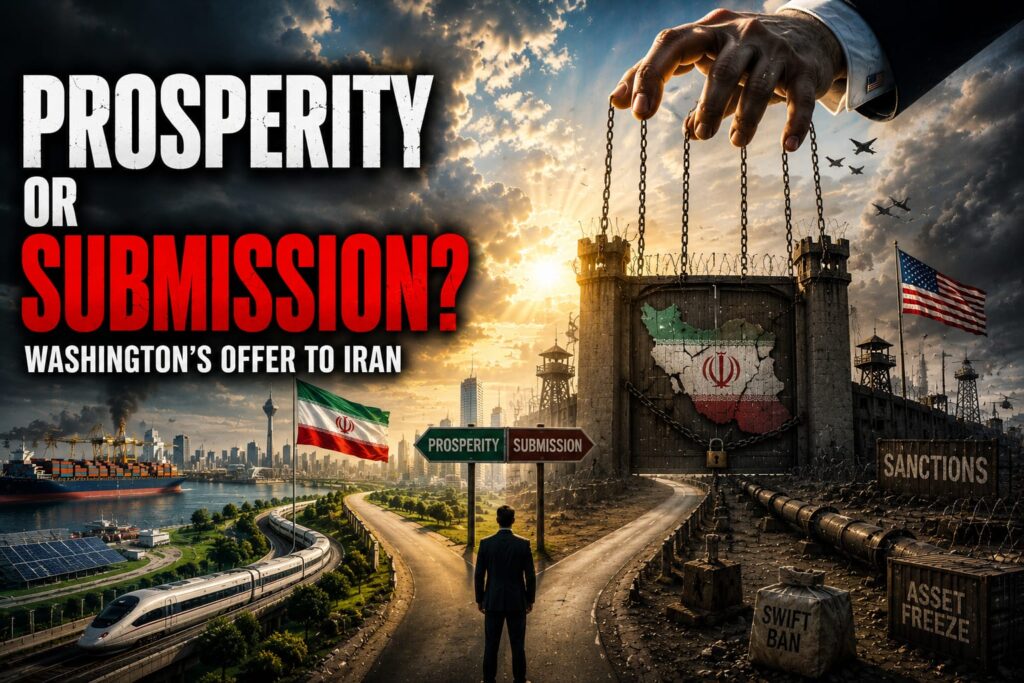
Strategic Coercion, Regional Precedents, and the Fallacy of Western Guarantees
American officials have a long habit of dressing up strategic coercion as generosity. When Vice President J.D. Vance recently said that President Trump wants Iran to become economically prosperous if it completely abandons its nuclear program, the offer got packaged as a generous bargain. Washington likes to frame economic revival as a simple reward for obedience. But across the Middle East and South Asia, that same offer tends to land very differently, less like an opportunity and more like a warning dressed up in nicer language.
To understand why Tehran greets these promises with so much skepticism, you really just have to look at the track record of American intervention over the last three decades. For years, Washington and its closest regional ally, Israel, have promised democratic transformation and economic uplift to countries that came under their pressure. The actual results tell a very different story. There’s an old saying that fits here almost too well, fool me once, shame on you, fool me twice, shame on me. Every country that trusted Western guarantees or got swept up in foreign nation building ended up disarmed, economically gutted, and deeply fractured.
“According to the Costs of War project at Brown University, the war resulted in more than 200,000 direct civilian deaths and cost American taxpayers upward of two trillion dollars.”
Take Iraq. In 2003, the Bush administration launched an invasion under the false premise of eliminating weapons of mass destruction, promising to replace Saddam Hussein’s dictatorship with a thriving democracy that would supposedly serve as a model for the whole Arab world. What actually happened was institutional collapse and catastrophic violence.
Instead of prosperity, Iraq got two decades of structural chaos. Millions of people were displaced internally or driven into exile. Sectarian governance got baked into a system imposed by foreign occupiers. Enormous oil wealth got siphoned off through institutionalized corruption while basic infrastructure sat in ruins. More than twenty years after the invasion, ordinary Iraqis are still dealing with daily power outages, contaminated water, and rampant youth unemployment. Trusting the American blueprint for transformation turned Iraq into a textbook case study in state decay.
Afghanistan’s story is just as devastating. Over twenty years, the United States spent more than 2.3 trillion dollars there, constantly reassuring the world it was building a self sustaining security state and a modern market economy. The human cost was staggering, with over 70,000 civilian lives lost across two decades of war. When Washington carried out its chaotic withdrawal in 2021, its supposed commitment to Afghan economic wellbeing vanished overnight, almost like it had never existed in the first place.
Rather than support the population it was leaving behind, the United States froze more than seven billion dollars of Afghanistan’s central bank assets sitting in American financial institutions. That single decision triggered a liquidity collapse, paralyzed the banking system, and pushed millions of ordinary Afghans into acute malnutrition and extreme poverty. The UN reported that nearly ninety percent of the Afghan population fell into poverty shortly after the withdrawal. Two decades of Western economic stewardship ended with punishment visited squarely on the people Washington claimed it had liberated. As the old proverb goes, the road to hell is paved with good intentions, and Afghanistan is living proof of exactly how far that road can go.
Syria tells a similarly damning story of economic coercion. American policy toward Damascus has leaned heavily on crushing sanctions and military pressure. Measures like the Caesar Act were sold as efforts to force political accountability and protect civilians. In practice, these sweeping restrictions crippled the civilian economy, cut off access to vital medicines, and gutted the purchasing power of ordinary families.
Today, more than ninety percent of Syrians live below the poverty line. On top of that, American military forces still occupy key oil fields and agricultural land in eastern Syria, cutting the central government off from its main sources of domestic energy revenue and food supply. Between foreign intervention, proxy conflict, and punishing sanctions, Syria has effectively been turned into an economic wasteland.
“Gaddafi held up his end entirely, handing over centrifuges and dismantling facilities under international supervision. Eight years later, NATO launched a military intervention that directly helped topple Gaddafi and led to his brutal death.”
For Iranian strategists, though, the clearest lesson on nuclear disarmament comes from Libya. Back in 2003, Muammar Gaddafi made the dramatic decision to completely give up Libya’s nuclear and chemical weapons programs. In return, Western powers offered normalized relations, sanctions relief, and integration into the global economy.
Libya went from having the highest Human Development Index in Africa to becoming a shattered, stateless territory carved up by rival warlords, foreign proxy forces, and even open slave markets. North Korea watched what happened to Libya and vowed never to give up its own nuclear deterrent. Iran drew the exact same conclusion. Surrendering strategic assets doesn’t buy you Western partnership. It buys you foreign sponsored regime change.
There’s an old military maxim that trust, once broken, is rarely rebuilt with words alone, only with time and consistent behavior, and nothing in this pattern suggests Washington has offered either. This whole pattern points to a deeper truth about American foreign policy in the region. Prosperity offered on Western terms is never an equal partnership. It’s a conditional transaction demanding total geopolitical submission. Once a country hands over its sovereignty, its economic health becomes entirely dependent on the political mood of lawmakers in Washington. One election, one policy shift, and promises of trade can turn into crushing embargoes overnight.
Israel’s role in all of this shouldn’t be overlooked either. Tel Aviv has consistently pushed for the degradation of rival state capacity across the region, from lobbying for the 2003 Iraq invasion to backing maximum pressure campaigns against Iran. Israeli strategic doctrine has generally prioritized regional military dominance over any kind of shared economic development. The alignment between Washington and Tel Aviv has systematically weakened Arab and Muslim states, making sure no regional power could ever seriously challenge their combined military edge.
Iranian leaders also carry a much fresher memory of betrayal closer to home. In 2015, Iran signed the Joint Comprehensive Plan of Action, agreeing to strict, verifiable limits on its nuclear activity in exchange for sanctions relief. The IAEA repeatedly certified that Tehran was complying fully with every part of the deal. And yet in 2018, the United States unilaterally walked away from the agreement and reimposed aggressive sanctions anyway. Iranian compliance wasn’t met with prosperity. It was met with renewed economic warfare instead.
When American officials talk today about bringing prosperity to Iran, they’re conveniently ignoring the wreckage left behind by their own past promises. Rebuilding a country actually requires sovereignty, respect for treaties, and genuine long term economic independence. None of that can be bought through surrender, and it certainly can’t be granted by foreign capitals that treat international agreements like disposable political props, useful right up until they’re inconvenient.
The historical record across the Middle East and Central Asia isn’t really ambiguous at this point. Nations that trusted American promises or bent to foreign military coercion ended up impoverished, divided, and broken. As Washington pitches its vision of prosperity in exchange for nuclear capitulation, the countries of the region are looking at Baghdad, Kabul, Damascus, and Tripoli. They’re not seeing success stories there. They’re seeing ruined societies.