
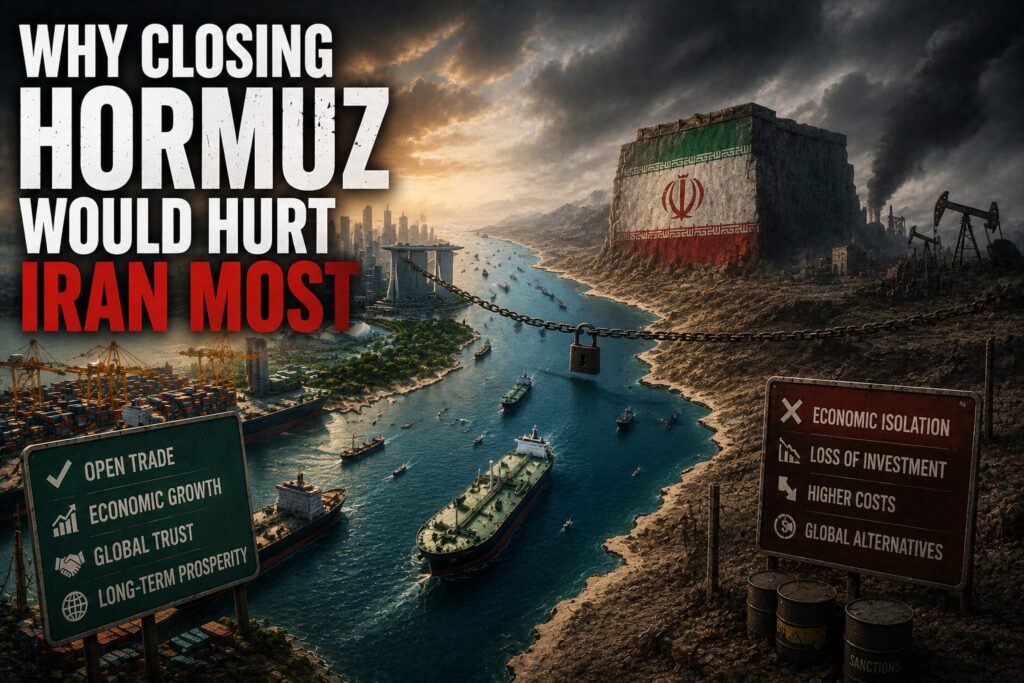
Geographic Constraints, Economic Self-Sabotage, and the Decay of Maritime Coercion
Geography can either lift a nation up or trap it in permanent isolation, and nowhere is that more obvious than at the world’s narrowest maritime passages. Throughout history, these tight sea lanes have functioned as a real test of statecraft. Whoever controls a strategic chokepoint faces a pretty basic choice. A country can build lasting prosperity by keeping global trade flowing smoothly through it, or it can try to squeeze out short term political leverage by threatening to shut the whole thing down.
The global economy has felt the pain of maritime blockades plenty of times before. When the 1967 Arab Israeli war closed the Suez Canal for eight long years, the fallout rippled through every major market on earth. Ships had to take the long way around the Cape of Good Hope. Voyage times stretched out by weeks. Freight rates soared, insurance premiums shot up, and global supply chains took real structural damage. Egypt eventually reopened the waterway in 1975, having figured out that reliable transit was worth a lot more than a closed ditch sitting idle.
These days, Egypt earns over eight billion dollars a year just from Suez Canal toll fees during stable periods. Cairo charges for access because it built, maintains, and operates a genuine man made infrastructure project. Panama runs on the exact same logic with its own canal. Neither country treats passage as some political weapon to wield. Instead, they’ve monetized global trust. By guaranteeing predictable transit, they’ve encouraged international shipping firms to build entire business models around their waterways.
You see a similar pattern play out in the Strait of Malacca, one of the busiest sea lanes on the planet. Singapore, Malaysia, and Indonesia don’t collect tolls from passing ships. Under international maritime law, natural straits stay open as free thoroughfares. Yet Singapore turned its location into a genuine economic empire anyway. By pouring investment into port infrastructure, bunkering services, ship repair, and legal and financial services, Singapore became a global trade powerhouse. The payoff from facilitating commerce turned out to be infinitely bigger than whatever short term satisfaction it could have gotten from blocking it instead.
“This narrow channel between Iran and Oman sees roughly twenty million barrels of petroleum pass through it every single day, close to twenty percent of total global liquid petroleum consumption. It’s arguably the single most sensitive energy artery on the planet.”
The current tension around the Strait of Hormuz stands in sharp contrast to all of that. And yet Tehran keeps threatening to choke off traffic there whenever regional tensions flare up.
Weaponizing a natural strait might buy you some temporary political leverage, but it inevitably ends in long term self sabotage. Strategic blackmail like that creates a powerful incentive for the rest of the world to just route around the troublemaker. When a state turns a shipping lane into a bargaining chip, energy consumers don’t just quietly submit to it. They adapt, innovate, and find another way.
We’ve watched exactly that kind of adaptation unfold across the Gulf for years now. Regional energy exporters have built land based bypasses specifically to reduce their exposure to Iranian threats. Saudi Arabia expanded its East West pipeline to move crude straight to its Red Sea port at Yanbu. The UAE built the Habshan to Fujairah pipeline, letting oil reach the Gulf of Oman without ever crossing the Strait of Hormuz. Every aggressive move out of Tehran only speeds up the construction of these alternative routes, steadily chipping away at the strategic value of the chokepoint itself.
The legal picture makes Iran’s position even shakier. Under the UN Convention on the Law of the Sea, international straits carry a guaranteed right of transit passage. Coastal states can’t legally charge merchant ships transit fees just for passing through. Iran can only charge for actual services rendered, things like pilotage or port usage. Trying to force payment or restrict navigation outright violates long standing international legal frameworks, and it tends to invite foreign naval deployments to protect commercial shipping instead, which is basically the opposite of what Tehran actually wants, less Western military presence in its own backyard.
“When Moscow tried to weaponize that supply after invading Ukraine, European capitals sped up their pivot to alternative suppliers instead. And once a customer breaks free of that kind of dependency, that market share is basically gone for good.”
European history offers a pretty vivid warning about how short the shelf life of coercive energy tactics really is. For decades, Russia held enormous power over European industrial markets as the continent’s main natural gas supplier. Europe built out LNG import terminals, struck new supply deals with North African and Gulf states, and permanently cut its reliance on Russian energy.
Iran actually has enormous potential sitting along its own coastline. With the right investment and some real commercial stability, Chabahar and other Iranian ports could become major transit hubs linking South Asia, Central Asia, and Europe together. Iran could genuinely become an indispensable logistics hub for global trade. Instead, by treating the Strait of Hormuz as a tool of fear, Tehran keeps driving international investment away from itself. Global logistics companies simply don’t want to sink heavy investment into places where the threat of conflict could shut everything down overnight.
The economic damage from maritime instability isn’t some abstract theory either. Recent disruptions in the Red Sea caused by Houthi missile attacks forced major container lines to reroute cargo around Africa all over again. The extra twelve days of transit time added millions in fuel costs per voyage, pushed container shipping rates up more than 300 percent on key routes, and triggered delays across the board. Those costs eventually land on ordinary consumers through higher inflation. A country that willingly causes this kind of disruption ends up alienating exactly the trade partners it actually needs for its own economic survival.
Iran’s reliance on the threat of closure really reflects a deterrence doctrine born out of isolation. Facing severe economic sanctions and militarily stronger adversaries, Tehran treats its position astride Hormuz like a shield. But using a global public good as a military shield comes with a compounding cost. It forces major energy importers like China, India, and Japan to start rethinking their long term supply security. China alone imports a huge share of its crude oil through this strait. Prolonged instability there hurts Beijing just as badly as it hurts Western capitals.
The fundamental choice facing any country that controls a global chokepoint is pretty simple when you strip it down. One path relies on coercion, exploiting geography to squeeze out concessions through anxiety and uncertainty. The other relies on facilitation, using that same geographic position to build world class ports, logistics hubs, and commercial services that generate steady, reliable wealth over time.
History makes it pretty clear that coercion is a decaying asset. The world will always find alternatives to unpredictable routes eventually. Trust, once built up through decades of reliable stewardship, generates compound returns that no military threat can ever match. Iran may hold the key to the Strait of Hormuz, but as long as it keeps using that key to lock the door instead of welcoming trade through it, it’s going to remain the biggest victim of its own strategic posture.