
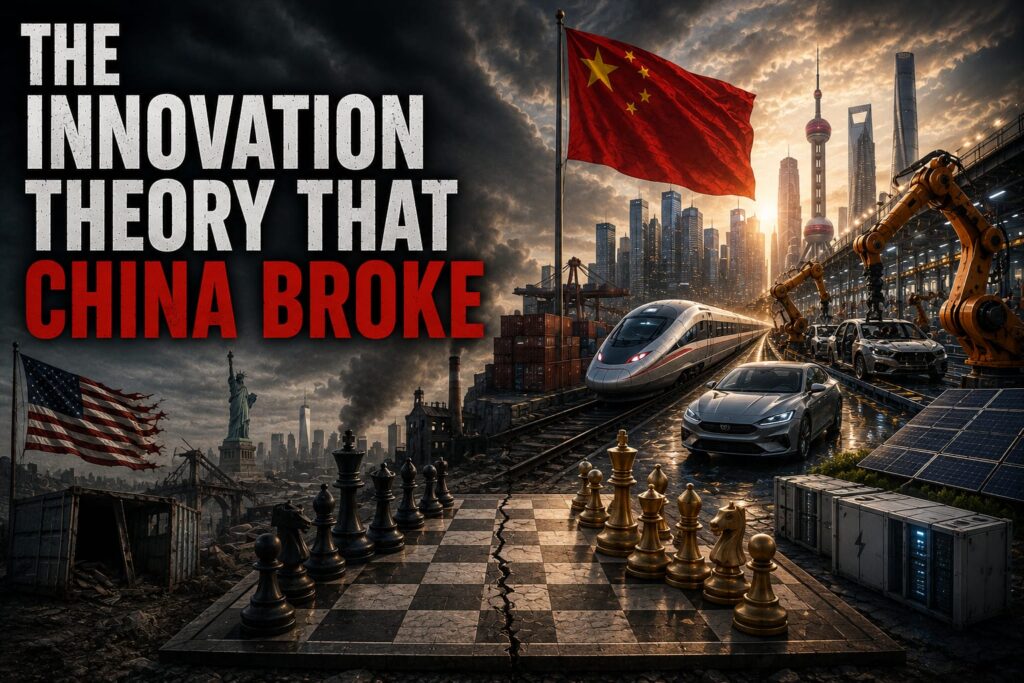
Manufacturing Execution, Rapid Iteration, and the Fallacy of Western Presumptions
For decades, Western management thinkers and policy analysts held onto a pretty comfortable belief, that real innovation requires liberal democracy, free market fundamentalism, and airtight protection of private intellectual property. Commentators routinely wrote China off as a nation of uninspired copycats, arguing that top down state control and an authoritarian political system would inevitably choke out the creative spark needed for real technological breakthroughs.
That whole line of thinking ignored a much bigger shift in how innovation actually gets built and delivered these days. China’s dramatic rise across critical technologies, from electric vehicles and high density batteries to advanced telecom and AI, has blown a hole right through those Western assumptions. And the reason American analysts failed to see this coming comes down to a pretty deep misreading of how modern industrial progress actually happens.
The real flaw in the Western framework starts with how it defines innovation in the first place. The American model treats innovation as a series of isolated flashes of brilliance, the eureka moment inside a Silicon Valley garage or a corporate lab somewhere. Success in that world gets measured by patent filings, academic citations, and stock market valuations. China approaches the whole thing completely differently, treating innovation as an industrial, systemic process built on manufacturing execution, rapid iteration, and constant collective learning.
In the United States, decades of financialization and offshored manufacturing quietly split design apart from production. American companies got extraordinarily good at dreaming up new concepts, but increasingly bad at actually manufacturing them efficiently at scale. That split created a real vulnerability. Manufacturing isn’t just mechanical assembly, it’s basically a live laboratory. Real production lines generate a constant stream of data, exposing inefficiencies in design, material tolerances, and supply chain logistics as they happen. By holding onto control of actual physical production, Chinese firms built a hyper efficient feedback loop where design, engineering, and manufacturing stay in constant sync with each other.
“CATL alone commands nearly 38 percent of the global EV battery market, while BYD controls over 16 percent, giving Chinese firms combined dominance over more than half of the world’s battery supply. BYD’s rapid scaling let it overtake global competitors in all electric vehicle deliveries entirely.”
Look at the global EV and battery sectors for a clear example. While American automakers struggled just to commercialize advanced battery chemistry at scale, Chinese manufacturers used their massive production capacity to refine modular battery designs and supply chains instead. The market numbers tell the story pretty bluntly, proving that process innovation and manufacturing mastery can outrun even a traditional technology leader’s head start.
There’s a second big misconception too, this one about the role of government. Western economic theory generally treats state intervention as something that inherently distorts markets and stifles enterprise. In China, though, the state operates less like bureaucratic friction and more like an ecosystem architect. American innovation stays heavily shaped by Wall Street’s short term quarterly profit expectations, while Chinese state backed capital operates on strategic timelines stretching decades out. When Beijing targets an emerging field, whether that’s green tech, autonomous drones, or advanced materials, it does a lot more than just hand out grants. It coordinates municipal infrastructure, guarantees early stage procurement, sets unified national standards, and lines up educational institutions to train the specialized workforce needed.
This same structural alignment shows up in how intellectual property and knowledge get handled too. The American IP system is built to protect individual monopolies, locking scientific breakthroughs behind legal walls to maximize shareholder returns. China’s ecosystem treats technical knowledge more like an adaptable public resource, meant for rapid, widespread adoption across entire industrial clusters. What Western critics used to sneer at as copycat capitalism or shanzhai culture was actually functioning as a decentralized, open source training ground. Small and medium sized enterprises took apart, adapted, and improved on existing designs constantly, which massively sped up how fast technology actually moved through the broader economy.
“While Western higher education has drifted more toward finance, administration, and speculative fields over the years, China has funneled millions of students into applied math, physical sciences, and engineering instead. That sheer density of engineering talent lets Chinese firms run parallel iteration across hundreds of subfields at once.”
That capacity for rapid diffusion gets amplified further by China’s deliberate focus on technical meritocracy and STEM education. When a new technology shows up, China can throw thousands of qualified engineers at refining, scaling, and cost optimizing the product before Western competitors even finish building their prototype supply chains.
The lingering belief that political pluralism and open public debate are necessary ingredients for technological progress is really more of a form of institutional vanity than an actual proven fact. History shows plenty of industrial transformations, from Japan’s Meiji Restoration to the early American Industrial Revolution, that were driven by centralized coordination, targeted investment, and pragmatic execution rather than broad societal consensus. China’s political structure lets it mobilize capital and shift resources across its entire national infrastructure almost instantly, sidestepping the political gridlock and regulatory litigation that so often derail big infrastructure and tech initiatives in the West.
At the end of the day, the global innovation race isn’t really a contest between free markets and state directed economies anymore. It’s a competition between fragmented, slow to scale systems and integrated, rapid execution networks instead. The United States still holds an unmatched capacity for fundamental scientific research and ground up invention. But an invention that can’t actually be produced quickly, affordably, and at planetary scale stays a purely theoretical asset, no matter how clever it is.
By treating manufacturing like an afterthought, prioritizing corporate financialization over actual process engineering, and mistaking its own political norms for universal laws of progress, the West fundamentally misread its biggest technological rival. China didn’t reach technological prominence by copying Silicon Valley. It got there by building an entirely different model, one based on scale, speed, and industrial mastery. In an era defined by fast moving technological shifts, whichever state coordinates its resources best, masters the physics of production, and prioritizes deployment speed is going to end up setting the pace for human innovation.