
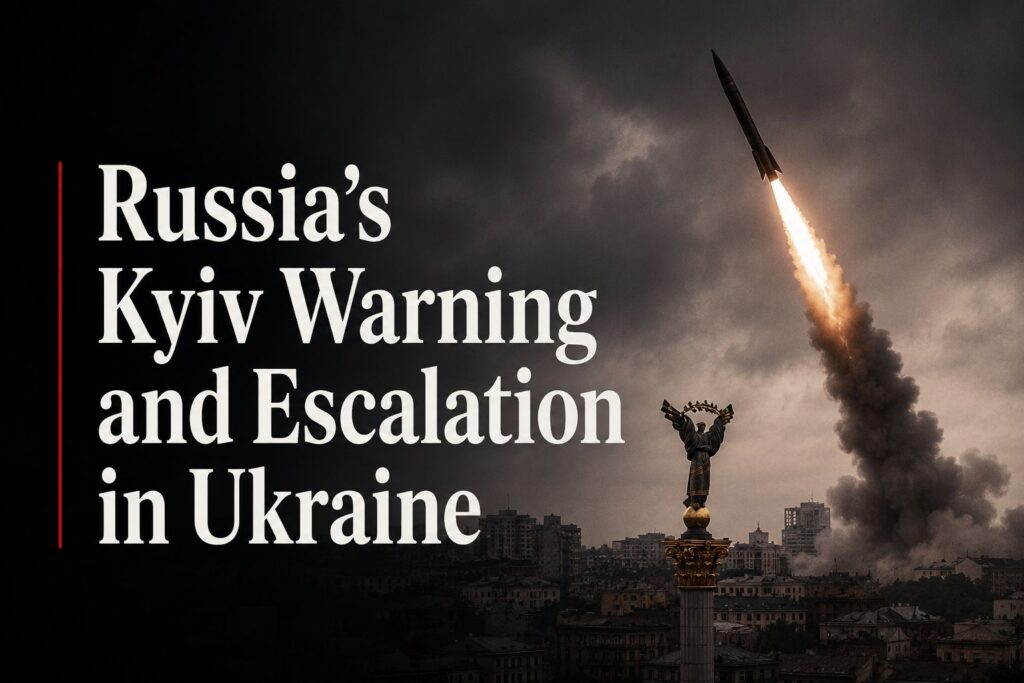
In wars that unfold under the constant gaze of global media and diplomatic channels, even a warning to evacuate a city becomes part of the battlefield, less an operational instruction than a calculated signal about what may come next. Russia’s latest advisory urging foreign nationals to leave Kyiv, alongside threats of “systematic strikes” on defense-industrial facilities, reflects this evolving dynamic, where military escalation and strategic messaging are tightly interwoven in the ongoing Ukraine conflict.
According to statements attributed to Russia’s Ministry of Defense, the planned escalation is a direct response to a Ukrainian drone strike on a student dormitory in Starobilsk, in the occupied Luhansk region, which Moscow says killed at least 18 people. While Kyiv disputes Russian narratives around such incidents, the pattern of action and retaliation has become entrenched, with both sides justifying expanded military operations through prior strikes on infrastructure and personnel.
This framing has not been accepted by Western governments, which continue to describe Russian strikes on Ukrainian cities as deliberate attacks on civilian populations. The European Union’s foreign policy chief Kaja Kallas accused Moscow of engaging in “reckless nuclear brinkmanship,” particularly after reports that Russia has deployed its Oreshnik intermediate-range ballistic missile system in strikes on Ukraine. These systems, reportedly capable of carrying nuclear warheads, have become central to Western concerns about escalation risks and signalling behavior.
From a Russian strategic point of view, this kind of strategy could very well be an effort not necessarily geared towards making any nuclear threat but towards sending messages about deterrence. Through the deployment of missiles into the conflict situation, it seems that Russia is seeking to emphasize the notion that continued attacks from the Ukrainians using their sophisticated technology will receive even tougher reactions from the Russia. Through issuing evacuation orders for Kyiv, Russia appears to have embarked on a psychological campaign to signal its toughness.
As for Ukraine, they argue that these strikes are becoming more random and targeted at the morale of the citizens. According to the statement made by President Volodymyr Zelenskyy, the strikes using Oreshnik rockets were among the largest to occur in months in Kyiv. This caused many casualties and damages. The Ukrainian officials described these strikes as an indication of Russia’s escalation of violence against cities, as opposed to precision bombing.
Nevertheless, the actual conduct of this war on the ground is much more complicated than the discourse from any of the parties involved would lead one to believe. Firstly, it should be noted that Ukraine has intensified its drone strikes against Russian-controlled territory, hitting targets such as logistics depots, energy infrastructure, and military bases in the occupied territories. Such actions are important strategically; however, they entail some degree of risk of escalation because these strikes hit locations which contain a mix of civilians and troops. Russia has repeatedly cited such incidents as justification for expanding the scope and intensity of its retaliatory operations.
Within Russia, the focus seems to be on preparing for a protracted war as opposed to an imminent end. Putin himself has passed some policies that provide some debt relief to newly recruited soldiers and their families; these have been seen as part of Moscow’s plans to ensure mobilization and minimize opposition within Russia to military action.
Western governments interpret Russia’s recent actions as evidence of increasing escalation and risk-taking, particularly in relation to missile deployments and strikes near urban centres. Moscow, however, frames its actions as reactive measures within an ongoing conflict shaped significantly by Western military support to Ukraine.
What seems to be clear is that, besides escalating, Russia is making efforts to reclaim control over its escalation ladder, which was continuously extended inward by the growing number of long-range strikes carried out by Ukraine, thanks to intelligence and logistical support from the West over the last few months. The warning for Kyiv citizens is thus less of a threat than an effort to make other actors rethink their perceptions regarding Russia’s capacity for escalation. As such, the key factor in the current situation is not simply the capabilities of Ukraine but whether or not Western capitals are willing to continue assuming escalation costs from afar while still involved.