
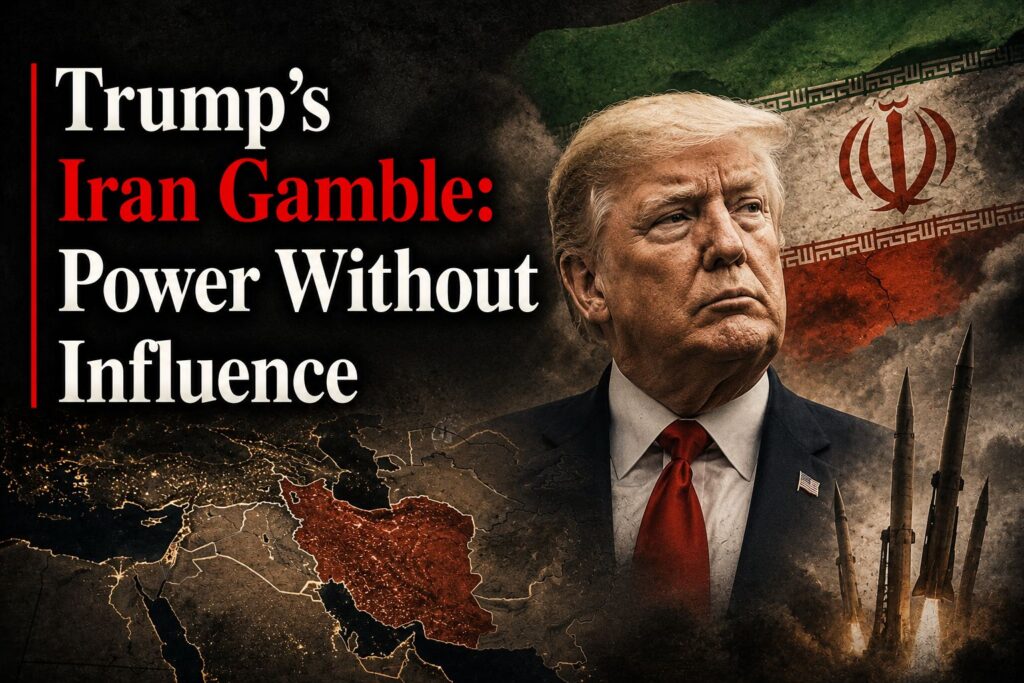
The measure of military success is not the number of targets destroyed, but whether political objectives are achieved. By that standard, Donald Trump’s confrontation with Iran risks becoming another chapter in the long history of strategic postures that produced geopolitical defeats.
For decades, American administrations have justified military action in the Middle East as necessary to preserve deterrence, reassure allies, and strengthen Washington’s global standing. Yet recent events have raised a more uncomfortable question: what if the use of force has produced the opposite outcome?
The Trump administration came into the crisis thinking that military pressure would make Iran submit to its demands and showcase America’s strength to friends and foes alike. However, what has emerged from this crisis is the realization that the days when America held the upper hand in everything are gone. Despite being inflicted with major military blows, the overall strategic situation favors Iran more than it did prior to the crisis.
History provides many instances where strong powers have realized that mere military might cannot guarantee political domination. The U.S. learned this lesson in Vietnam, Iraq, and Afghanistan. In all these instances, tactical successes on the battleground did not yield strategic success. However, while the scale is different for the Iranian instance, the lessons are similar. Rather than wondering about whether American power can penetrate into Iran or hit back against their forces, one needs to consider whether the military action will influence the strategic calculus of Iran.
The other crucial element is the effect on America’s alliances. One of Washington’s most valuable assets after the Second World War was its capacity for building coalitions. Military strength was always accompanied by diplomatic authority and support from allies. However, America’s confrontation with Iran revealed increasing tensions between the two sides of the Atlantic.
There were also several European administrations that were worried about possible escalations, and who were not very keen on becoming involved in what is clearly not their war. This division highlights another wider trend which has been growing long before this crisis emerged. Namely, there has been a growing tendency among the European cities to view security issues from a perspective which differs from that held by Washington concerning the use of force.
The consequences of Trump’s Iran gamble, therefore, extend beyond the Middle East. Great-power competition today is about perceptions of competence, endurance, and judgment. Both China and Russia are likely studying the confrontation carefully.
What Beijing takes from this episode is not about lack of power on the part of the U.S. military. It is about the reality that even the most powerful military force cannot overcome obstacles when dealing with a resolute adversary that employs asymmetry. This strategy is consistent with how Chinese strategists have traditionally viewed vulnerability exploitation versus advantage matching.
There is also a reason why Russia should be interested. The Kremlin has always maintained that Western military involvement tends to cause instability without accomplishing their goals. With each situation that proves this theory correct, Russia gains more credibility diplomatically, especially in areas of the developing world where there is doubt about Western military prowess.
Another factor that tends to be ignored is that of the strain on resources. Wars in today’s world utilize large amounts of advanced weaponry, anti-missile systems, and resources. This is well understood by military leaders. After a period of time, resource allocation, sustainability, and other similar concerns begin to arise. When Washington needs to concentrate on multiple theaters at once, overextending becomes very real.
But the highest cost, of course, lies in reputation. For one to be influential internationally, they need to not just be powerful but predictable as well. One’s allies have to be sure that the commitment will be kept. The enemies have to know what to expect from them when they make certain decisions.
One of the key arguments put forward by Trump’s supporters is that uncertainty could actually be an asset. The madman theory, which was popularized during the Cold War era, implies that an opponent tends to be more careful when he feels that a leader is ready to do anything to achieve his goal. Historical experience, however, suggest otherwise.
This problem is not only peculiar to Donald Trump’s administration. Various US administrations have had difficulty finding a balance between military superiority and the reality of regional politics. However, the case at hand brings to attention the hazards of relying solely on coercion.
The Iran confrontation may ultimately be remembered less for the damage inflicted on military facilities than for the questions it raised about American strategy. If deterrence becomes less credible, alliances more fragile, resources more stretched, and rivals more confident, then tactical advantages will offer little consolation.