
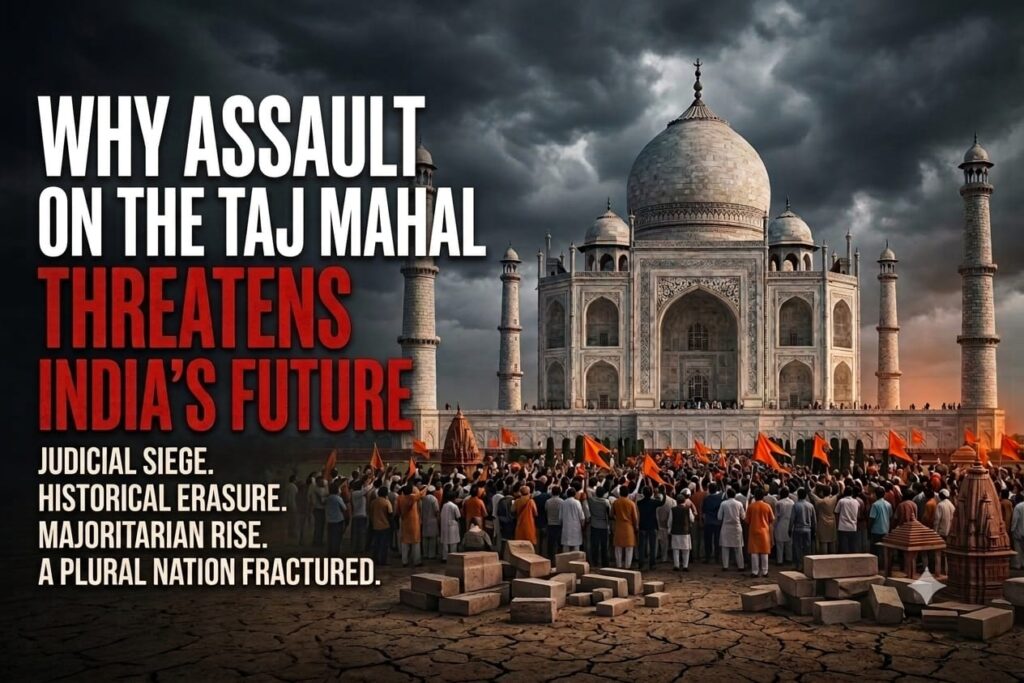
The notice issued by the Allahabad High Court to the Center and the Archaeological Survey of India (ASI) marks a perilous new low in India’s majoritarian slide. The court has demanded a formal response to a petition seeking a judicial inspection, photography, and videography of the Taj Mahal to investigate claims that it was originally a Hindu temple called “Tejo Mahalaya.” Under the political stewardship of the Bharatiya Janata Party (BJP), India has embarked on a systematic project of historical erasure where archaeological envy masquerades as judicial inquiry. The global icon of love, an architectural wonder that defines India to the world, is being dragged into the exact same legal pipeline that consumed the Babri Masjid and is currently suffocating the Gyanvapi mosque in Varanasi and the Shahi Eid-gah in Mathura. By weaponizing the judiciary to entertain fringe, long-debunked pseudo-histories, India’s majoritarian forces are demonstrating an insatiable appetite for cultural vandalism.
This sudden judicial indulgence of the “Tejo Mahalaya” fiction is not an isolated legal quirk; it is a calculated feature of a broader political project. For decades, the myth that the Taj Mahal was built by a 12th-century Hindu king was confined to the eccentric fringes of right-wing literature, championed by revisionists like P.N. Oak, whose claims the Supreme Court explicitly threw out in 2000. Yet today, those very fringes have become the mainstream. By allowing a petition filed in the name of a Hindu deity to advance, the courts are signaling that no Islamic monument is safe from revisionist excavation. The script is highly predictable and dangerous: first comes a civil suit, followed by an aggressive demand for an “Advocate Commissioner” to film and photograph hidden areas, which then morphs into a full-scale assault on the monument’s identity. It is a well-oiled mechanism designed to create a sense of historical injury among the majority of voters. Historian Irfan Habib has warned that this strategy aims to create a permanent state of polarization, noting that “there is no historical evidence, absolutely none, to support the claim that the Taj Mahal was a temple.”
The political utility of this historical rewrite is painfully obvious. The ruling BJP has effectively blinded its Hindu electorate to the complex realities of India’s pluralistic past by serving them a continuous diet of civilizational victimhood. Confronted with sluggish job growth, rising economic disparities, and modern administrative challenges, the state regularly pivots back to the medieval era to find its scapegoats. History is no longer treated as a social science to be studied, but as a political scoreboard to be settled. By convincing millions of voters that their primary duty is to “reclaim” structures built centuries ago, the political establishment has successfully replaced civic accountability with a permanent state of religious grievance. The average voter is encouraged to look backward at imaginary temple ruins rather than forward at failing public infrastructure. As French political scientist Christophe Jaffrelot observes, this “majoritarian engineering” redefines citizenship through the lens of dominant religious pride, rendering minority contributions invisible.
To gaze upon the Taj Mahal and see only a site for grievance requires a profound, cultivated blindness to artistic genius. The Indo-Islamic architecture brought to life by the Mughals is not a scar on the Indian landscape; it is its finest crown. The Taj Mahal represents the absolute zenith of human craftsmanship, an exquisite synthesis of Persian, Central Asian, and indigenous Indian traditions. Constructed over twenty years under the direction of Emperor Shah Jahan, it brought together over 20,000 artisans from across the Islamic world and the subcontinent. The luminous white Makrana marble changes its hue with the passing hours of the day, shifting from a soft morning pink to a dazzling midday gold, and finally to a serene ghostly blue under the moonlight. Its perfect bilateral symmetry, the intricate pietra dura inlay of semi-precious stones forming delicate floral patterns, and the soaring calligraphic bands framing its grand alcoves are testaments to a sophisticated civilization. To reduce this sublime testament of love and architectural mastery to an architectural crime scene is an insult to the very heritage India claims to protect.
This aggressive majoritarian impulse seeks to deny a fundamental truth: Muslim rulers did not destroy Indian culture; they co-created its golden age. From the majestic sandstone expanses of Fatehpur Sikri to the imposing bulwarks of the Red Fort, Islamic architecture reshaped the visual and cultural identity of the subcontinent. These structures were not alien impositions but deeply collaborative endeavors, built by the sweat and genius of countless local Hindu and Muslim artisans working side by side. The fusion of Islamic geometry with Hindu motifs, such as the lotus dome crests and elephant-shaped brackets found across Mughal sites, created a unique aesthetic vernacular known as the Ganga-Jamuni tehzeeb (composite culture). By trying to retroactively categorize these wonders as stolen Hindu property, majoritarian revisionists are attempting to rip out the syncretic spine of Indian history. They are demanding a sterile, monochrome past that never actually existed.
The tragedy of this revisionist obsession is the total degradation of India’s global standing and its legal framework. The Places of Worship (Special Provisions) Act of 1991 was enacted precisely to prevent this kind of historical revanchism by freezing the religious character of all holy sites as they existed on August 15, 1947. Yet, by continually finding procedural loopholes to allow “surveys” and “inspections” of centuries-old monuments, the Indian judiciary is effectively defanging its own statutory protections. While the world watches in disbelief, a nation that prides itself on being an emerging global superpower is busy interrogating its own tourist brochures. The historical revisionism that started with changing Muslim names of cities, transforming Allahabad to Prayagraj and Faizabad to Ayodhya, has now escalated into a full-blown judicial siege of UNESCO World Heritage sites.
If the courts continue to tolerate these bad-faith litigations, they will pave the way for permanent social friction. A democracy cannot build a stable future on a foundation of manufactured historical resentments. The obsession with unearthing grievances beneath every dome and minaret ensures that the nation remains trapped in an endless loop of iconoclasm. If India continues down this path of erasing its rich Islamic past, it will eventually succeed in defacing its own global image, leaving behind a fractured society that knows how to demolish monuments but has forgotten how to build anything of lasting beauty.