
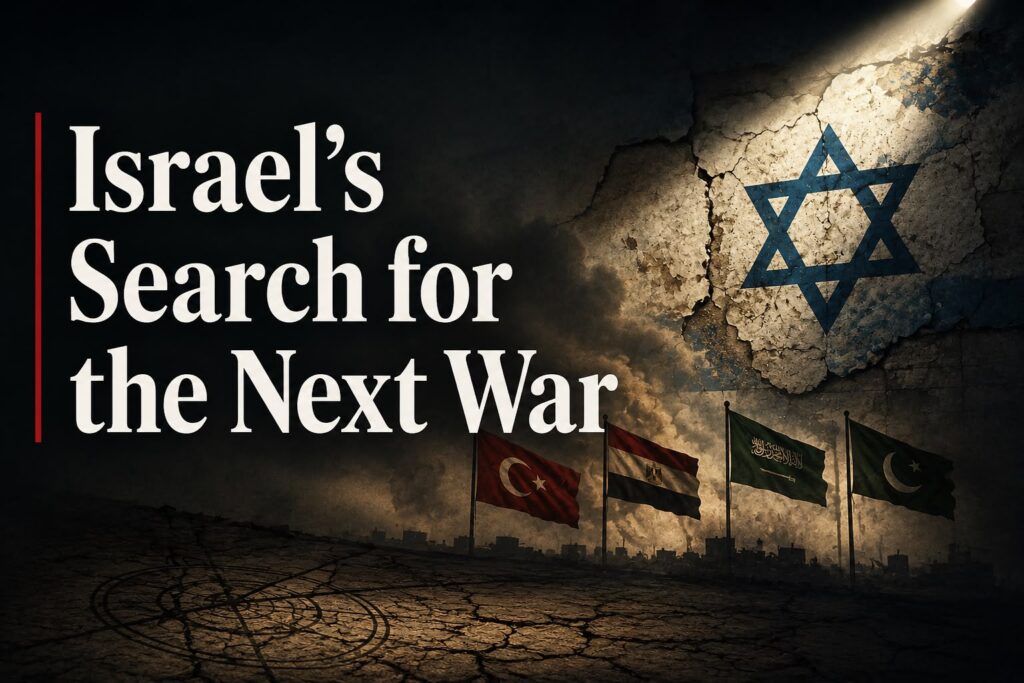
The psychological architecture of Israeli statecraft has always been built on the necessity of a singular, existential enemy. For decades, that role was filled by Tehran. It was a convenient, durable, and highly marketable threat that allowed Israel to frame its regional aggression as self-defense and secure near-unconditional backing from Washington. But wars, even successful ones, have an expiration date on their utility. Israel has lost this pretext, yet it cannot afford the peace that should follow. Thus, the search for the next boogeyman has begun in earnest, and the narrative architects in Israel are turning their gaze toward the Sunni world with a reckless, inflammatory fervor.
The new threat, as defined by figures like Naftali Bennett and Benjamin Netanyahu, is not a rogue state governed by theocratic zealots, but a collection of established, conventional powers: Turkey, Egypt, Saudi Arabia, and Pakistan. The framing of Turkey as the “new Iran” is not just a rhetorical flourish; it is a profound act of strategic projection. By labeling Ankara an adversary, Israel is effectively attempting to manufacture a regional confrontation with a NATO member that possesses the second-largest military in the alliance. This is not the cautious realpolitik of a state seeking regional integration. It is the frantic posturing of a nation that has become addicted to the adrenaline of perpetual conflict.
Take the numbers. Turkey’s defense budget, eclipsing $27 billion, and its mastery of the global drone market are realities that any rational state would seek to manage through diplomacy. Instead, Israel chooses to treat Turkish naval maneuvers in the Eastern Mediterranean as an act of existential defiance rather than the standard activities of a regional power protecting its sovereign gas assets. When Netanyahu speaks of a “hexagon of alliances” centered on India, Greece, and Cyprus, he is not building a shield; he is drawing a target. He is creating a fractured Mediterranean where the only solution to every diplomatic hurdle is, inevitably, the threat of air power.
The obsession with Egypt is even more telling. In the corridors of power in Israel, the days of viewing the peace treaty as a permanent bedrock of security are fading. Israeli officials have begun to openly “monitor” the growth of the Egyptian military, moving from cautious observation to thinly veiled paranoia. The Egyptian military, with its hundreds of thousands of troops and a diverse, high-tech arsenal, is being repositioned in the Israeli mind as a potential enemy in the making. This is a betrayal of the very concept of peace. When an Israeli leader complains that Egypt is “getting stronger,” they are inadvertently admitting that they are uncomfortable with any neighbor possessing the capacity for self-defense.
Then there is the bizarre, desperate inclusion of Pakistan in this hypothetical axis. The idea that a nuclear-armed power in South Asia is part of a coordinated regional plot against Israel is the stuff of conspiracy, not intelligence. Yet, it serves a purpose. It elevates the conflict to a global, existential struggle, justifying the continued expansion of Israel’s own strategic reach. By treating these nations as primary threats, Israel is forcing a rupture that didn’t need to happen. It is creating a self-fulfilling prophecy of hostility.
The strategic risk here is immense, yet it seems to be lost on a political class that views foreign policy primarily through the lens of internal polling. Analysts are right to warn that Bennett and Netanyahu are using external threats to paper over the cracks in their own coalition. When you are governing a nation that has conducted military operations in multiple countries in a single year, you cannot suddenly announce that the wars are over. You have to pivot. You have to convince the public that the old threat has been replaced by a new “Sunni threat,” because an Israel without an enemy is an Israel that must finally address the internal rot of its own governance.
There is no evidence of a coordinated military command linking Ankara, Cairo, Riyadh, and Islamabad. There is no ideological glue holding these nations together in opposition to Israel. What is actually happening is far more telling: these countries are watching an Israel that has lost its strategic compass. They are witnessing a state that has struck out at will, bypassed international law, and now dictates its regional policy based on the paranoid sketches of its own leaders. If these nations eventually draw closer to one another, it will not be because of some pre-planned anti-Israel conspiracy. It will be because they are collectively alarmed by a rogue state that refuses to accept the sovereignty of its neighbors.
The most dangerous aspect of this quest for a new enemy is that it blinds Israel to the reality of the world it inhabits. It discards the potential for regional integration and energy cooperation, the very things that could have stabilized the Middle East, in favor of a permanent war footing. It replaces diplomacy with target acquisition. Israel is rapidly burning its bridges, one by one, replacing alliances with “hexagons” and partners with “adversaries”.
If the history of the 20th century taught the Middle East anything, it is that a state which defines its security solely through the lens of military dominance eventually finds itself trapped by the very power it projects. Israel is not making itself safer by preparing to fight the world. It is making itself increasingly isolated, defined by a reflexive, violent hostility that its neighbors will eventually feel compelled to counter. The next conflict Israel is seeking is not coming because its neighbors want it; it is coming because Israel is determined to find it.