
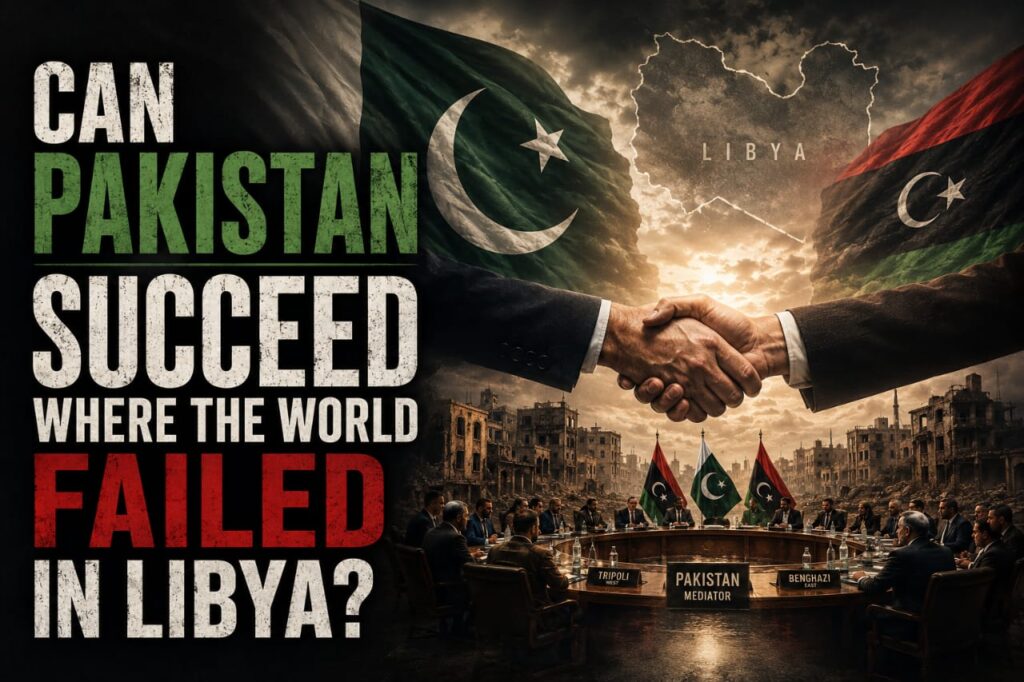
Something quiet but pretty significant is happening in global diplomacy right now, and the actor driving it is one nobody really saw coming. Pakistan, a country most people usually think of in terms of its chronic economic troubles, political rollercoasters, and its immediate security headaches in South Asia, has quietly turned itself into a major transnational peace broker. The news that Islamabad is actively mediating a 36-month reunification blueprint between Libya’s long-split eastern and western administrations says a lot about how far Pakistani statecraft has come lately. For a country that’s spent decades just trying to hold its own borders together and manage domestic crises, jumping into North African power politics like this is a genuinely bold move. It’s basically Pakistan saying it’s done being a bystander on the world stage, done being defined solely by its internal problems, and is actively rewriting its own foreign policy playbook.
This isn’t happening out of nowhere, either. It follows right on the heels of Pakistan’s central, surprise role in brokering the Islamabad Memorandum of Understanding earlier this year, the high-stakes deal that pulled Washington and Tehran back from the absolute edge of war. The credibility and diplomatic capital Islamabad built during those tense US-Iran negotiations has clearly given it a whole new tier of international leverage. Washington’s full backing of Pakistan’s Libya role shows Western capitals are starting to realize Pakistan has a rare, highly specific knack for bridging deep historical divides that leave everyone else stuck. In a world this fractured and polarized, Pakistan has managed to carve out a genuinely unusual niche: a neutral party that all sides actually trust enough to talk to, even when they won’t look at each other.
The “Libya Reunification Plan” Pakistan is running is a pretty clear-eyed piece of realpolitik. Instead of chasing some idealistic, overnight democratic transition with immediate elections, the exact kind of rushed Western formula that’s failed in Libya over and over again, the roadmap goes for something far more realistic: a 36-month transitional power-sharing arrangement that carefully balances Libya’s long-running regional rivalries. Under the specific terms of the plan, Abdulhamid Dbeibah, head of the UN-recognized western Government of National Unity based in Tripoli, stays on as prime minister to keep the civil administration running. Meanwhile, Saddam Haftar, the powerful deputy commander of the eastern-based Libyan National Army, becomes chairman of the Presidential Council. The east, meanwhile, gets full control over the national budget, which finally addresses a long-standing, bitter complaint from the eastern tribes about how Libya’s massive oil money gets split up.
What’s really impressive is how Pakistan managed to pull this off in such an incredibly crowded, messy room. Libya’s been a brutal geopolitical battleground for over a decade, with outside players like Turkey, Qatar, Egypt, Russia, and the UAE all constantly jostling for influence and backing different armed factions. Most of those countries are simply too partisan and too deeply invested in their own proxies to talk to both sides at once. Pakistan, on the other hand, has pulled off a genuinely rare balancing act. Its long-standing ties with Ankara and Doha, both major backers of the western government, gave it an early opening, and both capitals actually pushed Islamabad to get involved in the first place. At the same time, Pakistan’s close relationship with Saudi Arabia helped lock in critical support and diplomatic cover from the broader Arab world.
On top of that, Islamabad has built the kind of deep structural relationships with the eastern side that almost no other neutral country can match. You could see that clearly when Pakistan’s military chief, Field Marshal Asim Munir, hosted Libyan commander Saddam Haftar in Rawalpindi. That high-level meeting came right before Haftar flew out to Washington to meet US Secretary of State Marco Rubio. That kind of precise diplomatic sequencing doesn’t happen by accident; it says a lot about Pakistan’s underlying role as a reliable bridge to the West, coordinating moves behind the scenes so all parties stay aligned before agreements ever hit the press.
All of this soft power is also backed by some incredibly hard-nosed defense dealmaking. Late in 2025, Islamabad signed a massive $4 billion defense agreement with the eastern-based Libyan National Army, covering the sale of 16 JF-17 Thunder fighter jets and 12 Super Mushshak trainer aircraft. Pairing big military sales with high-level diplomacy is a pretty savvy move on Pakistan’s part. It means Pakistan isn’t just mediating peace out of pure goodwill; it has real, tangible leverage baked directly into the process it’s overseeing. By becoming a key defense supplier to the LNA, Islamabad ensures that the eastern leadership remains deeply cooperative throughout the transition.
If this actually works and Libya finds lasting stability, the payoff for Pakistan back home could be absolutely huge. The biggest one is economic: before the 2011 NATO-backed uprising sent Libya into a tailspin of chaos, the country was a major destination for Pakistani labor, hosting more than 150,000 expats whose monthly remittances were a real lifeline for families back home. A stable, unified Libya heading into a massive reconstruction phase would suddenly need huge amounts of foreign labor, engineers, and technical expertise. By positioning itself as the main architect of Libyan peace, Pakistan is setting its state enterprises and private sector up to grab a big share of those reconstruction contracts, creating a serious win for its own domestic economy.
But the whole thing hinges on Pakistan sticking with it for the long haul and refusing to take its foot off the gas. Libya has a brutal track record of chewing up diplomatic breakthroughs, and agreements there can fall apart within months once regional proxy interests start pulling in different directions again. Tarek Megerisi, director of the geopolitical advisory firm Informmi, makes a perfectly fair point: there’s absolutely no guarantee any signed deal actually holds in a place that’s defied every single previous attempt at a fix. Pakistan can’t just broker this, sign the papers, and walk away. It’s going to need to stay actively involved as a kind of institutional guarantor on the ground if it wants this fragile power-sharing setup to actually survive the intense pressure that’s coming.