
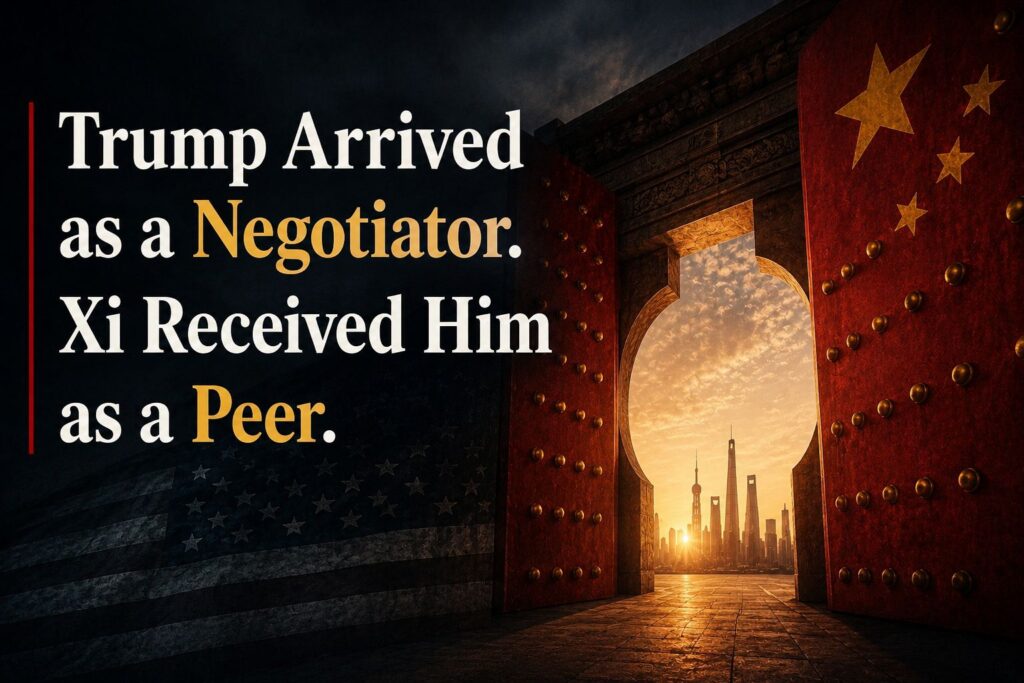
President Trump arrived in Beijing carrying the swagger of a dealmaker. He left the impression of a man seeking accommodation from a rival he once described as America’s greatest strategic threat. That contrast, between Trump’s domestic rhetoric and his tone before Xi Jinping, may become the defining image of the summit.
For years, Trump built political capital on portraying China as the architect of America’s industrial decline, a currency manipulator, a technology predator and a geopolitical adversary. But inside the Great Hall of the People, the language changed dramatically. The combative nationalism of campaign rallies gave way to admiration, deference and appeals for cooperation. Trump praised Xi as a “great leader,” repeatedly framed tensions as manageable through personal chemistry, and surrounded himself with America’s most powerful corporate figures as though offering proof that Wall Street and Silicon Valley were prepared to return to Beijing’s court.
Meanwhile, Xi Jinping, appeared unmoved by spectacle. Where Trump sought warmth, Xi established terms. Within minutes, he drew the summit’s central boundary: Taiwan. The message was clear. China wants stability and trade but not at the expense of its core sovereign interests.
The asymmetry in posture was worth noting. Trump looked transactional, Xi looked historical. Trump emphasized trade and market access, Xi spoke in the language of strategic equilibrium. Even the setting reinforced the contrast. Visit to the Temple of Heaven was projection of continuity, patience and confidence. Beijing was not just hosting an American President, it was also presenting itself as the inheritor of an ancient statecraft now reasserting itself in a fractured global order. This was not simply diplomatic theatre. It was depiction of the balance of psychological confidence between Washington and Beijing.
Trump arrived in China weighed down by multiple crises, like Strategic overstretch in the Middle East, polarization at home and growing anxiety over industrial decline. Xi, on the other hand, projected composure. Xi’s references to the “Thucydides Trap” were not casual academic flourishes. They were declaration that China now sees itself not as a rising power pleading for acceptance, but as a peer demanding recognition.
Trump, with his actions, unintentionally validated that perception. His emphasis on bringing the “best” American business leaders to Beijing sounded like an acknowledgment of dependence. The world’s largest economy publicly signaling that access to China’s market remains indispensable, even after years of tariff wars and decoupling rhetoric.
While Critics will call it weakness, there is another interpretation worth considering. A period when the world is trapped into confrontation, from Ukraine to Iran to the Indo-Pacific, the sight of the American and Chinese presidents choosing engagement over escalation carries undeniable value. Great powers do not always drift toward conflicts because of ideological differences, often, they stumble into it because of accumulated mistrust and domestic political rigidity. Dialogue, even tense dialogue, creates strategic breathing room.
That may explain why Xi appeared firm and welcoming. China understands that America’s confrontations elsewhere is an opportunity for China, but it also knows uncontrolled rivalry with Washington could derail its own ambitions. Stability serves Chinese interests too.
The summit, therefore revealed two parallel realities. The first is that China perfectly understands that time is on its side. The second is that the US, despite its military and technological advantages, losing unchallenged confidence of the post-Cold War era.
Trump came to Beijing promising great trade deals. Xi offered something more important, a framework in which China is treated not as a problem to be managed, but as an equal global power.
It is uncertain whether Washington accepts that reality or not. But the optics have already manifested that the argument is moving in China’s favor.