
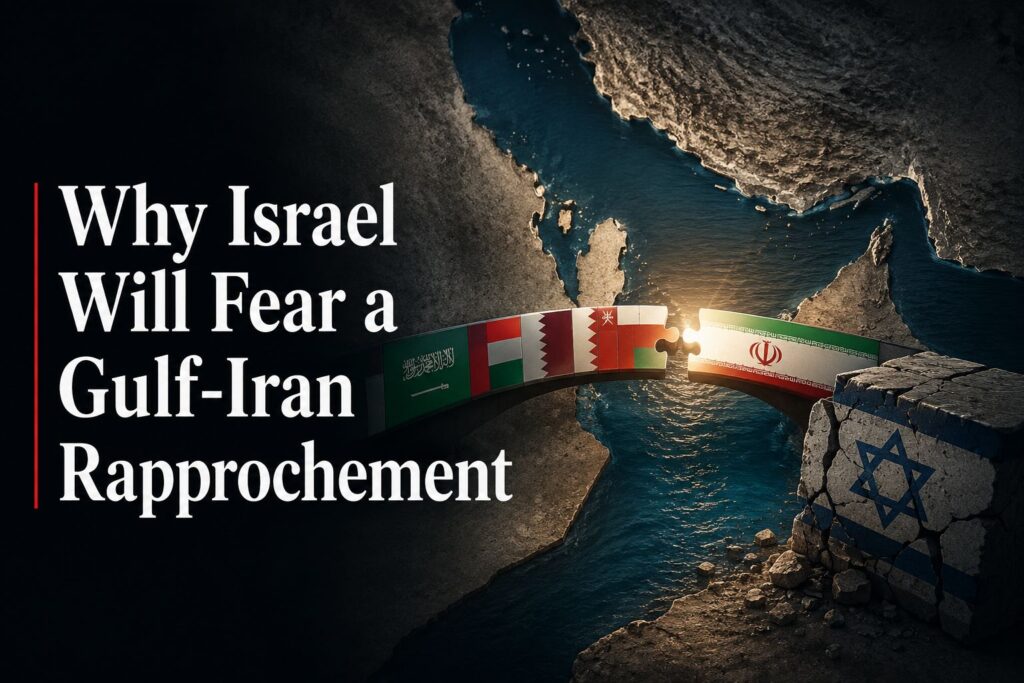
The reported Saudi push for a Middle East non-aggression pact with Iran marks a quiet but interesting shift in regional geopolitics, one that could unsettle the strategic architecture Israel has carefully built over the past decade. If Gulf states begin moving from confrontation to managed coexistence with Tehran, the foundational logic of Arab-Israeli alignment against Iran may begin to weaken, altering the balance of power from the Levant to the Gulf.
The Abraham Accords were never solely about peace between Israel and Arab states. It was a shared perception of Iran as the region’s primary threat, that brought them together. The UAE, Bahrain, and later Morocco normalized relations with Israel mainly within the framework of an anti-Iran alignment supported by the US. Israel’s military capabilities and security partnerships became attractive to Gulf monarchies because Tehran was portrayed as an existential threat requiring collective containment efforts. If Saudi Arabia now moves toward institutionalized coexistence with Iran, it will shake that strategic foundation.
The Helsinki Accords are an interesting reference in this context. It was Signed in 1975 between Western and Soviet bloc to reduce the risks of escalation by creating rules of engagement, recognition of territorial realities, and channels for diplomatic management. Riyadh is interested in applying a similar pattern to the Gulf, not friendship with Iran, but managed coexistence. For Gulf leaders, stability has become more valuable than ideological blocs.
This approach directly conflicts with Israel’s strategic interests. Israel needs a polarized Middle East in which Arab states consider Iran as a greater threat than Israel’s policies in Gaza, Lebanon, and the occupied Palestinian territories. As long as Iran remains the dominant regional fear, Israel can propagate for its security partnerships with Arab governments while minimizing pressure over the Palestinian issue. A Gulf-Iran rapprochement changes that equation.
If Arab leaders no longer see Tehran as existential danger, then the urgency behind normalization with Israel weakens. The ongoing war has already reinforced fears that Israel’s escalation against Iran could drag neighboring countries into conflicts they neither initiated nor control.
This elucidates why Israel will view any such Pact with suspicion. Israel’s regional influence has expanded dramatically over the last decade because Arab-Iranian tussles created space for Israel’s integration into Gulf security structures. A reduction in those tensions inevitably reduces Israel’s leverage.
Moreover, Iran also appears interested in capitalizing on such an opportunity. Tehran’s current diplomacy manifests resilience rather than retreat. Iranian FM Abbas Araghchi’s assertion that “there is no military solution” shows that Tehran is willing to negotiate regional rules from a position of endurance rather than weakness.
For Gulf states, that message may be persuasive. They have understood that Iran, regardless of sanctions or military pressure, remains a permanent geographic and strategic reality. Israel, by contrast, is considered as a powerful but risk-generating actor whose confrontational designs could repeatedly destabilize the region.
The reported Saudi proposal, therefore reflects a quiet recognition that endless regional polarization benefits external military agendas more than Gulf stability itself.
And that is precisely why Israel will fear it.