
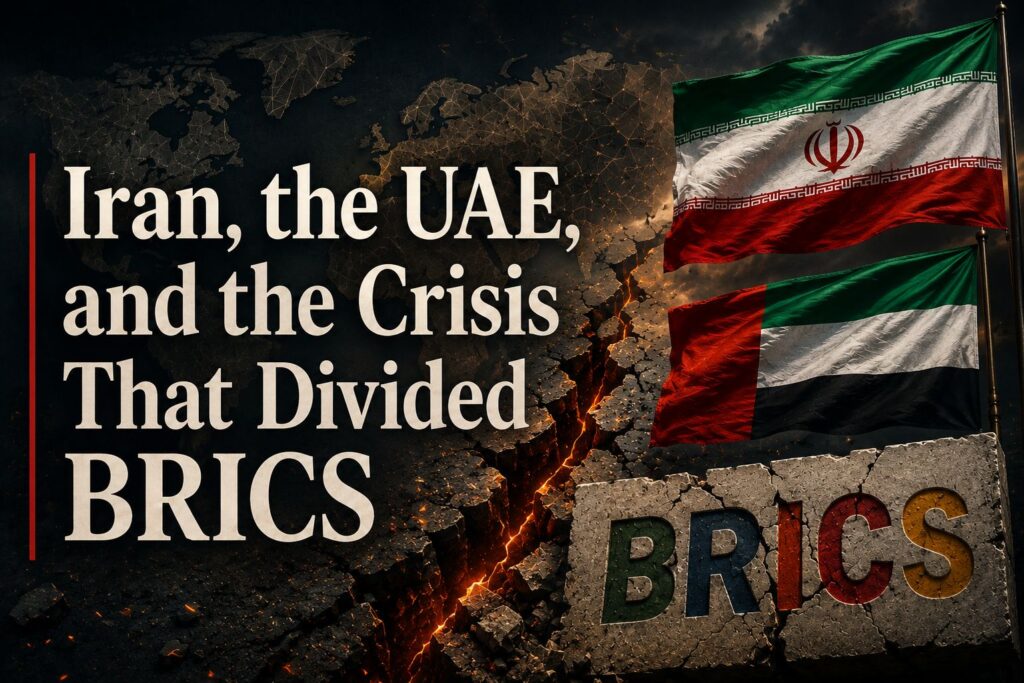
The failure of the BRICS foreign ministers’ meeting in New Delhi was not caused by procedural disagreements or diplomatic miscommunication. It was caused by a war that forced the bloc’s members to reveal where their real loyalties, dependencies, and fears lie.
For years, BRICS has marketed itself as the political face of a changing world, an alliance capable of challenging Western dominance and giving the Global South an independent voice. But the moment the Iran war entered the room, that image fractured.
No joint statement emerged from the summit. Behind the carefully worded diplomatic language about “differing views” was a far more uncomfortable reality: BRICS members could not even agree on how to respond to the bombing of one of their own members.
For Iran, the summit was diplomatic test of BRICS solidarity. Iranian FM Abbas Araghchi pushed for strong language condemning American and Israeli actions. But resistance reportedly came from within the bloc, particularly from Gulf-aligned states unwilling to endorse any wording that could be interpreted as support for Iran’s regional position.
The UAE’s stance was not surprising. In recent past, Abu Dhabi has accelerated defense coordination with the US and Israel while simultaneously portraying itself as a champion of strategic balance. The problem is that strategic balance becomes harder to sustain when wars begin reshaping alliances in real time. India now sits directly inside this emerging fault line.
India has historically maintained a delicate balancing policy in Middle East. Iran was important because of connectivity projects like Chabahar, and as an energy partner capable of diversifying India’s Gulf dependence. At the same time, the UAE is one of India’s closest economic and political partners in the Arab world. During periods of peace, India could maintain strong relations with both sides without serious friction. But regional polarization is now narrowing that diplomatic space.
Iran considers several Gulf states are indirectly facilitating American military pressure through bases, intelligence cooperation, and strategic coordination. The UAE’s assertive defense posture has further validated those suspicions. Abu Dhabi recently defended its growing military partnerships as a “sovereign matter” after Iranian criticism linked Gulf security cooperation to threats against Iranian national security. This is where India’s balancing act becomes vulnerable.
By enhancing defense partnership with the UAE while attempting to preserve working relations with Iran, India risks being viewed by Tehran less as a neutral regional actor and more as part of Gulf security ecosystem tilted toward the American-led order. India may not formally endorse anti-Iran coalitions, but perception increasingly matters as much as policy in a militarized region. The BRICS summit exposed this discomfort publicly.
The bloc has been branding itself as an alternative to Western-led order. But when confronted with the largest geopolitical crisis facing one of its own members, it could not even produce common diplomatic wording. The issue was not merely disagreement over Iran. It was the exposure of a deeper structural weakness that BRICS members do not share a common vision of the international system they claim to support.
India hoped the summit would elevate its status. Instead, the meeting highlighted the shrinking space for middle powers trying to satisfy everyone simultaneously. India wants strong Gulf ties, stable American relations, continued access to Iran, and leadership within BRICS, all at once. The Iran war manifested how difficult that equation becomes when regional tensions stop being theoretical.
The summit’s failure to produce a joint statement, was therefore bigger than a procedural disagreement. It manifested that the quest for multipolar order is still constrained by old security dependencies and economic hierarchies. BRICS may speak the language of a new world order, but in moments of crisis, many of its members still behave according to the logic of the old one.