
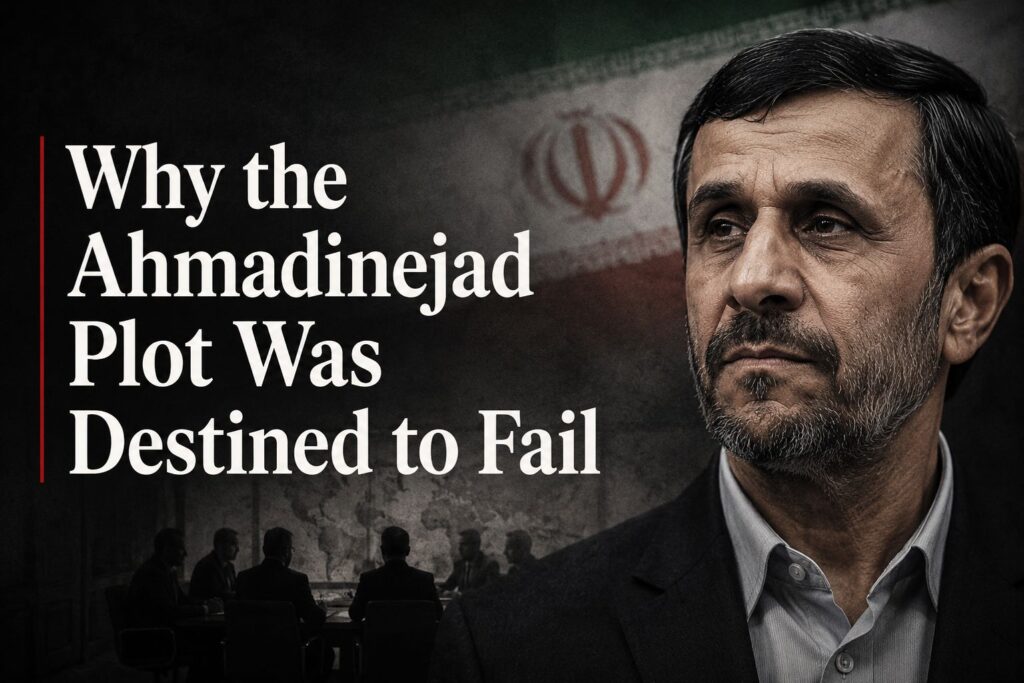
The most revealing part of modern regime-change politics is not that powerful states still attempt it. It is that they no longer even pretend to care about ideological consistency while doing it. According to the shocking story published by New York Times and later amplified by Aljazeera, the US and Israel allegedly planned installing former Iranian president Mahmoud Ahmadinejad as the post-war leader of Iran after the killing of Supreme Leader Ali Khamenei. If true, the episode may become one of the most extraordinary examples of geopolitical hypocrisy and intelligence hubris in recent history.
For two decades, Ahmadinejad built his political stature on anti-American rhetoric, Holocaust denial controversies, militant nationalism, and confrontational nuclear policies. During his tenure, Iran dramatically accelerated uranium enrichment. He almost did everything Washington and Tel Aviv publicly claimed to oppose. But suddenly, behind closed doors, the S-Israel planners reportedly viewed the same man as a potential “stabilizing figure” capable of managing a post-Khamenei Iran.
The contradiction is impossible to ignore. It suggests that modern foreign policy has entered a deeply transactional phase in which ideological principles matter far less than short-term strategic utility. Democracy promotion, human rights, and liberal values are frequently invoked in public speeches, but in practice the overriding concern often appears to be finding a politically useful operator who can preserve order during periods of instability. In this case, Ahmadinejad’s value reportedly lay not in his beliefs, but in his populist credentials, nationalist image, and estrangement from Iran’s clerical establishment.
The logic itself reveals an absolute misunderstanding of Iranian political psychology. Iran is not a desperate client state waiting for a foreign-engineered regime change. It has a deeply entrenched socio-political structure, a powerful security apparatus, and a national memory driven heavily by outside intervention. Even a perception that a leader has been elevated through foreign sponsorship, particularly by the US or Israel, would immediately poison his domestic legitimacy.
But the plan failed even before it began. According to accounts cited by international media, an Israeli strike intended to free Ahmadinejad from house restrictions instead wounded him and shattered the operation before it could mature. The irony is almost cinematic: the very forces attempting to “rescue” their preferred candidate nearly eliminated him themselves. If the reports are accurate, the failed “jailbreak” operation demonstrates more than tactical incompetence. It reflects a recurring pattern of intelligence overconfidence that has haunted Western interventions for decades.
This is not the first miscalculation from the US. It repeatedly underestimates nationalism, overestimates local allies, and assumes that political systems can be reordered like pieces on a chessboard. Take For example the 1953 coup against Iranian Prime Minister Mohammad Mosaddegh and catastrophic assumptions underpinning the 2003 invasion of Iraq, again and again it convinced itself that complex societies can be reshaped through covert political engineering and military pressure.
Iran, however, has historically remained united against external pressure. Even many Iranians critical of the Islamic Republic remain deeply suspicious of foreign intervention. Ahmadinejad himself likely understand this reality that no Iranian politician can survive while appearing to arrive in power aboard foreign missiles.
This failed plot also reveals the widening gap between political rhetoric and actions. For years, Western discourse framed Iran’s leadership as uniquely irrational and dangerous. But the same establishment reportedly planned bringing one of the most controversial figures in Islamic Republic of Iran. That contradiction erodes the moral credibility of future Western claims about democracy and human rights, not only in Iran but across the globe.
Ultimately, this was not only a failed operation, but also a window into the mindset of modern power politics, which is willing to abandon principle when strategic convenience demands it. The lesson may not be about Ahmadinejad at all. It may be about the enduring inability of outside powers to understand that nations are not laboratories for geopolitical experimentation.