
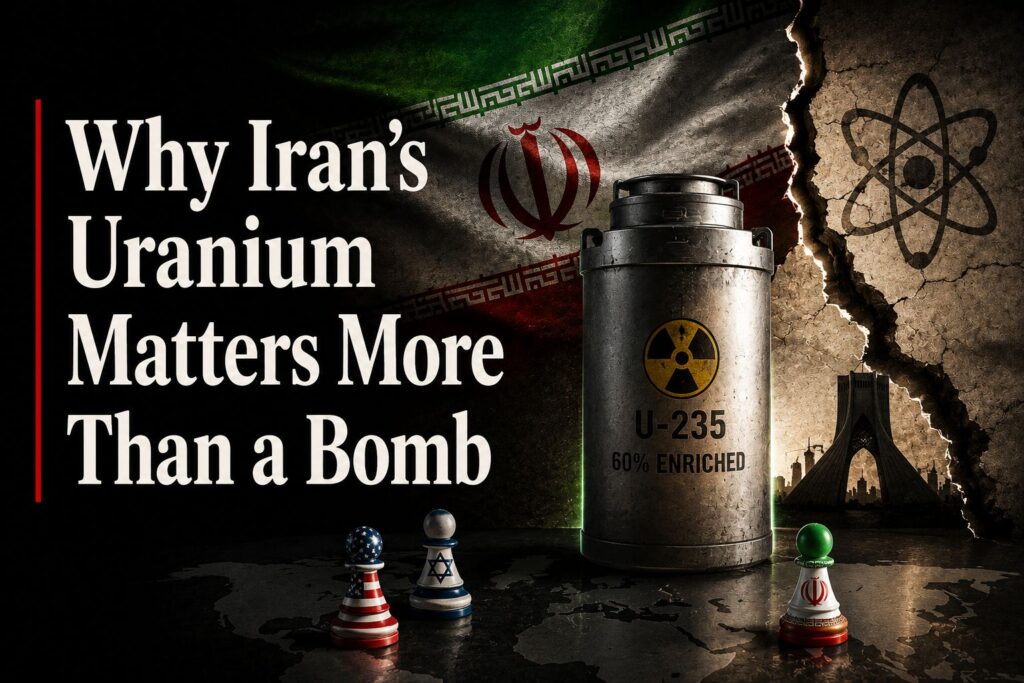
The most heavily guarded substance in the Middle East today is not oil, territory or even missiles hidden in mountain tunnels. It is a stockpile of uranium that exists in a strange space between civilian technology and military deterrence. To Washington and Tel Aviv, Iran’s enriched uranium represents the possibility of a future nuclear threshold state. To Tehran, it represents something equally powerful: proof that despite sanctions, sabotage and isolation, Iran has mastered a technology that only a handful of states truly control.
For the US and Israel, Iran’s enriched uranium is something far more dangerous than a hypothetical bomb. It represents strategic latency, the ability of a sanctioned and isolated state to stand at the threshold of nuclear capability without fully crossing it. Reportedly, Iran’s stockpile is around 440 kilograms enriched to 60 percent, which means it has already completed the hardest phase of enrichment. It requires years of scientific effort and thousands of separative work units. The remaining part is comparatively shorter.
Israel views such capability as intolerable because its long-standing strategic doctrine depends on maintaining an undisputed regional military monopoly. An Iran capable of rapidly producing weapons-grade uranium weakens that monopoly psychologically and strategically. It introduces uncertainty into Israeli military calculations and limits the freedom with which Israel can threaten or strike regional adversaries.
For Washington, Iran’s nuclear infrastructure will endanger its power to manage alliances in Middle East. It will also become harder for the US to isolate, to intimidate and to coerce Iran. For Iran, keeping the technical capacity to build nuclear arsenal alone gives it enough bargaining power against sanctions and military pressure. That is precisely why the issue dominates every negotiation.
Under the Non-Proliferation Treaty (NPT) Iran has the legal right to enrich uranium for civilian and peaceful purposes with requirements of international safeguards, Tehran defends this right by arguing that enrichment for reactor fuel, medical isotopes and industrial use is permitted under international law. But there is a trust deficit between the US and Iran.
Iran does not trust the US because it has tasted the unpredictability of its leadership. The 2015 nuclear agreement is a manifestation of this unpredictability. It imposed strict enrichment limits and inspections in exchange for sanctions relief. Despite Iran’s compliance confirmed by international inspectors, the US unilaterally withdrew from the agreement in 2018 and restored sanctions. From Iran’s perspective, the lesson was brutal that compromise did not produce security.
The current deadlock therefore revolves around a single unresolved question: should Iran be treated as a permanently restricted exception within the global nuclear order, or as a sovereign state entitled to the same peaceful nuclear rights enjoyed by others?
One cannot ignore the irony. On the one hand, Israel possesses undeclared nuclear weapons, remaining outside the NPT and with no international inspections of its own facilities. On the other hand, Iran, an NPT signatory under inspection for years, faces military strikes and Western scrutiny for even keeping enriched Uranium below weapons grade. This asymmetry is now viewed as selective enforcement shaped by power politics.
That perception may ultimately matter as much as the uranium itself. Because the more the issue appears rooted in strategic inequality rather than universal rules, the harder it becomes for Washington and Israel to convince the world that this confrontation is solely about preventing nuclear war.