
By Ketty L.
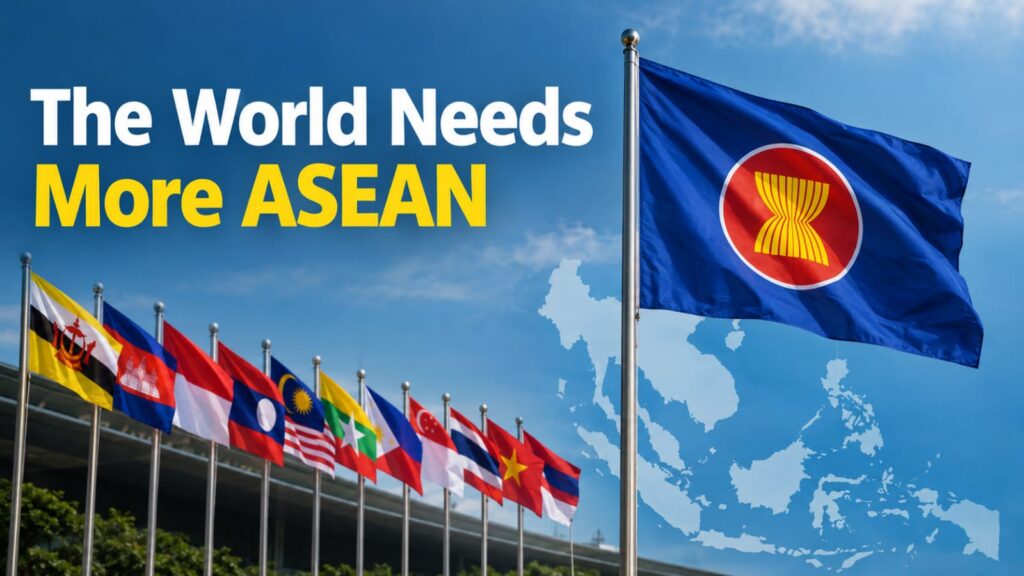
Right now, the world feels like it is always a half step away from a crisis. Leaders lurch from one summit to another, hungry for sweeping breakthroughs, quick fixes, or at least some headline that reassures markets and allies. International diplomacy, in the thick of shifting alliances and mounting tension, seems to chase the big moment. But let us be real: for most of us, these breakthroughs are rare, and too fragile to shape any lasting order. If you want to see real, sustainable diplomacy, you have to look somewhere unexpected: Southeast Asia, where something quieter and far more durable is playing out in the halls and meeting rooms of ASEAN.
What ASEAN does so well is keep people talking. Not just when it is easy, but especially when tempers are frayed and trust is running low. That is no small feat. ASEAN’s calendar is a marathon, dense with endless working groups, cascading consultations, and summit after summit. More than a thousand official meetings a year, if you can imagine. To seasoned outside observers, it probably looks excessive, maybe even hopelessly bureaucratic. They might scoff at all that process and see it as inertia or indecisiveness, not the tough, direct action we are told is needed in today’s world. But honestly, that is missing the point.
All these repeated conversations, all the persistent engagement, add up to more than just inertia. They are the routines that keep ten vastly different nations at the table. Consider the range: absolute monarchies, single party socialist states, constitutional democracies, and countries still run by their militaries, all trying to cooperate in a group whose collective GDP tops $3.8 trillion and represents over 680 million people. One is a high income financial center, another is struggling with poverty. There is no way to manage friction between such diverse neighbors without a thick, dependable web of dialogue, a framework everyone understands and trusts will be there, no matter what headline crisis is flashing.
There is no way to manage friction between such diverse neighbors without a thick, dependable web of dialogue, a framework everyone understands and trusts will be there.
At the heart of this system is consensus. ASEAN makes no major move unless everyone is on board. It is written into their Charter, and it matters. The biggest player, Indonesia, carries more than a third of the region’s GDP and land, but it restrains itself, accepting that its voice is just one of many. Smaller nations get a say and do not have to fear being steamrolled by their neighbors. That balance is not just fair; it is practical. It keeps everyone committed for the long haul, even when their interests collide.
That self restraint from the big players and security for the small ones means disagreements do not morph into existential showdowns. People can dig in, argue, and still not break the process. Small disputes that would trigger broader crises elsewhere, here, are contained before they boil over. That is stability through habit, built up one meeting at a time.
And this matters even more as power gets sliced and diced in a world tilting towards multipolarity. The old rules, where might makes right, just do not fit. Influence now depends as much on technology, trade, or who controls a choke point in a supply chain, as it does on bombs or bases. Here, ASEAN’s endless roundtables look less like stalling and more like adaptation. Rigid alliances get brittle and obsolete quickly, but a flexible, inclusive forum can stretch and absorb shocks.
Rigid alliances get brittle and obsolete quickly, but a flexible, inclusive forum can stretch and absorb shocks.
ASEAN does more than just look inward, too. Through a patchwork of expanded forums, think the ASEAN Regional Forum, East Asia Summit, ADMM Plus, they bring in the heavyweights: the US, China, India, Russia, Japan. These groups, together, span more than half the world’s people and over sixty percent of its GDP. ASEAN does not just participate; it sets the table, defining the terms on which outsiders engage the region. That is a real measure of centrality, and it stops Southeast Asia from being carved up into spheres of influence by outside powers.
Insistence on things like non alignment and nuclear weapon free zones is not just piety, it is a diplomatic shield, a set of house rules that stops any single power from getting too comfortable. If you want in, you play by ASEAN rules, not the other way around.
When global competition peaks, and the risk of miscalculation runs high, the value of these habits, continuous, structured dialogue, becomes tangible. You do not want to be scrambling to build trust channels after the crisis has already started. Here, the communication is routine, even boring, but it is ready for when things get tense. The idea is not to erase national differences or force everyone to live under one set of values. It is to keep talking, keep listening, and keep the machinery moving, so differences do not harden into fatal cracks.
That is a lesson the rest of the world, honestly, needs right now. With global institutions under pressure, and old alliances fraying, what stands out is not just loud declarations of unity or strength, but the methods that actually survive when serious disagreement arises. Power, it turns out, is not simply economic or military; it is in who controls the process, who gets to shape the habits that define everything else.
Dialogue, patience, restraint: these are not signs of weakness. They are the best tools that Southeast Asia has forged, and maybe the only ones the rest of us should be borrowing right now.
ASEAN shows that you do not need to agree on everything, not on your politics, not on the way you run your economy, not even on your friends. What you need is buy in on the process, the willingness to keep the lines open, the discipline to choose process over pride. That is how you weather shocks.
So when critics roll their eyes at yet another ASEAN summit, or dismiss those endless meetings as aimless talk, they miss the living core. It is not just bureaucracy, it is a subtle, vital kind of statecraft. Dialogue, patience, restraint: these are not signs of weakness. They are the best tools that Southeast Asia has forged, and maybe the only ones the rest of us should be borrowing right now. In a world that celebrates the big statement, sometimes the most important achievement is what ASEAN does best: keeping the conversation alive.
About the Author
Ketty L. is a Columnist writing on politics, and international affairs.