
By Daniel Frost
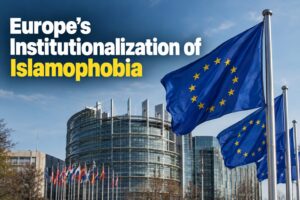
Anti-Muslim rhetoric isn’t lurking at Europe’s far-right fringes anymore, it’s set up shop right at the heart of the continent’s political life. The shift is most glaring inside the European People’s Party (EPP), the biggest bloc in the European Parliament. With fourteen of the European Commission’s twenty-seven seats, the EPP doesn’t just have clout; it sets the tone. When the party’s presidency recently adopted its resolution on “Interference of Political Islam in European Democratic Processes,” it wasn’t responding to a one-off outcry or indulging the hobbyhorse of some backbench radical. This came straight from the top.
What makes this moment so important is that it represents a structural, not symbolic, transformation in how Europe’s political mainstream treats its Muslim communities. The EPP has always prided itself on being broad, fusing Christian democrats with conservatives, taking its cues from Germany’s Christian Democratic Union and Christian Social Union. But what’s happening now isn’t just coalition politics. The party has formalized the language of “legalistic Islamism” and “entryism”, concepts long present in national debates, pulling them up into the machinery of the European Union itself.
Supporters wrap these shifts in benign language: they say the new policy document protects democratic values, keeps society cohesive, and defends freedom. Look past the surface, though, and a worrying pattern emerges. The resolution insists that individual equality trumps collective religious expression, framing it as a bedrock principle for everyone. But the reality is, this approach leaves minority religious communities exposed. European and international human rights laws protect not just individual faith, but the right to come together, educate, organize, and serve society as a group. By narrowly recognizing only “individual” practices, the state hollows out the foundation that lets religious groups actually participate in public life.
What makes this moment so important is that it represents a structural, not symbolic, transformation in how Europe’s political mainstream treats its Muslim communities.
At the core of this policy is “entryism”, the idea that Muslims are systematically infiltrating European political, civic, and governmental institutions with hidden agendas. Suddenly, basic acts of civil participation, debating, campaigning for fairer treatment, leading local charities, turn suspect. Muslim groups don’t get the benefit of the doubt; instead, they’re expected to prove, again and again, that their loyalty to European values is genuine. The consequence is a full reversal of legal norms: scrutiny and suspicion replace the presumption of innocence.
The model that the EPP now wants to spread comes straight from Central Europe, mainly Austria, where authorities set up the Documentation Centre Political Islam. A digital map, plotting hundreds of Muslim-run associations and mosques across the country, made headlines and drew sharp rebuke from human rights organizations and the Council of Europe. Privacy was tossed aside; the risk of public harassment, ramped up. No matter: the EPP’s resolution asks Europe’s member states to do the same.
These ideas have real consequences. In late 2020, Austrian police launched Operation Luxor. Sixty Muslim families, academics, businesspeople, and civic leaders faced raids, frozen assets, and travel bans, their lives thrown into chaos on the charge of subverting the state. After years of legal wrangling, most charges collapsed in court. There was no proof, no evidence of violence, extremism, or criminal plots. Still, despite the lack of convictions, this operation is being held up as a model for EU-wide security coordination.
By setting ‘political Islam’ alongside security threats from states like Russia and China, Europe sends a stark message: your faith and your civic engagement are security questions now.
The EPP’s resolution goes deeper, aiming at the financial life of Europe’s anti-racist civil society. It authorizes surveillance of foreign money flows, and opens the door to withholding EU funding from organizations categorized as “radical.” The effect is immediate. Groups like the European Network Against Racism have found themselves targeted by vague ideological accusations, some pushed by conservative figures in Brussels, who link them to foreign groups like the Muslim Brotherhood. The tactic is clear: tie civil rights groups to supposed extremists, then sideline them, discredit them, and cut off their funding.
This crackdown isn’t unfolding in a vacuum. The backdrop is a European anxiety over foreign influence, regularly stoked by intelligence files pointing fingers at Gulf states or other “outside” powers. Leaks like the Abu Dhabi Secrets have shown just how eagerly foreign actors try to shape European debates, pressuring policymakers, journalists, and security agencies to expand the use of “terrorism” designations to groups that are, by law, peaceful and engaged in public life. Dragging domestic Muslim organizations into this frame twists the reality: legal, civic activism gets painted with the shadow of foreign, hostile interference.
By setting “political Islam” alongside security threats from states like Russia and China, Europe sends a stark message to its Muslim citizens: your faith and your civic engagement are security questions now. The relationship between state and minority isn’t about mutual integration or equal rights anymore. It becomes one of constant oversight, mistrust, and surveillance, a fundamental shift in what it means to “belong” in Europe.
These aren’t isolated legal disputes or technical questions. The broader consequences ripple through the continent’s political landscape. Established center-right parties face surging pressure from nativist, populist competitors; they chase votes by taking harder and harder lines on immigration and diversity. But as mainstream parties swallow the rhetoric and tactics of the far-right, by policing mosque networks, by surveilling civic organizations, by normalizing state suspicion, they drag discrimination into the heart of European politics.
When European institutions treat entire communities as threats before they’ve done anything criminal, they chip away at the rule of law for everyone.
Liberal democracy is rooted in a simple promise: the law protects peaceful participation, even when citizens disagree with the state. When European institutions instead treat entire communities as threats before they’ve done anything criminal, when they map, monitor, and defund groups for simply being who they are, they chip away at the rule of law for everyone. Of course, societies must defend themselves against genuine security risks, but that can’t mean turning democratic institutions into engines of suspicion. In the end, weaponizing state power against lawful civic life endangers the very freedoms Europe claims to cherish. In the battle to “protect democracy,” it’s worth asking: whom does this new Europe really serve, and at what cost?
About the Author
Daniel Frost is a Foreign affairs columnist specializing in global geopolitics, European security, and strategic policy.