
By Adam Reed
The Middle East’s strategic picture is constantly shifting, with old rivalries rubbing up against dramatic new economic dreams. Right in the thick of it is Saudi Arabia, trying to pull off one of the most ambitious economic overhauls the region’s ever seen, even as it wrestles with threats on its southern flank. The spotlight right now is on Vision 2030, the brainchild of Crown Prince Mohammed bin Salman. He’s betting the kingdom’s future on this push to turn Saudi Arabia from a one trick oil economy into a magnet for global investment, tourism, tech, and logistics, all built on the backbone of massive projects like NEOM. But none of that works without the one thing investors care about most: stability. If things go sideways, and missiles or drones start hitting infrastructure or shipping lanes, the billions that Vision 2030 needs will vanish in a heartbeat. Investors don’t gamble on chaos, and global supply chains expect the Bab el Mandeb strait, a bottleneck for nearly 12 percent of world trade, to stay open and safe.
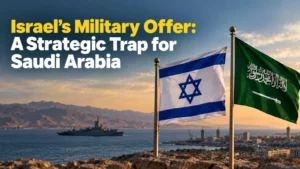
Now, toss Israel into the mix. Reports are swirling about Israeli offers to help Riyadh fight off Houthi attacks from Yemen. On the face of it, this sounds like two countries finding common cause in their standoff with Iran’s regional allies. But look closer, and it’s a strategic trap. If Saudi leadership accepted Israeli military help, they’d be walking into a political minefield that could blow apart their own regional strategy and derail the economic transformation Vision 2030 aims for.
Think about the position Saudi Arabia finds itself in. The region’s economic engine is meant to be trust: trust from foreign investors who want to park their cash in giant projects, and trust that the kingdom can keep its ports, airports, and supply chains safe from attack. Persistent Houthi airstrikes and drone attacks mess with that confidence directly, forcing up risks for anyone looking to do big business in Saudi Arabia.
If Saudi leadership accepted Israeli military help, they’d be walking into a political minefield that could blow apart their own regional strategy.
That’s where Israeli Prime Minister Netanyahu’s move comes into play. He’s offering security partnership, pitching Israel as the key to a shared defense in the Gulf. The logic is simple: if Saudi Arabia accepts, Israel gets a firm foothold in Gulf security circles, which is a cornerstone of its broader normalization strategy. But the catch is, the pitch doesn’t hold up under scrutiny. Israel’s military hasn’t shown it can handle the Houthi threat any better than Saudi Arabia. Since late 2023, Houthi fighters have lobbed long range missiles and flown drones right at Israeli targets, especially the port city of Eilat. The attacks didn’t just make headlines, they gutted Eilat’s cargo operations by 90 percent, a staggering blow that forced ships to reroute all the way around Africa, burning up cash and time.
Israel’s efforts to strike back haven’t delivered, either. Airstrikes on Hodeidah, a port under Houthi control, smashed fuel tanks and power stations, but retaliation didn’t slow down. Instead, the Houthis doubled down, striking commercial ships and warships in the Red Sea. If Israel can’t defend its own waterway and cities, it’s hard to imagine what, exactly, it can offer Saudi Arabia as a real solution. Bringing Israel’s military into the mix in Yemen would amount to little more than a symbolic move, with enormous political costs.
And those political costs are serious. Yemen isn’t just another battleground. It’s a regional and ideological fault line. If Saudi Arabia closes ranks with Israel, openly or secretly, it hands the Houthis a propaganda jackpot. Their entire narrative revolves around fighting off Western and Israeli interference in the Arabian Peninsula. One whiff of Saudi Israeli partnership and the Houthis can frame Saudi Arabia as puppets for foreign powers, instantly poisoning Riyadh’s reputation across much of the Arab and Islamic world. For a country that claims stewardship over Islam’s holiest sites, that’s a stain not easily washed away.
Diplomatically, things could unravel fast, too. Remember the tricky but important 2023 normalization deal between Saudi Arabia and Iran? It was hammered out in Beijing with promises to dial down tension and respect state boundaries. If Saudi Arabia swings toward military cooperation with Israel in Yemen, Iran will see it as a betrayal, igniting fresh confrontation, not just in Yemen but probably beyond. Rather than isolating the Houthis, such a move could push Iran to ramp up its support, transforming Yemen into an entrenched conflict zone that drains Saudi resources, disrupts air travel, scares off investors, and leaves infrastructure open to attack.
Netanyahu’s pitch is tailored to cement Israeli influence and foster division for Saudi Arabia, accepting the offer would amount to self sabotage.
The way out isn’t more fighters or firepower, it’s politics. Riyadh seems to get this, having spent the past couple years talking directly with the Houthis, with Oman acting as a go between. These meetings are about more than just ending hostilities; they’re a roadmap for finally closing the Yemen chapter, securing borders, and figuring out a sustainable peace. Diplomatic work here actually protects Saudi infrastructure and cities better than any missile defense system.
Lasting stability in Yemen won’t come from more foreign armies. It needs smart, regional diplomacy. Gulf neighbors like Oman have proven channels for mediation, and there are regional security mechanisms that can underwrite the peace everyone claims to want. The alternative, an endless, grinding war, only bleeds Saudi money, hinders aviation, terrifies potential partners, and leaves the kingdom dangerously exposed.
So here’s the reality: Netanyahu’s pitch is tailored to cement Israeli influence, foster division, distract the world from Palestine, and anchor Israel more deeply in Gulf affairs. For Saudi Arabia, accepting the offer would amount to self sabotage. The real priority is keeping outside actors at bay, locking in the gains from economic reforms, and making sure Saudi Arabia determines its own future, not outsiders. The kingdom doesn’t need Israeli hardware or military bands to secure its borders. It needs the resolve to finish the delicate diplomatic work that’s already started, and the wisdom to avoid falling into political traps that threaten everything Vision 2030 stands for.
About the Author
Adam Reed is an International affairs analyst focusing on geopolitics, defense strategy, and global security trends.