
By Adam Reed
The most dangerous moment for any imperial power shows up when it convinces itself that the only way to justify a war is by making it even bigger. That is the place Washington finds itself now with Tehran, a cycle where every setback just becomes another excuse to widen the fight. You see it every time a strategy falls short; it just fuels the argument for pouring in more troops, more money, more everything, chasing a victory that actually slips further out of reach with each step. Years of sunk military and political investment start to demand a clean win at a moment when winning like that is barely possible. The U.S. is sliding fast toward a point where the war it launched to show its strength now threatens to expose the limits of that very power.
What is driving this deadlock is that core belief in a manageable enemy. For decades, American policy in the Middle East has danced around the idea of having a bad guy who is scary enough to warrant a huge military presence, a bogeyman to keep alliances tight and the arsenal ready, but not so strong that the U.S. cannot call the shots. Drawing from Carl Schmitt’s political theory, the authority of any power that claims to protect others hangs on its promise to keep threats contained. But the more U.S. interventions drag on, spitting out local chaos, economic pain, and new dangers, the weaker that claim sounds. The U.S.’s ability to destroy things far outpaces its ability to actually shape any kind of lasting political order, and that gap is where real hegemony slips away.
The ability to destroy things far outpaces the ability to shape lasting political order, and in that gap, true strategic leverage slips away.
Recent fighting has ripped the cover off this contradiction. That US Israeli offensive kicking off in February 2026? American planners thought it would be short and sharp, maybe a month, maybe a little more. Instead, months later, Washington is stuck in a grueling war of attrition, with choices boiling down to ramping up and risking even more, or desperately trying to engineer a way out that does not look like defeat. The price tag has shot up fast, Congressional Budget Office estimates put the bill for U.S. operations at more than 38 billion dollars by August 2026. Meanwhile, constant trouble in the Strait of Hormuz, which carries a fifth of the planet’s oil, has slammed global energy markets. Oil shipments through the passage plummeted from nearly 15 million barrels a day at the start of the year to under 5 million at the war’s fever pitch.
Even with continuous airstrikes pummeling Iranian targets, the technological edge has not brought political collapse. Iran’s deep rooted institutions and tough sense of national identity, honed by decades of outside pressure, have helped the regime take huge hits and still keep command and control intact. Iran has shown it can adapt in ways that are not captured by counting buildings bombed or vehicles destroyed. By insisting that only total Iranian surrender counts as victory, Washington ties its reputation to something that is just flat out unreachable.
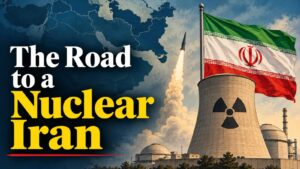
For Iran, this sort of hard won survival does not amount to a real solution, either. There is no future in just enduring cycles of bombardment and blockade. Living with endless destruction and recovery weighs down society and drains the economy, until even die hard pragmatists start looking at things differently. If all the rockets, proxies, and regional threats in the world still cannot deter another attack, then that old internal debate over building a nuclear deterrent starts looking less theoretical and more like a necessity.
In trying to reassert dominance through endless military pressure, Washington risks producing exactly the kind of nuclear armed adversary it set out to prevent.
That debate is heating up right now. You hear it from lawmakers, security experts, and think tanks in Tehran, more voices are saying that sticking with the Nuclear Non Proliferation Treaty and relying on traditional deterrence strategies basically invites more aggression. Reports from places like the Carnegie Endowment for International Peace highlight rising pressure inside Iran to ditch the old limits and push for a clear nuclear shield. The irony hurts: U.S. campaigns launched to stop nuclear proliferation might be the very thing that drives Tehran to cross the nuclear line.
If Washington pushes ahead with another major round of strikes, it risks speeding up this nuclear pivot. At some stage, Iran’s leaders will just conclude that U.S. force is a constant threat, one they can only blunt for good by getting a warhead of their own. And from Tehran’s perspective, that would not look like a reckless move, but sheer survival. International Atomic Energy Agency inspectors might report destroyed centrifuges and damaged labs, but wiping out buildings does not erase the knowhow needed to rebuild. Instead, every bomb just makes the political argument for weaponization stronger.
Right now, the U.S. faces a make or break moment in its grand strategy. Confusing a messy withdrawal from a failing war with the collapse of American leadership, that is a dangerous mistake. By insisting that only humiliating Iran will preserve U.S. power, Washington traps itself in a spiraling wager that gets riskier every time it doubles down. A third wave of strikes will just become a new test of American credibility, while Iran draws the lesson that only a nuclear bomb can change the math. In trying to reassert dominance, Washington risks producing exactly the kind of nuclear armed adversary it set out to prevent.
About the Author
Adam Reed is an International affairs analyst focusing on geopolitics, defense strategy, and global security trends.