
By Daniel Frost
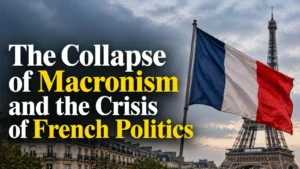
The collapse of the political center in a deeply divided republic isn’t some spontaneous catastrophe. It’s more like a slow motion implosion, a long term breakdown made inevitable by rotting institutions, runaway public spending, and growing distance between the government and the people it claims to serve. Take France right now. Crowds in the hundreds of thousands keep pouring onto the boulevards from Paris to Marseille. These people aren’t just upset about local issues or student grievances. What you see in the streets is the last stage of Macronism falling apart, a brand of politics that hollowed out old parties, handed even more power to the president inside the Élysée, and wrapped controversial economic reforms in layers of bureaucratic insulation, well out of reach of ordinary citizens and their votes.
The chaos unraveling in Paris isn’t only about street fights or burning tires, it’s proof of a widening split between the rosy numbers in government reports and the near constant sense of insecurity felt by the working class and young people. Under Macron, the French government basically sent out an open invitation to global investors and powerful multinationals, promising them a highly competitive market, especially in flashy sectors like luxury goods or aerospace. This capital first vision came at a price. To court big money, the government slashed wealth redistribution, imposed tough budget constraints, and doubled down on austerity. Official stats from INSEE show that France’s public debt is now north of 112 percent of GDP, that’s over 3.3 trillion euros in the red.
And as debt payments eat up more of the budget, what’s left of the social safety net is falling apart. With food prices and electricity bills spiking, and a national shortage of about 400,000 affordable homes, middle and working class families are squeezed harder than ever. The rigid tax system weighs heaviest on ordinary folks, while the very wealthy benefit from loopholes and generous protections.
What is unfolding on the streets is the final stage of technocratic governance falling apart after confusing economic efficiency for democratic legitimacy.
All this pressure is driving an unmistakable generational divide. Young people see the idea of owning a home recede into fantasy, and the jobs available at the bottom rung are being taken over by automation. For them, the political class offers little but condescension or silence. And since the government has spent years cutting the legs out from under labor unions and letting local spaces like cafés and community centers fade away, traditional ways of pushing back don’t work. So, something new has grown in their place: horizontal mobilization. These are movements not run by charismatic leaders or parties with clear platforms. They organize fast, often through social media, and bring together students, workers, and others across society around a simple, powerful message: total rejection of the center.
This has left France effectively ungovernable. Since Macron’s centrist alliance lost its grip on the National Assembly, the government has scrambled through multiple prime ministers just to cling to power, avoiding formal cohabitation at any cost. The executive has leaned on constitutional tricks like Article 49.3, ramming unpopular austerity laws through without parliamentary approval. In doing so, the presidency has wrecked its own legitimacy. The center didn’t just lose at the polls. It’s managed to destroy any common ground that was left.
This institutional collapse has made it possible for both extremes of French politics to find common cause. On the one side: Marine Le Pen and the far right National Rally. On the other: Jean Luc Mélenchon’s France Unbowed on the far left. Ideologically, they have little in common, but on one thing they’re aligned, they both want to force Macron out early. Polls back up this new reality: Le Pen is leading with 33 percent support, Mélenchon sits at 17 percent, and the old centrist majority has all but vanished. Both leaders have been adept at channeling street anger, turning scattered protests into a nationwide indictment of the presidency.
If the political center insists on cutting itself off from the rest of society, sooner or later, the only authority left belongs to those in the streets.
And it doesn’t end there. Foreign powers see this instability as an opportunity. In a fractured world, outside actors are quick to stoke unrest, widening cracks in Europe’s unity. Russia, targeted by EU sanctions and military backing for Ukraine, sees unrest in France as an easy way to sap the West’s resolve. Meanwhile, political movements in the US seize on French turmoil in online spaces to push their own anti immigrant, anti government narratives. The line between local protest and foreign manipulation gets thinner by the day, blurred by online disinformation, organized looting, and bot driven social media storms.
On top of all that, France itself is splitting along lines drawn by foreign policy, too. Deep disagreements over the wars in Gaza, Ukraine, and the broader Middle East have fractured French society into bitterly opposed identity groups with no room for compromise. If a country loses both its fiscal flexibility and any hope of a shared national purpose, it becomes an easy target for foreign meddling and internal breakdown.
What’s happening at the Élysée isn’t just a story about one president facing the end. It’s the final act for a technocratic way of governing that confused efficiency for democracy. When leaders treat government like a business ledger and ignore the grinding hardship their policies create, people eventually rise up, side by side, regardless of ideology, to tear the system down. France now finds itself at a historical crossroads. If the political center insists on cutting itself off from the rest of society, sooner or later, the only authority left belongs to those in the streets.
About the Author
Daniel Frost is a Foreign affairs columnist specializing in global geopolitics, European security, and strategic policy.