
By Ketty L.
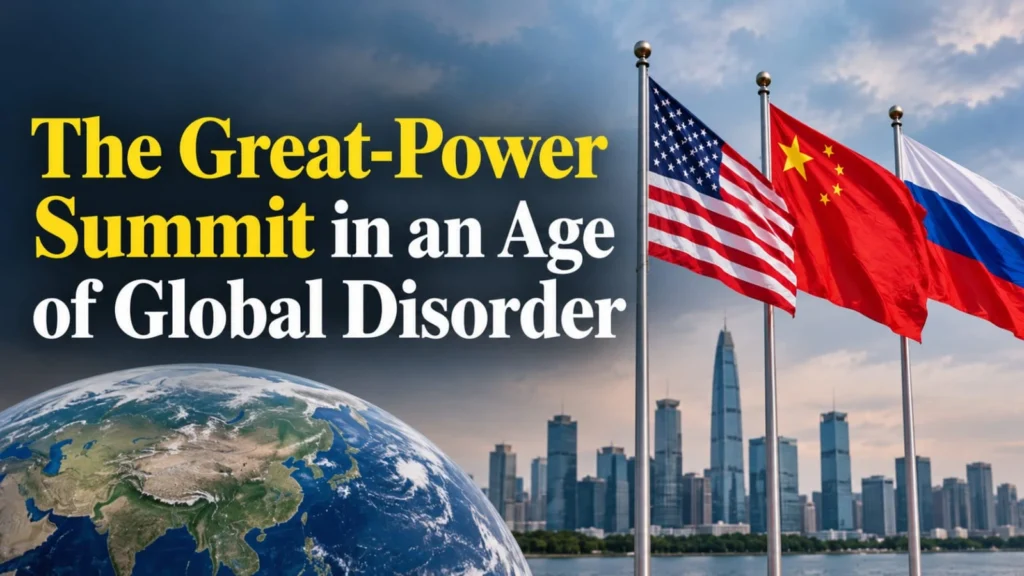
When history rhymes, it rarely captures the spirit or dignity of what came before. Think back to February 1945, Roosevelt, Churchill, and Stalin huddled together at the Livadia Palace in Yalta, grinding through days of negotiations. They took on the falling Nazi regime and sketched out the shape of the future world, dividing influence and setting the stage for half a century of global order. That was real, weighty statecraft. Now look at this week’s hurried summit in Shenzhen. It is wedged into the margins of the Asia Pacific Economic Cooperation forum, allocated barely an hour, so says the Kremlin. The meeting between Donald Trump, Xi Jinping, and Vladimir Putin is not much more than theater, heavy on posturing, light on actual substance.
Each man comes to southern China loaded with his own set of anxieties. Trump has wounds to hide: he just lost both houses of Congress after a disastrous war in the Persian Gulf and stubborn inflation. For him, sharing a stage with Putin and Xi is a chance to look important again, maybe distract from his bruising loss back home. Putin loves any moment he can sit as an equal with big players, signaling he is not isolated after years of chilly relations with the West. Xi? He is playing the host, but keeps the agenda vague, promising strategic stability while watching Trump closely, as he does not trust him.
And you cannot ignore the specter hanging over the whole scene, the war against Iran. Washington and Tel Aviv launched it to stop nuclear proliferation, but it has turned into a mess: energy routes through the Strait of Hormuz and Bab al Mandab are squeezed, so global supply tanks and consumers everywhere get hit. China feels this sharply. They have invested massively in clean energy and solar, trying to lessen their reliance on foreign oil, but when things move fast, those investments are not much comfort. The shock is still real.
The meeting between Donald Trump, Xi Jinping, and Vladimir Putin in Shenzhen is not much more than theater, heavy on posturing and light on substance.
On the flip side, Moscow is quietly cashing in. Soaring oil prices and distracted Western sanctions mean Russia’s revenues swell. Plus, the chaos lets Putin draw a parallel between his war in Ukraine and the American campaign in Iran, both framed as security moves. If Xi and Putin manage to convince Trump he is headed for a dead end in the Gulf, maybe we get a small diplomatic win. But expecting Trump to break with Israel’s interests? That is probably wishful thinking.
Then there is nuclear arms control, another glaring example of big talk with no real follow through. Nine months ago, the last treaty between Washington and Moscow lapsed. Now, for the first time in over fifty years, their nuclear stockpiles have no constraints. Trump says he wants a new trilateral deal that includes Beijing, but that idea is a non starter. China’s arsenal is minuscule compared to America’s and Russia’s, and Beijing is not about to lock itself in as the junior partner just so Trump can grab a headline.
Same goes for the Ukraine question. Trump wants to bring it up in Shenzhen, which makes Kyiv and European leaders uneasy. But the idea of a back room deal cutting out Zelensky is not likely. Beijing keeps calling it a European issue that needs bigger, multilateral fixes, and Putin is not about to offer concessions to an American leader who suddenly has no legislative muscle. As for tech rivalry, there is no solution in sight. The recent fallout with Nvidia’s Jensen Huang and the Singapore cloud scandal only highlight the ongoing mess. Washington’s efforts to curb Chinese AI progress through chip bans have not really stuck.
As climate negotiators fight uphill in Antalya, the world’s biggest polluters meet in China talking trade and power as if saving the planet barely matters.
Maybe the starkest detail about Shenzhen is what is missing. Four thousand miles away in Antalya, Turkiye, the COP31 climate summit is underway, with diplomats and scientists battling for urgent breakthroughs. The U.S. skipped the talks again, walking away from any claim to climate leadership, even as disasters mount. Europe’s heatwaves have killed tens of thousands, and Nepal’s glacier collapse sent floods that wiped out more than fifteen hundred lives. Meanwhile, wars in Gaza, Iran, Ukraine, and Sudan tear up both land and people, and America’s massive data centers just add to the drain.
Greta Thunberg, speaking at Antalya, went straight to the point: the planet is not simply dying, it is being killed. Antonio Guterres, the outgoing UN Secretary General, echoed her urgency, stating humanity faces a choice, he said: make or bake. He pointed out that fossil fuels need to follow the dinosaurs, and unlike dinosaurs, fossil fuel companies have powerful lobbies.
That ties everything together, Antalya and Shenzhen. As climate negotiators fight uphill, hemmed in by corporate oil interests, the world’s biggest polluters meet in China, talking trade and power as if saving the planet barely matters. Yalta’s leaders knew the stakes, and they built something tough, flawed but lasting. Shenzhen looks set to produce only emptiness: just another show of egos, while the world catches fire.
About the Author
Ketty L. is a Columnist writing on politics, and international affairs.