
By Adam Reed
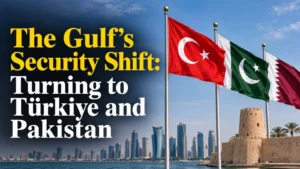
When small, wealthy Gulf states start to see that having the biggest American military base overseas does not give them real protection from the region’s crossfire anymore, they quickly look for something safer. That basic urge to survive pretty much explains the sudden rush of new agreements drawing leaders to Istanbul, Doha, Riyadh, and Islamabad this fall. Take November 13, 2026, when Turkish President Recep Tayyip Erdoğan and Qatari Emir Sheikh Tamim bin Hamad Al Thani met at Dolmabahçe Palace to sign a detailed mutual defense deal. Less than a week later, on November 19, Qatari Interior Minister and Lekhwiya Commander Sheikh Khalifa bin Hamad Al Thani joined Pakistani Interior Minister Mohsin Naqvi and Prime Minister Shehbaz Sharif in Islamabad to ink a bilateral security cooperation memo and a plan for counter narcotics action. Official statements dress up these deals as natural steps in brotherly friendship. The truth is, they are fueled by geopolitical panic, a reaction to the harsh realization that Washington’s old security umbrella over the Persian Gulf is full of holes that cannot be patched.
For years, Doha felt safe. Hosting the Al Udeid Air Base and acting as the region’s go to mediator felt like a shield from invasion or attack. That sense of safety vanished in the span of just over one turbulent year. First came the shock of September 2025, when Israeli jets targeted Hamas leaders right in Doha, crossing Qatari airspace even as peace talks over Gaza dragged on. Next was the 2026 regional firestorm: Gulf states got hammered by thousands of missiles and drones, and Iran even struck Al Udeid directly. On top of that, shipping through the Strait of Hormuz stalled, and Washington’s own political chaos after the midterm elections left it distracted and weak. Qatari leaders had no choice but to admit something stark, relying only on a distracted superpower for protection was an enormous risk.
Türkiye and Pakistan jumped at the vacuum, moving fast to stitch together overlapping security networks throughout the Muslim world. The Istanbul Qatar treaty and Islamabad’s pact were not made in a vacuum. Both came just after the October 21 Badr Memorandum in Doha, which brought Türkiye, Qatar, Pakistan, and Indonesia into a joint defense manufacturing and research group. Add to that the Mecca Joint Defence Agreement, joining Pakistan, Saudi Arabia, and Türkiye in a collective security pact styled loosely on NATO’s Article 5, and the region starts to show a new pattern. All these agreements, when viewed together, reveal a bold plan: turn regional industrial and military strengths into independent power, matching the wealth of Qatar and Saudi Arabia to Turkish arms production and Pakistani nuclear capability and manpower.
All these agreements reveal a bold plan: turn regional industrial and military strengths into independent power, matching Gulf wealth to Turkish arms production and Pakistani manpower.
Pakistan sits in the middle of this security puzzle for very practical reasons and because of the diplomatic muscle it has built up. Islamabad buys about 85 percent of its oil from the Gulf, and it leans heavily on money sent home by overseas workers, a workforce of nearly 300,000 Pakistanis in Qatar alone. When war between the US, Israel, and Iran choked off the Gulf’s oil flows, Pakistan was at immediate risk of an economic crash. Earlier this year, after Houthi missiles hit Saudi Arabia, Pakistan sent over 8,000 troops and air defenses. Its key role as mediator between the US and Iran also gave Islamabad fresh leverage. The recent security memo, tying Qatar’s Internal Security Force to Pakistan’s Federal Constabulary, cements a deeper institutional bond. It stretches cooperation from classic military deterrence right down to policing, intelligence sharing, and border control.
But if you dig into the details, there is a noticeable gap between big talk and actual military commitment. The Mecca pact is pretty clear: if one country gets attacked, the others treat it as an attack on themselves. The new Turkish Qatari pact, though, does not make that kind of promise. In fact, Türkiye’s Defense Ministry had to clarify for the public that the agreement does not automatically mean sending troops if war breaks out. Instead, both countries agree to come up with a common political line, share intelligence, and build up combined defense industries. The Islamabad deal, likewise, is about specialized training and fighting terrorism and drugs, not about rushing to each other’s defense on the battlefield.
These caveats point to a bigger truth: while Türkiye has NATO’s second largest army and a booming drone industry, and Pakistan fields tough, experienced soldiers and has nuclear weapons, neither country can protect Gulf energy facilities alone from a sustained missile barrage. Erdoğan’s comments after signing, highlighting Ankara and Doha’s pledge to avoid a wider war, plus Sharif’s call to revive the talks that might reopen the Strait of Hormuz, all make it clear. These leaders want diplomatic problem solving, not to get sucked into a regional shooting war.
Gulf leaders are openly hedging their bets, building multiple security ties to Ankara and Islamabad because the US is no longer reliable or cost effective as a shield.
There are also real headaches when it comes to joint weapons manufacturing under the Badr Memorandum, tied to these bilateral security deals. Trying to develop advanced arms across four countries, with different risks, budgets, and bureaucracies, means years of careful coordination. For Pakistan, tying itself even closer to Gulf monarchies creates new dilemmas. Islamabad has to keep its border with Iran stable and manage its own domestic sectarian issues, all while promising security support to Riyadh and Doha.
When you zoom out, what matters most about this network is not its immediate military punch but what it signals about the Middle East after America’s dominance. For years, Washington discouraged regional alliances that might undercut its influence or disrupt profitable arms sales. Now, Gulf leaders are openly hedging their bets. They are building multiple security ties to Ankara and Islamabad because the US is no longer reliable or cost effective as a shield.
The agreements struck in Istanbul and Islamabad are not about forming a single, unified Middle Eastern military bloc. Instead, they are a practical response, a sign of states trying to take more control over their own security by pooling intelligence, training, and armament production. Whether this patchwork of deals can hold up if another Gulf war hits, that is the real test. In global politics, promises made on paper only scare off threats when you back them up with real power and political resolve. Until these new arrangements prove they can work during a real crisis, not just in glittering palaces, Gulf security will stay uncertain and fragile.
About the Author
Adam Reed is an International affairs analyst focusing on geopolitics, defense strategy, and global security trends.