
By Ketty L.
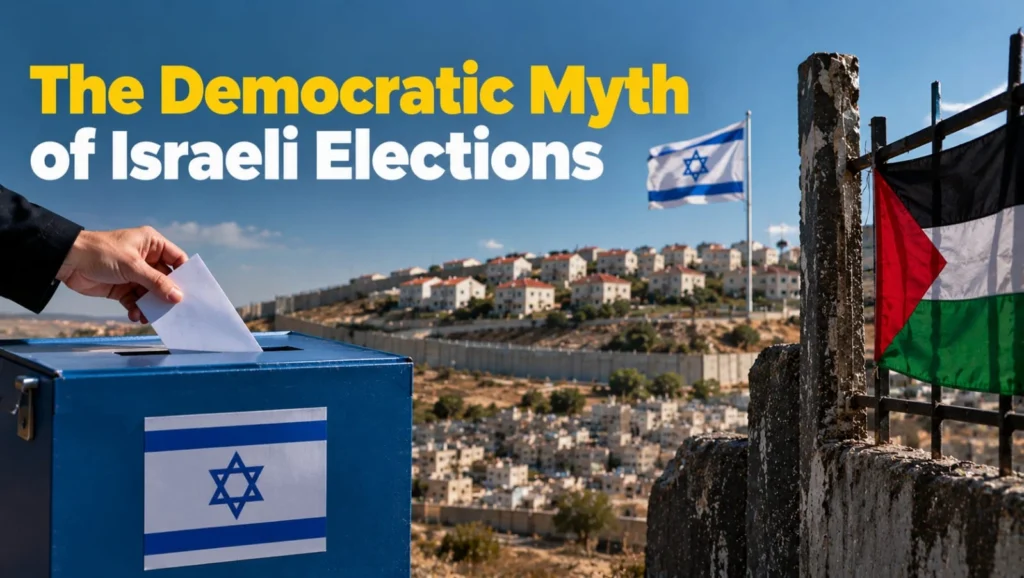
Every time a democratic nation heads to the polls, people like to call the ballot box the great equalizer. Supposedly, this is how ordinary citizens steer their collective future, keep leaders in check, and claim their sovereign rights. But as Israelis gear up to vote, that familiar story falls apart. Take a look at the occupied West Bank: you have got two populations ruled by the same authority, under the same government. One group gets full voting rights. The other does not vote at all. The difference between these two realities could not be clearer, what is happening is textbook apartheid, right out in the open for everybody to see.
Apartheid is not just some relic from South African history books. Under international law, it is a very real, well defined crime against humanity, a system where one ethnic or racial group dominates and systematically oppresses another. And in the West Bank, you can see this regime on full display during elections. Over half a million Israeli settlers, living in what the international community calls illegal settlements, have all the rights of citizenship. They cast ballots, send politicians to the Knesset, help make the laws that rule the land. But the nearly three million Palestinians living alongside them? They do not vote, do not have representation, and have zero say in the military regime that rules over every part of their lives.
This is not some temporary glitch, a side effect of a military occupation. This is exactly how the system was built, to keep control from the Mediterranean Sea to the Jordan River under a single, sovereign authority. You can even see it in black and white: Israel’s 2018 Nation State Law spells out that only Jewish people have the right to self determination in the state. That principle gets enforced through a tangled legal system in the occupied territories. Settlers operate under civil law, enjoying every protection of Israel’s constitution. Palestinians, living beside them on the same patch of earth, are controlled by harsh military orders, dealing with land being seized, arbitrary arrests, and near constant surveillance.
No vote where half the people under a regime’s rule are blocked from participating because of their ethnicity can ever be called free, fair, or democratic.
A common deflection goes like this: Palestinians have their own government, the Palestinian Authority, so they should use that for democracy. But this is just a distraction. The Palestinian Authority exists at Israel’s discretion; it does not wield real governmental power. Whenever Palestinians try to run their own democratic processes, Israel steps in to shut it down. There are crackdowns on candidates, campaign offices sealed off, especially in East Jerusalem, political organizations broken up, and activists intimidated. In reality, genuine Palestinian democracy is smothered at every turn.
This systematic marginalization does not stop at the Green Line. Even Palestinian citizens within Israel, who technically have the right to vote, face constant attempts to sideline them. Political parties representing Palestinians are always under threat, disqualified, delegitimized, or targeted by the Central Elections Committee. Dozens of new laws in the past decade have zeroed in on Palestinian political activities and speech, basically limiting civil society and protest to whatever does not threaten the status quo. So yes, a minority can take part, as long as it does not shake the foundations of Jewish political dominance.
People around the world are seeing through the old narratives. Large human rights organizations, think Amnesty International, Human Rights Watch, have stopped pretending this situation is just temporary. Their reports are blunt: Israeli authorities are guilty of apartheid against Palestinians. Human Rights Watch said the line has been crossed; the intent to dominate, and to keep millions oppressed, is obvious. Then in July 2024, the International Court of Justice backed this up with a ground breaking legal opinion: decades of occupation, growing settlements, and unrelenting discrimination in Palestinian territories all add up to serious violations of international law’s core bans on racial segregation and apartheid.
A state that restricts fundamental human rights to one privileged caste while keeping millions of disenfranchised subjects in permanent subjugation is not a democracy under strain.
Still, leaders in Western democracies keep holding up the Israeli electoral process as evidence of a healthy, thriving democracy in the region. Election night comes, and major news outlets cover it just like any European or North American race, they break down party numbers and likely coalitions, never mentioning the people right next door, denied any say under the very same government. This kind of coverage papers over a reality of authoritarian rule, dressing it up as something much more democratic and inclusive than it really is.
But let us be honest, no vote where half the people under a regime’s rule are blocked from participating because of their ethnicity can ever be called free, fair, or democratic. The way Israeli elections play out in the West Bank is not just about tolerating inequality, the entire system runs on it. And as long as global partners keep pretending these elections are the real thing, they end up supporting exactly the system of injustice they claim to oppose.
The truth is not complicated. A state cannot occupy, oppress, and segregate while calling itself a democracy. Real democracy means everyone gets a vote, everyone has equal protection under the law, and the whole discriminatory structure comes down. Until that happens, no amount of voting or international praise changes what is actually going on. Elections, in this context, just help mask a system of permanent conquest and political exclusion. A state that restricts fundamental human rights to one privileged caste while keeping millions of disenfranchised subjects in permanent subjugation is not a democracy under strain. It is an apartheid state operating exactly as intended. To call it anything else is not diplomacy, it is cowardice.
About the Author
Ketty L. is a Columnist writing on politics, and international affairs.