
By Adam Reed
As an old proverb goes, “He who pays the piper calls the tune.” Nowhere does this saying ring truer than in the shifting sands of the Arabian Peninsula where every time another barrage of Houthi drones or ballistic missiles pummels key Saudi targets, it feels like déjà vu in the West. Washington and its allies barely pause before they pin the blame directly on Tehran, insisting these attacks are just the latest not so subtle volley from the Islamic Revolutionary Guard Corps. On the other hand, plenty of critics push back. They say, look, the Houthis are not just some puppets dancing on Iranian strings, they have got their own grievances, deep seated historical issues with Saudi Arabia, and their own decision making machinery. But if we really zoom in on how things work, it starts to look less like an even match between local agency and foreign pulling of strings. The simple truth? The Houthis never became this powerful on their own. Iran’s support, money, tech, know how, turned them into the regional force they are today, no matter how much independence they claim.
Supporters of the Houthi independence argument love to remind everyone that their feud with Riyadh did not start in 2015, or even in this century. These bitter disputes, especially with the movement’s Zaydi rulers, stretch way back, rooted in local power struggles, old vendettas, and a constant need to juggle unruly tribal coalitions. From Sana’a, the Houthis chase their goal of consolidating power, holding their own against local rivals, and sometimes browbeating tribes into alliances. But let us be honest: even the deepest historical grievances do not somehow conjure up advanced ballistic missiles and long range drones out of thin air. Without steady, high level foreign sponsorship, there is no way a cash strapped militia fighting out of the barren hills of northern Yemen could morph into a force that can threaten neighboring kingdoms, much less target oil installations hundreds of miles away.
Without steady high level foreign sponsorship, there is no way a cash strapped militia could morph into a force capable of threatening neighboring kingdoms.
If you want hard evidence that the Houthis are an Iranian proxy, you just need to follow the trail of weapons and expertise. Iran did not let the sheer logistics of the thing, hundreds of miles of hostile territory and open ocean, stop it. Through a mix of clandestine sea routes, tricky supply chains, and a whole lot of patience, the Quds Force kept the pipeline running. UN investigators (and not just once or twice) have busted shipments of carefully packed missile parts, gyroscopes, and advanced electronics, all smuggled by sea, only to be assembled in Yemen with Iranian and Hezbollah advisers standing close by, guiding the process.
But it is not just about hardware. The Houthis’ most skilled fighters did not pick up their craft overnight, they learned it in Iran. Intelligence shows that the movement sent not just soldiers but engineers, drone operators, intelligence officers, hundreds of them, through specialized training at Iranian camps by the Caspian or outside Tehran. Naval operations, missile launches, how to operate and modify drones, you name it, they learned it there. At that point, it is not just about “inspiration” or a few spare parts. When your experts rely on Iranian know how, your supply chains run through Iranian smuggling networks, and your battlefield hardware is stamped with Iranian blueprints, “proxy” fits better than any other label.
And then there is the money. The Houthis try to present a self sufficient front, through taxes, extortion, whatever local revenues they can scrape together, but that just does not pay for a years long war featuring guided missiles, sprawling drone bunkers, and non stop high tech operations. Only a committed state backer, with cash to burn and tech to share, can keep those lights on. Iran fills that role to a T. Without Tehran’s money and supplies, the Houthi war machine grinds to a halt, no question.
What is striking is just how advanced this proxy game has become. Think back to the Cold War, when the Soviets or Americans all but micromanaged their clients, leaving them little room to maneuver. That is not how Iran runs things. They saw early on that clamping down on every decision would make the Houthis less useful and more vulnerable. Instead, Iran built up their skills, handed them the tools, then let them run with it, so long as the broad goals matched Iran’s own: challenging Riyadh, jabbing at Washington, and generally keeping the Gulf on edge.
Tehran stays out of the line of fire, achieves its foreign policy goals, and projects power, all without risking a direct war on its own turf.
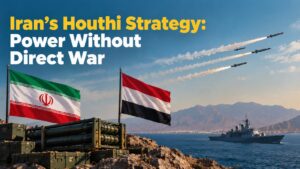
This is what sets the Iran Houthi relationship apart. The Houthis get to choose their targets, wrangle with domestic issues, act with real autonomy on the ground, but only within the lines drawn by Iran’s regional ambitions. When they block ships in the Bab el Mandeb, hit Saudi oil fields, or force the U.S. and its friends to keep spending a fortune on missile defense, it is Iran that reaps the biggest rewards. Tehran stays out of the line of fire, achieves its foreign policy goals, and projects power, all without risking a direct war on its own turf.
Just look at the timing of Houthi offensives and the weaponry they use. Their escalations always seem to line up with growing regional tensions, usually traceable right back to Iran’s broader standoffs. Sure, Houthi spokesmen will say they are acting for pan Islamic solidarity or Yemeni sovereignty, but the debris left after an attack, the advanced drones, “suicide” boats, and precision munitions, read like a what is what of Iranian defense tech.
In short, it is misleading to pretend the Houthis are an independent group fighting a purely local war. Yemen’s internal tensions may have sparked their rise, but it was Iranian money, brains, and hardware that turned the spark into a wildfire. The Houthis, without a doubt, are Iran’s most successful proxy in decades. They have redrawn the map of regional security, giving Iran leverage it never would have had alone, and allowing Tehran to keep its fingerprints just blurry enough for plausible deniability. The missiles may leave from Yemeni soil and serve Yemeni ambitions, but their range, their precision, and their very existence are a testament to Iranian planning and support. That is the reality behind the launches lighting up the skies over the Gulf.
About the Author
Adam Reed is an International affairs analyst focusing on geopolitics, defense strategy, and global security trends.