
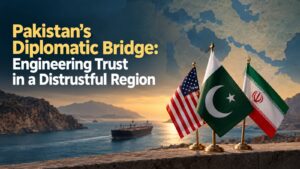
 Pakistan’s Diplomatic Bridge: Engineering Trust in a Distrustful Region
By Adam Reed
As the old Persian saying goes, “Trust is built by drops, but lost in buckets.” Nowhere does this ring truer than in the shadowed corridors of West Asian diplomacy, where suspicion seeps through every conversation and historic scars refuse to fade.
When Field Marshal Asim Munir, Pakistan’s Chief of Defence Forces, touched down in Tehran, the gravity of his mission hung in the air. This was not a passing courtesy call. Munir was greeted at the highest ranks, a full audience with Iranian President Masoud Pezeshkian and Supreme National Security Council Secretary Mohsen Rezaei. The agenda quickly zeroed in on matters that shape the lifeblood of the region. When the Iranians talk, they do not mince words: “End the sanctions, ease the military blockades, and then maybe we will talk.” On the nuclear front, they are not budging either, Tehran keeps its cards close, especially when it comes to enriched uranium reserves.
But zoom out from these crowded boardrooms and you see the real puzzle. Dialogue is only part of the equation. The greater challenge is designing a system durable enough to survive two adversaries locked in chronic suspicion. And here, Pakistan stands out, not just as another neighbor, but as a rare, credible bridge, a role Islamabad has cultivated, somewhat against the odds, in the snake pit of West Asian politics.
Recent events have laid bare how quickly promises can dissolve. Take the Islamabad Memorandum of Understanding from June 17. This was no small feat, a frantic bout of behind the scenes negotiating gave birth to a short, sixty day experiment: halt the clashes, lift the American blockade, open up commercial traffic through the Strait of Hormuz. Hope flickered for a moment. Then reality struck hard. Missile attacks rattled shipping corridors, and just as quickly, American firepower answered. In the aftermath, the agreement unraveled, revealing an all too familiar flaw: legal ambiguity. Each side found a loophole, an interpretation that suited their narrative. With no independent referee on hand to police those claims, the deal was doomed.
Not many countries can have honest conversations in Tehran, Washington, and Riyadh all in the same week.
Even so, it is worth recognizing what few seem to: Pakistan’s diplomatic artistry. Not many countries can have honest conversations in Tehran, Washington, and Riyadh, all in the same week. Islamabad’s relationships are not perfect, but they are functional. That utility counts for a lot. In a region where misunderstandings turn deadly, just having trusted back channels is nothing short of essential.
Pakistan’s role is not about pushing through some grand vision of its own, or strong arming either capital into submission. Instead, Islamabad is building something more subtle but much more valuable: a communication lifeline trusted by Washington and Tehran. The focus, rightly, is on technical, incremental progress. Baby steps, but steps that someone is actually checking. No one here is asking for blind faith, because that is a currency in short supply.
The real roadblock is trust, specifically, the lack of it. Tehran has learned (at a cost) that American promises without ironclad verification run hollow, especially after years of economic siege and military threats. For Washington, Iran’s appetite for uranium enrichment and its regional proxy networks scream for scrutiny and oversight. Layer on upcoming elections and political chaos in both camps, and you get a perfect storm of inertia. In this environment, trust is not given; it is earned, and often, it is never earned at all.
So, what works? Sober, technical arrangements with clear deadlines and limited risks. Forget sweeping, hollow declarations about “peace in our time.” What matters now are nuts and bolts agreements, starting with the most dangerous flashpoints. Maritime security is an urgent and obvious place to begin. Simple, standardized methods for reporting naval run ins or disputed missile strikes. Shared hotlines. Joint technical teams actually investigating, not just posturing. These steps alone will not unravel decades of rivalry, but they will lower the chances of a misunderstanding spilling into open conflict.
If sustainable security comes to West Asia, it will be built, drop by drop, on the quiet scaffolding of relentless, unglamorous diplomacy.
Longer term stability hinges on one thing: confronting tough issues head on. Legal ambiguities over the Persian Gulf and Bab el Mandeb straits do not get cured by elegant phrasing. They need hard nosed, multiparty negotiations, messy, maybe, but honest. On the economic front, arrangements need to be tightly sequenced, temporary, and reversible. Nobody is going to lay down their leverage for vague promises about future compliance.
And then there is the nuclear file, the perennial elephant in the room. Here, meaningful diplomacy is all about technical verification, not political grandstanding. The International Atomic Energy Agency brings the know how, but what is missing is an explicit, legal lane to operate. Tie each milestone clearly: “Show us this, we will unfreeze that.” Lay out in writing the standards, the penalties, and, most critically, independent panels to resolve disputes before they explode.
This kind of process is not flashy. It does not deliver Instagrammable handshake moments. But it is how progress actually happens: slow, methodical, and painstaking. Pakistan’s edge comes not just from its diplomatic reach, but from its ability to make these mechanisms real, working closely with regional allies who have just as much at stake.
And the stakes are enormous. Attacks in the Strait of Hormuz or Bab el Mandeb pinch energy supplies everywhere, hiking up shipping costs, nudging inflation across continents. For Pakistan, stability in its turbulent west is not just an ideal, it is an existential need. Cross border trade, energy, and security all hang in the balance.
Pakistan has shown it can move the needle, sometimes when no one else can. The hard part is not getting adversaries to the table; it is helping them build a system robust enough to weather the inevitable storms ahead. Islamabad knows it cannot manufacture trust that simply is not there. But what it offers, and is steadily constructing, is the structure needed to keep that deficit from turning deadly. If sustainable security comes to West Asia, it will not come from singular acts of political courage. It will be built, drop by drop, on the quiet scaffolding of relentless, unglamorous diplomacy.
About the Author
Adam Reed is an International affairs analyst focusing on geopolitics, defense strategy, and global security trends.