
By Ahan S. Prakash
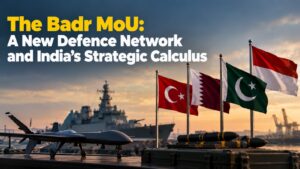
Western analysts tend to react in predictable ways when non Western powers sign new security agreements. The usual move is to dust off old Cold War ideas and slap some dramatic label on it, like calling every Muslim majority defense pact a Muslim NATO. You saw this exact reaction when Turkiye, Qatar, Pakistan, and Indonesia signed the Badr Memorandum of Understanding in Doha. But honestly, this shorthand just misses what is really happening in global politics today. The Badr agreement is not an ideological military bloc. It is not some expeditionary alliance ready to march under a single flag. Instead, it is something much more practical: a defense industrial consortium, a new kind of collective that matches the realities of a multipolar world.
To actually understand what Badr is, you have to see it alongside the Mecca Pact that Saudi Arabia, Turkiye, and Pakistan signed earlier. The Mecca Pact is straightforward, classic collective security. Attack one, and the others come to your defense. It lays out who is in, what the rules are, and even spelled out mutual defense obligations when things heated up in the Middle East not long ago. Badr is different. Mecca draws the battle lines and promises backup. Badr builds the machinery. Mecca is about standing together in a crisis; Badr is about building the hardware, the factories, and the tech that keeps these alliances supplied and ready.
Look at the map: Badr stretches from West Asia to South and Southeast Asia. Each country brings unique strengths. Turkiye serves as the tech powerhouse, already producing advanced drones, modern warships, and avionics. After enduring years of embargoes, Qatar shows up with capital and a drive to secure reliable domestic procurement. Pakistan brings in its well tested military, affordable engineering, and heft in making munitions. Indonesia joins with its huge scale, challenging terrain, and ambition to acquire aerospace and naval technology while sticking to its independent bebas aktif foreign policy. None of these capabilities overlap, and together, they create a network much stronger than the sum of its parts.
Mecca draws the battle lines and promises backup; Badr builds the hardware, factories, and tech that keep alliances supplied and ready.
The timing of Badr is not random. There is a clear lesson here, learned the hard way across the Global South: buying Western weapons means you are also buying Western politics. Fancy fighter jets and missile systems often come with tricky conditions, think software locks, supply chains controlled far away, and the ever present threat of sudden export bans or embargoes based on political whims in Washington or Europe. So, Badr represents a push for real independence: a chance for member states to build joint supply lines and co produce what they need, shielding themselves from external pressure and arbitrary restrictions.
What makes Badr powerful is how it links what were once standalone deals into a big, coordinated system. Past projects like Turkish Pakistani ships, the Turkish Indonesian KAPLAN MT tank, and Turkish Qatari arms manufacturing did not really connect; Turkey always played the central broker. But imagine, now, Pakistani engineers working directly with Qatari investors in Indonesian shipyards, or Turkish and Indonesian firms swapping drone tech, all without a middleman. Badr aims to do exactly that, create a full scale, alternative supply chain outside the traditional Western sphere of influence.
Nowhere is this new pact being watched more closely than in New Delhi. Indian defense planners are not panicking about an immediate military threat, but Badr does pose a complex, growing challenge for their long term security calculations.
First, the pact undercuts the longstanding goal of India of isolating Pakistan militarily and outpacing it technologically. Pakistan has struggled to keep up financially, hampered by tight budgets and shrinking reserves. But with Badr, they are plugged into a co production ecosystem supported by Turkish expertise and Qatari funding. This gives Pakistan access to modern upgrades, better electronics, new naval gear, and drones, without footing all the research and development bills. It lets them keep up their deterrence posture far more affordably than before.
Badr undercuts New Delhi’s goal of isolating Pakistan militarily by plugging Islamabad into a co production ecosystem backed by Turkish tech and Qatari capital.
Second, the role of Indonesia in Badr creates some real headaches for the Act East policy of India and its growing role in the Indo Pacific. India has invested heavily in strengthening military ties with Indonesia, including selling them cutting edge missiles. Those deals come with strict legal and technical safeguards, but the decision of Indonesia to join a defense network that also includes Pakistan means India has to watch closely. There is now a potential risk, however slight, of sensitive technology or strategic trust leaking into the wrong hands, and it complicates the defense relationships of India throughout the region.
Third, with Badr, India faces new competition across West Asia and the Indian Ocean. Until now, India has built strong ties with the United Arab Emirates, Saudi Arabia, and other Gulf countries, partly to offset the influence of Pakistan. But if the manufacturing consortium of Badr manages to start exporting affordable, state of the art weapons throughout the Global South, it becomes a direct rival to the own ambitions of India to become a leading arms exporter with its Aatmanirbhar Bharat self reliance push.
Of course, big speeches and ceremonial signings mean little unless they translate to real world results. The real challenge for Badr lies on factory floors in Karachi, Surabaya, and Ankara. There are plenty of tough issues ahead: Western controls on key tech, intellectual property fights, and the nitty gritty of getting joint production lines running smoothly.
Still, brushing Badr off as just another empty gesture would be a serious mistake. The pact is a sign that middle powers are not willing to stay as mere customers or junior partners anymore. They are now building the nuts and bolts, the actual industrial engines, of their own independence and strategic power, shifting the balance across regions from the Gulf all the way to Southeast Asia.
About the Author
Ahan S. Prakash is a Geopolitical analyst and columnist covering South Asian affairs, strategic security, and international relations.