
Transactional Diplomacy, Sovereign Red Lines, and the Escalation of Proliferation Risks
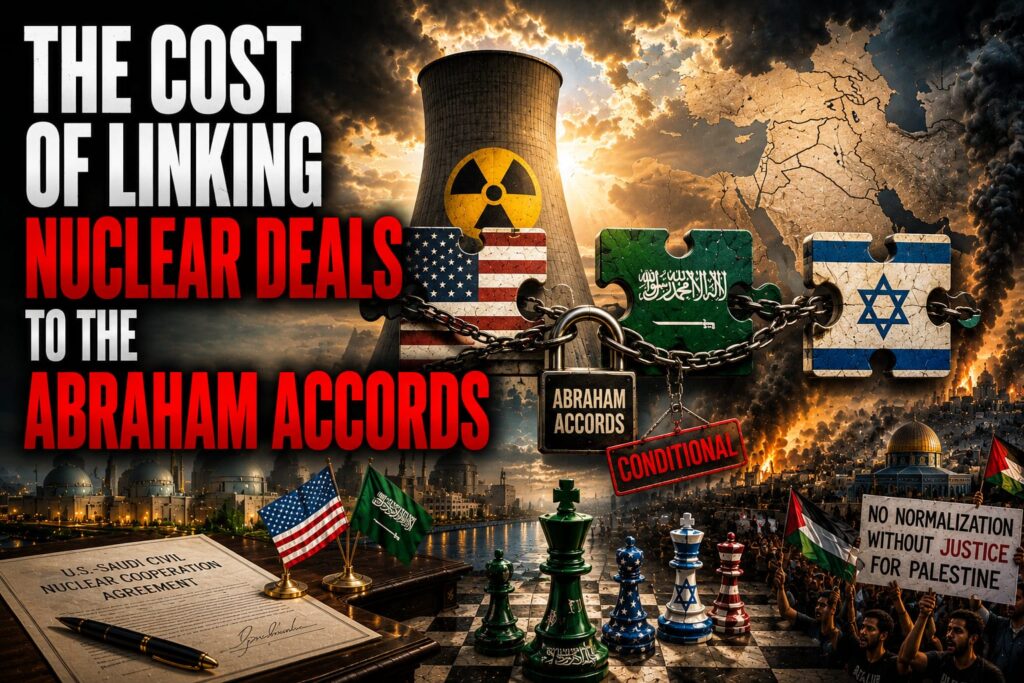
The ink on the multi decade US Saudi civil nuclear cooperation agreement was barely dry in Washington before the whole thing got turned upside down. In a sudden burst of transactional statecraft, Trump declared that the Section 123 pact, meant to lock in American corporate dominance in Saudi Arabia’s emerging nuclear sector through giants like Westinghouse, is now entirely contingent on Riyadh formally joining the Abraham Accords. What global markets initially celebrated as a huge win for commercial techno diplomacy and strategic alignment got instantly turned into a rigid ultimatum instead.
By tying a major strategic nuclear framework to immediate regional diplomatic normalization with Israel, Washington has basically walked straight into its own trap. Instead of acting as a catalyst for lasting Middle East peace, this linkage turns civil nuclear infrastructure into a blunt political weapon. In doing that, it badly misreads Saudi Arabia’s domestic red lines, stirs up regional security anxiety, and risks locking American foreign policy into a rigid, zero sum framework that doesn’t really work for anyone.
To understand just how big a miscalculation this is, it helps to look at how American foreign policy tries to merge commercial technology transfers with legacy building regional diplomacy. The civil nuclear agreement itself was designed to help Saudi Arabia move away from burning its own fossil fuels domestically as part of Vision 2030. By generating clean energy to power its rapidly growing economy, Riyadh wants to save more of its crude oil for lucrative export markets instead.
From a purely economic angle, locking down this partnership was supposed to anchor Saudi Arabia’s technological future firmly with American companies, shutting out competitors like China and Russia from a critical piece of Gulf infrastructure. But by suddenly layering a politically explosive precondition on top of this complex economic arrangement, the White House shifted the whole conversation away from commercial viability and straight into the much more treacherous territory of regional identity politics.
“The exact tool meant to bind Riyadh closer to Washington ends up alienating its leadership instead, proving that blunt transactional coercion is a poor substitute for genuine, long term strategic empathy.”
This whole approach really shows a misunderstanding of how modern sovereign states actually manage their national security priorities. Treating high tech industrial cooperation like some simple real estate deal you can just reshape through a sudden social media post is a genuinely risky mistake.
It also exposes some deep cracks in Western strategic thinking about the Middle East, particularly a persistent habit of underestimating the domestic political limits inside absolute monarchies. Washington’s foreign policy machinery has long assumed that big enough economic and military incentives carry enough gravitational pull to override local ideological sensitivities. But the current leadership in Riyadh, led by Crown Prince Mohammed bin Salman, is operating under a dual mandate right now, aggressive modernization on one side and nationalist legitimacy on the other.
While Vision 2030 needs cutting edge foreign technology to work, state survival and regional prestige still require sticking to core pan Arab principles. By demanding Saudi Arabia swallow a bitter diplomatic pill in exchange for civilian nuclear reactors, American diplomacy has accidentally boxed the kingdom into a corner where compliance carries domestic political costs that badly outweigh the technological upside. That creates a real paradox.
The fallout from this forced linkage goes well beyond hurt feelings or delayed corporate contracts. It cuts right to the heart of regional stability and international non proliferation norms. When foundational high tech agreements get subjected to the whims of electoral politics, the predictability of the whole international order takes a hit. Regional rivals watch these unpredictable shifts with real alarm, reading the mix of nuclear technology transfers with exclusionary security alignments as something close to an existential provocation.
At the core of this whole miscalculation is a badly misread set of Saudi priorities. In the simplified worldview of transactional diplomacy, everything’s negotiable. But Crown Prince Mohammed bin Salman’s government has held firm on one point consistently, formal normalization with Israel stays strictly conditional on a credible, irreversible, internationally backed path toward Palestinian statehood.
“For the kingdom, accepting a landmark nuclear deal under obvious coercion tied to immediate normalization with Israel… would project serious political weakness. It would badly undercut the regime’s own claim to regional and Islamic leadership.”
By tying the nuclear agreement to a deal that completely bypasses that core pan Arab and domestic priority, the White House has put Saudi leadership in a genuinely impossible political spot. For the kingdom, accepting a landmark nuclear deal under obvious coercion tied to immediate normalization with Israel, especially with regional turbulence, humanitarian suffering in Gaza, and intense public feeling over Palestinian rights all still very much live, would project serious political weakness. It would badly undercut the regime’s own claim to regional and Islamic leadership.
So this heavy handed conditional demand doesn’t actually push Riyadh to yield or rush to the table. Instead, it just completely freezes the whole agreement. It alienates key Saudi decision makers who see their technological modernization as an absolute sovereign right, not some flexible bargaining chip, turning what should have been a genuinely historic economic partnership into a stalled diplomatic standoff.
On top of all that, trying to manufacture leverage through nuclear cooperation ignores just how diversified Saudi foreign policy has become in a multipolar twenty first century. Unlike decades ago, when Riyadh really had nowhere else to turn for advanced technological security infrastructure, today’s global landscape offers alternative partners who are more than happy to skip the political lectures in exchange for a commercial foothold. Beijing and Moscow both maintain solid, cooperative relationships with the Gulf, backed by real nuclear capabilities and none of the democratic or diplomatic conditions that come with dealing with Washington.
By tacking on rigid, politically explosive preconditions tied to the Abraham Accords, Washington risks pushing Riyadh straight into the arms of its strategic rivals instead. The assumption that American technological supremacy is somehow irreplaceable creates a genuinely dangerous blind spot in Washington’s strategic thinking. If American leaders keep treating essential industrial cooperation like some kind of political loyalty test rather than a mutual economic necessity, they’re going to find out that Saudi Arabia is perfectly willing to walk away from the table, diversify eastward, and leave American companies locked out of one of the most lucrative energy transformation markets of the modern era.
Beyond the immediate diplomatic standoff and commercial friction, using a civil nuclear pact as a tollbooth for the Abraham Accords creates a much bigger global hazard too. A civil nuclear agreement of this scale already faces intense scrutiny from arms control experts, watchdog groups, and international lawmakers over its oversight and monitoring protocols. Injecting a deeply polarizing normalization demand into an already sensitive nuclear equation compounds that risk exponentially, turning a delicate technical file into a chaotic political football.
When crown jewel dual use technology gets tossed into the turbulent waters of Arab Israeli normalization politics, the integrity of the broader global security architecture takes real damage. Regional rivals and neighboring states don’t read this maneuver as a sincere peace building effort. They read it as an aggressive realignment that dangerously merges advanced nuclear capability with a hostile security setup. That builds an environment of genuine strategic mistrust, where technical safeguards get viewed through a lens of suspicion rather than objective scientific verification, which only lowers the threshold for regional proliferation anxiety even further.
At the end of the day, this whole linkage shows the danger of treating foundational security agreements and advanced technology frameworks as just another extension of high stakes political negotiation. By tying the delicate future of nuclear stability to a diplomatic shortcut that may never actually arrive, Washington risks building a towering geopolitical mirage, one that alienates its most important Gulf partner while pushing the Middle East closer to a dangerous, unchecked arms race.
Chasing quick diplomatic wins through coercive linkages like this ultimately weakens the very alliances it’s supposed to strengthen. Policymakers in Washington need to face a sobering truth here, nuclear diplomacy needs a foundation of real strategic trust, careful institutional safeguards, and genuine respect for sovereign red lines, not the shifting winds of opportunistic political theater. Failing to grasp that isn’t just going to sink the prospects of a US Saudi nuclear deal. It’s going to leave an already unstable Middle East even further unmoored from the structural guardrails that international security actually depends on.