
Youth Uprising, Structural Decay, and the Limits of Majoritarian Control
When a political regime spends over a decade perfecting a system built on fear and controlling the narrative, it rarely expects to get taken down by laughter and satire instead. But that’s basically what happened when New Delhi’s Jantar Mantar turned into a stage for genuinely high energy youth defiance recently. This weeks long student uprising, sparked by a broken education system and repeated exam paper leaks, ended up doing something far bigger than just forcing one cabinet minister to resign. It exposed the fragile cracks running through a state that built its entire political dominance on division, economic neglect, and calculated majoritarianism.
For years, the ruling Bharatiya Janata Party carried an aura of pure invincibility. It built a political machine that took economic distress and soaring youth unemployment and redirected all that frustration into institutionalized prejudice instead. Whenever dissent showed up, the state ran a pretty reliable playbook. Lower caste scholars got isolated, student activists got branded as subversives, and religious minorities got painted as internal enemies. National media routinely acted as a megaphone for official messaging, turning every crisis into a story about national security instead of accountability.
This time, that whole machinery broke down. The protests were anchored by urban, middle class Hindu students from the northern Hindi belt, a group long considered the ruling party’s core base. Their own parents, many of whom admitted to voting for Prime Minister Modi in past elections, openly said they’d become completely disillusioned. Protests broke out across Maharashtra, West Bengal, Manipur, and the southern states too, proving the anger stretched well past regional and linguistic lines.
“The reference was aimed squarely at the state’s ideological hostility toward interfaith marriage, drawing an explicit parallel to historical laws that sorted citizens into rigid, mutually exclusive racial and religious categories.”
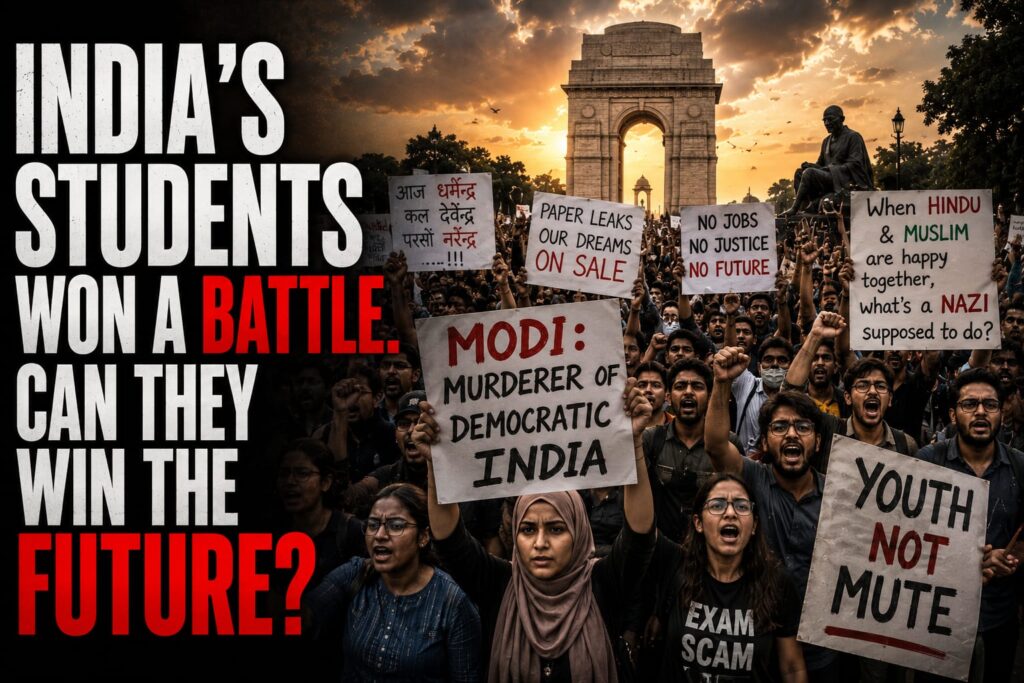
The movement actually brought back something like the inclusive spirit of Indian democracy in the process. Sharp slogans and biting parodies rang out through the crowds. Striking images filled public spaces, including one of a woman in a hijab holding a sign reading, MODI: Murderer of Democratic India. Another poster took a jab at the state’s policing of interfaith relationships with a sharp rhyme, roughly translating to when Hindu and Muslim are happy together, what’s a Nazi supposed to do.
Underneath all the biting humor sat a genuinely devastating human cost. At least twelve students died by suicide, pushed to despair by a corrupt exam system where question papers were leaked and sold openly on black markets. Millions of young people had poured their families’ life savings into degrees that ended up leading nowhere. When the government tried to just ignore the protests, students responded with dark humor instead. Two protesters in the Delhi subway held up a sign predicting the regime’s political decline step by step, joking that today it’s Dharmendra, tomorrow Devendra, and the day after, Narendra himself.
Education Minister Dharmendra Pradhan’s forced resignation on July 25 marked a rare, genuinely humiliating retreat for a government that prides itself on never backing down from anything. To manage the fallout, the administration announced a high powered task force under technocrat Nandan Nilekani to reform the national exam framework. But swapping out a loyal minister and standing up a committee doesn’t actually fix the structural decay sitting underneath public education. State funding for education remains well below international benchmarks, public schools keep closing, and private tuition costs keep climbing.
This whole revolt highlights the deep social and economic cracks that majoritarian politics tries so hard to paper over. India has the largest youth population in the world, yet its economic growth just isn’t generating formal jobs to match. The state tried substituting economic security with religious nationalism, betting that communal pride could indefinitely mask real material hardship. This student movement proved that once economic desperation hits a boiling point, that kind of majoritarian solidarity just collapses.
“The last time India saw a student rebellion on this scale was in Gujarat back in 1974. That movement spread to Bihar and grew into what became known as the Total Revolution against Prime Minister Indira Gandhi’s stagnant administration.”
History offers a pretty sobering perspective on what might come next here. When judicial rulings threatened her hold on power, Gandhi declared a national Emergency in 1975, suspending civil liberties and jailing opposition leaders outright. Two years later, voters threw her out decisively at the ballot box.
Dismantling the current political setup, though, is a far more complicated task. Over the past twelve years, the ruling party has built an ecosystem reaching deep into state institutions. Key oversight bodies, parliamentary leadership, and parts of the judiciary have all aligned closely with the executive’s agenda. Countering something this entrenched is going to require sustained political mobilization across every corner of society, not just a few weeks of protest.
This student movement is still limited by fairly narrow immediate demands, similar to earlier protest movements in India. When Sikh farmers blockaded the borders of New Delhi for over a year to force the repeal of three controversial agricultural laws, they lost roughly 700 lives to harsh weather and state action along the way. Those farmers had a clear organizational structure and real economic leverage behind them. Students, while agile and digitally sharp, are going to need to build lasting institutional bridges if they want to turn this moral victory into actual structural political change.
The broader opposition parties now face a real test of their own. They need to show whether they can actually channel this youth anger into a coherent political alternative, or whether they’ll just let the regime claw back control through the same old divide and rule tactics. The government will almost certainly try to win back lost ground by stoking regional, caste, and religious rivalries all over again.
What the students actually pulled off at Jantar Mantar was puncturing the illusion of political invincibility. They proved that humor and solidarity can cut through a compliant media and break through a climate built on fear. By refusing to take the bait of religious polarization, they forced the state to actually confront its own governance failures for once. Whether this momentum turns into a permanent shift in the political landscape is still uncertain. But as the students showed on the streets of Delhi, a genuinely formidable movement has taken its first real steps, and well begun really is half done.