
Keeping the peace was a delicate act of constant maintenance. It survived, to date, thanks to mediators who stayed patient, ensuring diplomatic lines never went dead. They tried to bridge deep divides by carefully timing each concession and stepping in during heated moments to prevent a return to full-blown fighting. Despite all these efforts, the negotiations remain stalled, not for lack of facilitation, but for lack of flexibility, with each side waiting for the other to concede first, turning a managed pause into an impasse.
The dangerous aspect of this moment is not the absence of a ceasefire, but its hollow persistence. Into this fragile equilibrium steps Donald Trump with yet another shortsighted plan under the name “Project Freedom.” It is a move framed as humanitarian that is, ironically, operationalized through a visible military footprint. A step meant to stabilize the situation is instead accelerating the resumption of war.
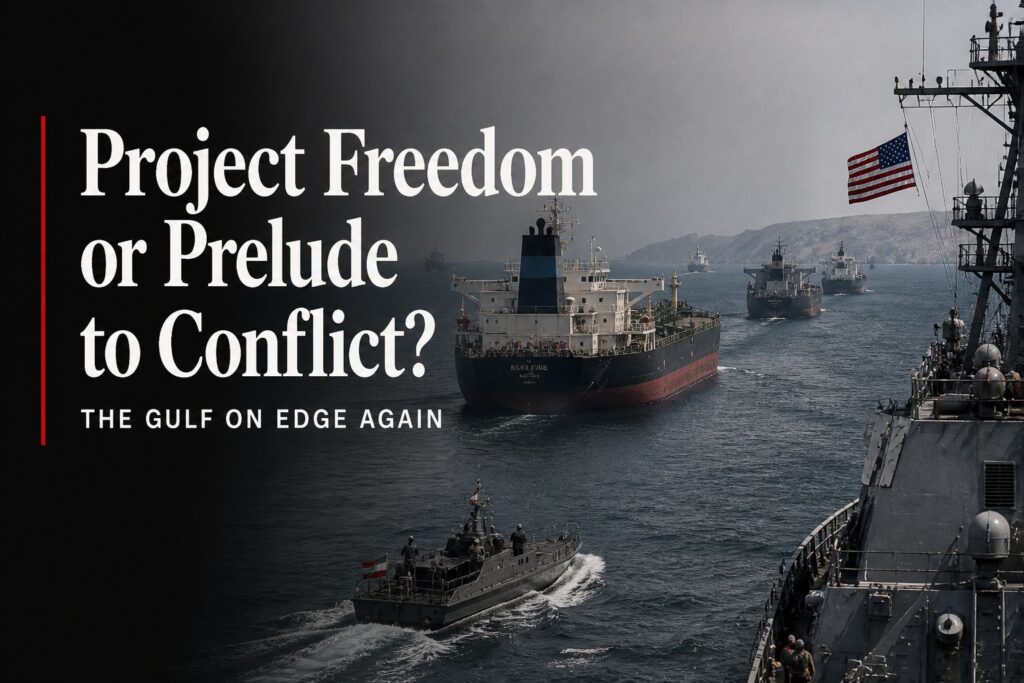
By deploying naval assets to guide stranded cargo ships, Washington is trying to take back the reins of a major shipping route. But from Iran’s perspective, seeing foreign warships nearby, no matter the excuse, feels like a direct hit to their sovereignty. The response, therefore, is predictable, warnings and calibrated acts of resistance aimed at showing resolve without triggering outright war.
The current dynamics are a strategic seesaw. On one hand, the U.S. frames its involvement as a mission to keep global trade moving; on the other, Iran insists it’s just doing what’s required to hold the line at its borders. Between both sides lies a narrowing space where diplomacy once operated.
In this context, Project Freedom intersects directly with the diplomatic deadlock. Altering the operational environment in the Strait will risk hardening positions. For Iran, any concession under visible military pressure carries the cost of perceived capitulation. For the US, going home without tangible gains risks appearing weak. Both sides are locked into their postures.
Military assets are operating in close proximity. What is unfolding, then, is the return of a war footing. In such an environment, the margin for error shrinks. A misinterpreted maneuver can escalate faster than political mechanisms can contain it.
The language surrounding the crisis, however, is worth heeding. Terms like humanitarian, guidance, and restoration of transit create a narrative of control and benevolence. But the reality is more ambiguous. Commercial vessels are forced to navigate geopolitical constraints, uncertain of which authority to heed, which signal to trust, and how close they are to becoming collateral damage for the decisions they cannot control. The fate of people stranded with vessels depends upon every next move.
The tools for peace are present. The mechanisms exist, the channels are open, and the facilitation has been consistent. But without political will from the principal actors, even the most skillful mediation cannot produce convergence. Thus, each side is making its own calculations to yield a more favorable outcome than compromise.
Unless the current trajectory is changed and unless pressure is matched by genuine engagement, the Strait of Hormuz will remain more than a chokepoint for energy. It will become a symbol of a collective failure. The failure of power to translate into stability, and of opportunity to evolve into peace.