
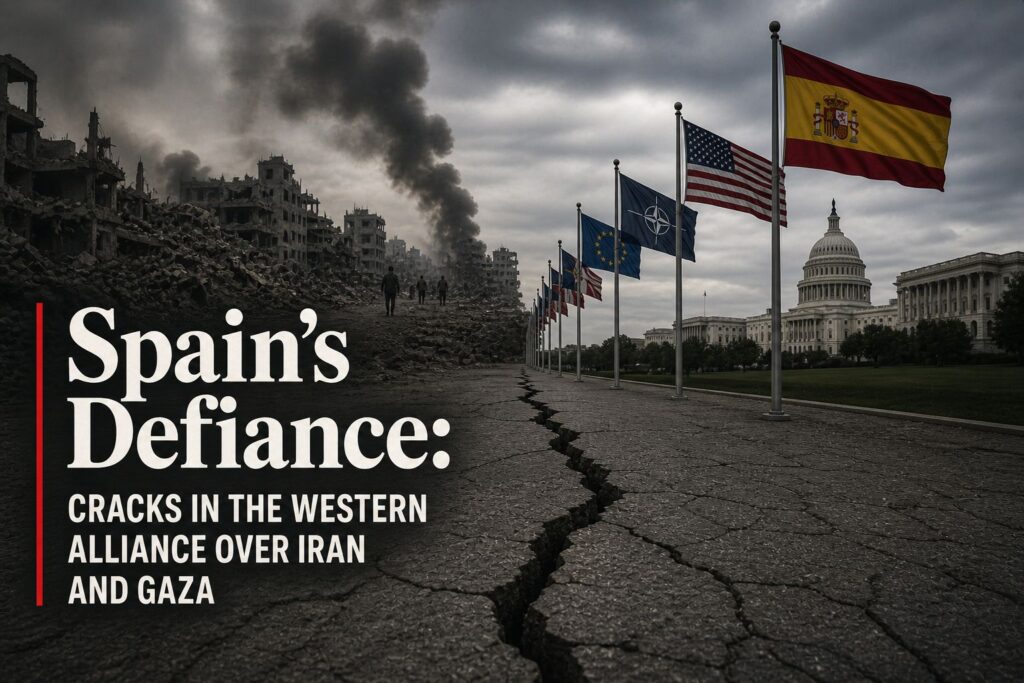
Spain’s defiance the United States and Israel over Iran and Gaza war is not just a routine diplomatic disagreement, it’s actually poking a hole in the foundation of the Western alliance. While most of NATO and the EU are playing along with Washington’s playbook, Prime Minister Pedro Sánchez has chosen confrontation over compliance. The result is one of the biggest rifts we’ve seen across the Atlantic in years.
Spain’s position lies in a legalistic argument. They’re saying out loud what others might be whispering: that recent US and Israeli military actions in Iran, Gaza, and Lebanon are against international law. But Spain isn’t just paying lip service; they’re taking action. By shutting down their airspace to U.S. planes involved in the Iran campaign and limiting access to major bases like Rota and Morón, they’ve done something almost unheard of for a NATO member during an active conflict
This creates a massive headache for the US policy makers. Moving operations to places like Ramstein in Germany makes everything more expensive and complicated. More than that, it shatters the idea that the U.S can always count on Europe to fall in line. Spain even went as far as pulling its ambassador and cutting off arms sales to Israel, moves most European leaders are too nervous to make. Sánchez knows this could lead to economic blowback from the US, but he seems willing to pay that price to stick to his guns
So, why, then, is Spain standing alone within the European Union? Part of the answer lies in domestic political calculus. Sánchez’s coalition leans hard into humanitarian norms and international law, and the Spanish public is largely on board, especially after Spain officially recognized Palestine.
However, geographic position is equally important. Unlike Poland or the Baltics, Spain isn’t staring down Russia every day. Because they don’t rely on the U.S as a primary shield against Moscow, they have more “breathing room” to disagree.
There is also an economic dimension. Spain’s trade with the United States, while significant, is less critical than that of some northern European economies. Since the trade with the U.S. is not the only thing keeping its economy afloat, Spain seems to be working on long-term reputational values, positioning itself as a defender of international law. Particularly, in the Global South, where people are increasingly tired of what they see as Western double standards.
By calling out US-Israeli actions as illegal and unjust, Spain is highlighting a sensitive point: that the rules-based international order comes into play only when it’s convenient for the West. Washington is clearly annoyed and has hinted at economic pressure, but their hands are somewhat tied. NATO doesn’t really have a punishment button for members who disagree.
Ultimately, Spain’s defiance isn’t just about the specific wars in the Middle East. It’s about rewriting the rules of the Western alignment. By putting legal principles ahead of strategic loyalty, Spain is testing whether a middle power can challenge dominant narratives without being marginalized. Regardless of consequences, Spain has already introduced a rare element of dissent into a disciplined bloc. Whether other countries join them or not, the door for dissent is now wide open.