
Sanctions were imposed to suffocate them. Instead, they have learned to breathe in the dark. Western powers unleashed an unprecedented wave of economic restrictions on Russia after Feb 2022, with clear punitive expectations: isolate, weaken, and cripple Russia’s fighting capacity. Banks were cut off, advanced technologies blocked, and the oil economy targeted. Apparently, it was a massive sanctions onslaught in modern history. However, reality reveals a different story: the global economy is adept at adaptation. This is where a quiet reconfiguration of global trade routes comes into play, leading to a shadow system that thrives on economic warfare.
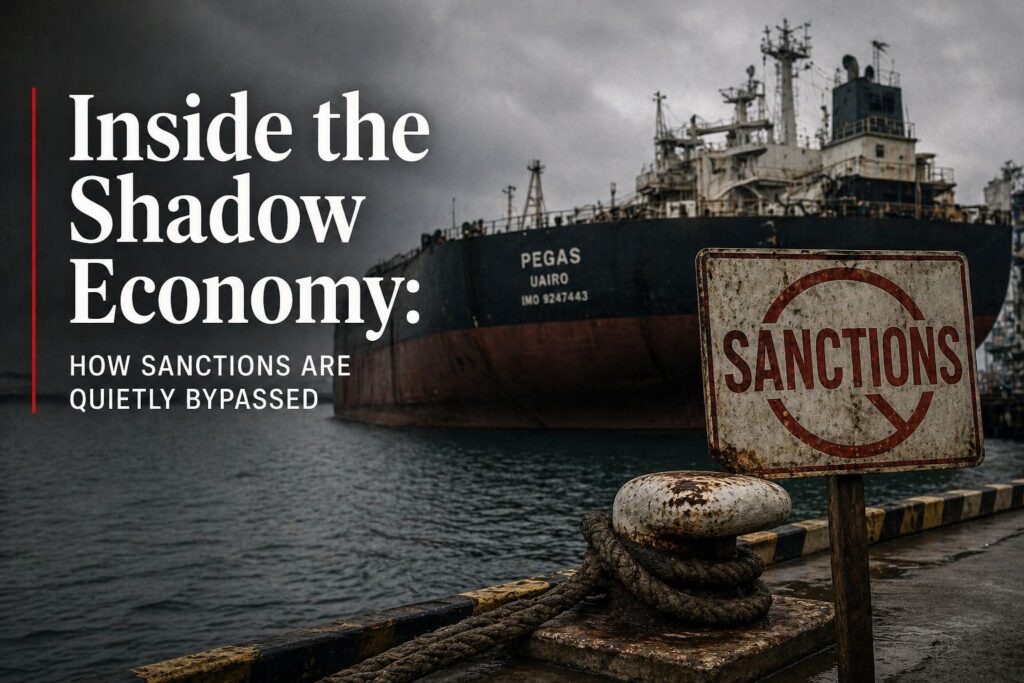
The most significant pillar of this system is energy supply. Despite price caps and embargoes, Russia is the World’s second-largest oil exporter, trailing only Saudi Arabia. The G7-led price cap, adjusted to $44 by early 2026, aimed to limit Russia’s revenue. Yet enforcement remains ineffective. A shadow fleet of aging tankers, operating without insurance and frequently disabling tracking systems, now carries a significant share of Russian crude.
Iran is also a notable example, operating a comparable dark fleet of over 300 tankers using ship-to-ship transfers, obscuring ownership to keep oil flowing above sanctions. Nearly 190 million barrels of oil sit unsold on shadow tankers at sea, a floating reserve that highlights the fragility of enforcement. Oil that remains on water makes global markets vulnerable to sudden disruptions, forcing Western powers to stay cautious about tightening sanctions too aggressively.
But the oil is only a part of a broader picture. Trade networks have reorganized across the globe. China has become a vital lifeline for the countries surviving under sanctions. It supplies Russia with machinery, electronics, and dual-use restricted goods. Crucially, sanctions have forced the two to shift away from the dollar. China’s cross-border interbank payment system is gaining prominence as an alternative to SWIFT. It is not just a tactical evasion, but a structural shift in the global financial order, accelerated by sanctions.
On the other hand, India is playing a very interesting game. It imports discounted Russian crude, refines this oil, and re-exports petroleum products to global markets with significant profit margins. This strategy is widely described as “sanctions arbitrage.”
Even more shadowy is the rise of parallel financial systems. Sanctioned countries are increasingly relying on cryptocurrency flows and other such channels to withstand financial isolation. North Korea is arguably the most heavily sanctioned country in the world, which has turned cybercrime into statecraft, stealing over $1.6 billion in cryptocurrency in 2025 alone to sustain its economy.
Analysts argue that sanctions have developed alternative economic systems and hardened economic resilience, often at significant social cost. The consequences of sanctions extend beyond targeted states. Spillover costs expose a fundamental paradox, where sanctions intended for a specific target end up restructuring international markets.
What this suggests, then, is the unintended consequences of sanctions. Instead of being clear instruments of economic pressure, they function as a driving force behind the creation of alternative networks, currencies, and alliances that operate beyond traditional oversight. And in this shift, the burden often falls not on states, but on societies. Hence, as long as economic pain is unevenly distributed, the shadows will continue to grow.