
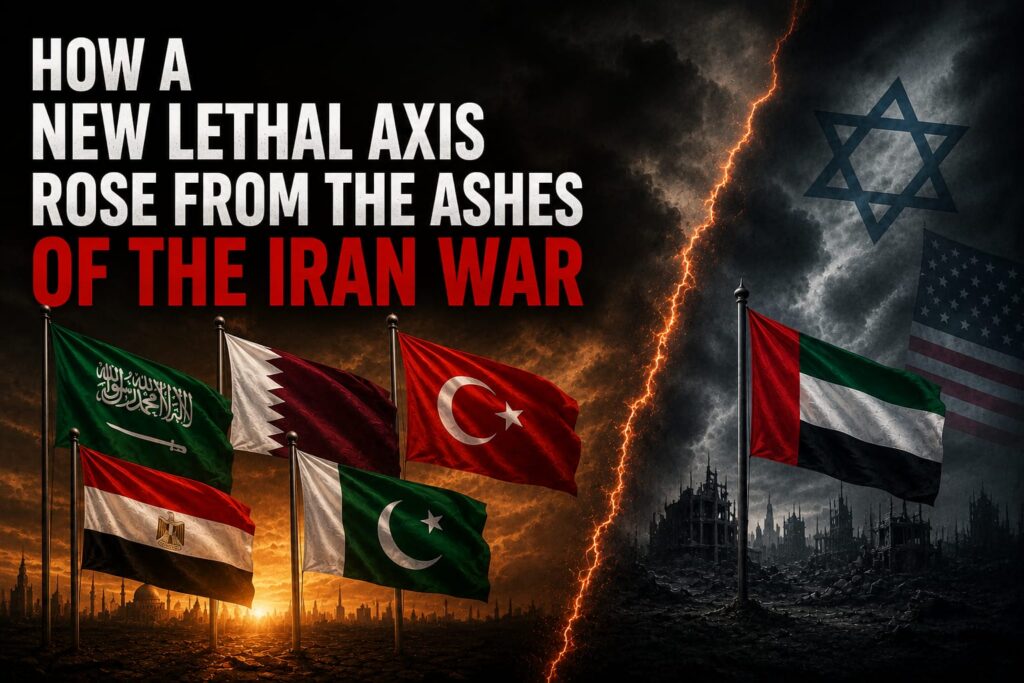
The geopolitical architecture of the Middle East has undergone a profound realignment, accelerated by the devastating friction of the recent Iran war. A new diplomatic and strategic bloc has quietly crystallized outside the traditional confines of the Gulf Cooperation Council. This emerging coalition brings together Saudi Arabia and Qatar alongside major non-Gulf powers, including Egypt, Pakistan, and Turkey. Conspicuously absent from this grouping is the United Arab Emirates, highlighting a deep and widening strategic fracture between Riyadh and Abu Dhabi. The formation of this new axis signals that the war has fundamentally reordered regional security politics, creating a powerful framework that extends well into the broader Islamic world.
This newly formed bloc is driven by clear strategic necessities. The participating states seek to collectively regain political and diplomatic influence across regional theaters while simultaneously serving as a deliberate diplomatic bulwark designed to push back against Israeli military adventurism and define strict limits to its expansion. The impetus for this cooperation sharpened significantly following Israel’s cross-border strike on Doha, which was aimed at hunting Hamas members. That operation deeply alarmed neighboring Gulf capitals, fostering an unprecedented convergence of interests between former regional rivals like Riyadh and Ankara. Underpinning this entire security architecture is Pakistan’s conventional military weight and nuclear capability, which effectively provides a strategic umbrella under an expanded, long-standing defense framework.
While Israeli security reports frequently label this grouping a “Sunni alliance” or an “expanding Islamic NATO,” its emergence is rooted in a fundamental divergence of economic and political visions. As the major Gulf economies attempt to aggressively diversify away from an oil-based model, Saudi Arabia and the United Arab Emirates find themselves in direct, intense competition for identical pools of foreign direct investment. This economic rivalry has shattered the post-Arab Spring consensus where Riyadh and Abu Dhabi moved in lockstep against common political threats. Today, the strategic gap is stark: the UAE remains fully committed to its normalization path with Israel, while this new five-nation alignment has gathered an explicitly Israel-critical collective.
The economic fallout of the conflict illustrates why these states have opted for a new model of collective resilience. Saudi Arabia successfully exploited the resulting energy crisis. With the vital Strait of Hormuz shut down by hostilities, the value of Saudi petroleum exports recorded a dramatic three-year surge. As global oil prices spiked from $74 to over $119 a barrel, the state-owned oil giant Saudi Aramco witnessed a massive 26 percent jump in net profits during the first quarter of the year. This financial windfall was enabled by the strategic utilization of the East-West Pipeline, which bypassed the blocked gulf by operating at its full capacity of 7 million barrels per day toward the Red Sea coast.
Yet, this energy boom came with domestic trade-offs. The kingdom’s overall GDP growth slowed to 2.8 percent down from 3.7 percent as numerous domestic wells were forced to shut down during the rerouting of supply lines. This economic friction has permanently altered the kingdom’s long-term planning, driving massive new infrastructure investments along its western coastline.
Qatar has similarly transformed its regional standing through the crucible of this war. Once ostracized and blockaded by its neighbors during the 2017 diplomatic crisis, Doha has successfully emerged as an indispensable diplomatic arbiter. The realities of the conflict, including severe geographical constraints and the evident inability of Washington to entirely shield the Gulf from incoming ballistic salvos, led Qatari leadership to conclude that proactive diplomacy offered the best path forward. This calculation was reinforced when a targeted strike shut down the vital Ras Laffan refinery, one of the premier liquefied natural gas infrastructure facilities on earth, instantly knocking out an estimated 17 percent of Qatar’s total export capacity.
Recognizing the limits of purely military solutions, Doha threw its full weight into intense mediation efforts. When initial peace tracks faltered, Qatari diplomats successfully managed high-stakes negotiations in Switzerland. At a luxury resort overlooking Lake Lucerne, negotiators endured a grueling 18-hour session involving U.S. Vice President J.D. Vance, Trump administration advisors Steve Witkoff and Jared Kushner, and chief Iranian negotiator Mohammad Bagher Ghalibaf. A person familiar with the closed-door proceedings noted that even as the principals sat down for talks, “there were tensions over Lebanon.” Qatari mediators successfully extinguished these last-minute fires, leveraging their open channels to secure a Hezbollah cease-fire statement while simultaneously pressuring Washington to restrain Israeli forward operations.
The other members of this five-nation axis are moving rapidly to lock in their own strategic dividends from the post-war landscape. Egypt is positioning itself to be the primary beneficiary of a massive Saudi infrastructure push, which includes finalized plans to construct a monumental bridge over the Red Sea to the Sinai Peninsula. This project is explicitly designed to convert Egypt’s Mediterranean coast into a primary logistic gateway to European markets. Turkey is capitalizing on the region’s pervasive anxiety by aggressively boosting its advanced arms sales to states looking to rapidly upgrade their defense posture. Pakistan, for its part, has solidified its role as a pivotal stabilizer in the regional defense architecture, drawing positive international coverage for its balanced diplomatic maneuvering and constructive mediation efforts during the height of the crisis.
In stark contrast to this coordinated five-nation alignment, the United Arab Emirates has chosen a path of isolated, hyper-specific alignment with external powers. The country endured an unmatched level of destruction during the conflict, absorbing more than 3,000 missile and drone strikes, a figure that far surpasses the combined total of attacks directed at the other five GCC members. This intense bombardment left Abu Dhabi profoundly shaken, with Emirati leadership openly favoring a prolonged, decisive military campaign by the United States to permanently cripple regional adversarial capabilities before any truce was enacted.
To survive this onslaught, Abu Dhabi relied heavily on its relationship with Tel Aviv. Reports indicate that the UAE actively received critical defense hardware from Israel during the height of the war, including an entire “Iron Dome air defense system with troops to operate it.” This direct military cooperation has permanently bound the UAE’s security architecture to Israel, locking it into a pro-Israel camp. Meanwhile, the five-nation axis views Israel’s unchecked military adventurism as a primary force of regional instability that must be actively contained and countered through collective diplomatic and military deterrence.
Ultimately, the emergence of this new five-nation axis reveals a fundamental truth about the modern Middle East: the era of unified Arab action through traditional institutions like the GCC is entirely over. The region has split into two distinctly irreconcilable camps over how to manage its collective security. One side seeks a separate peace and integrated defense systems with Israel, while the other has assembled a diverse, powerful coalition spanning from Ankara to Islamabad to enforce a more cautious, autonomous balance of power. As these nations begin planning a comprehensive regional summit to dictate the terms of the post-war order, the deliberate exclusion or hesitation of the UAE confirms that the future of the Islamic world will no longer be dictated by old alliances, but by this newly forged axis of structural survival.