
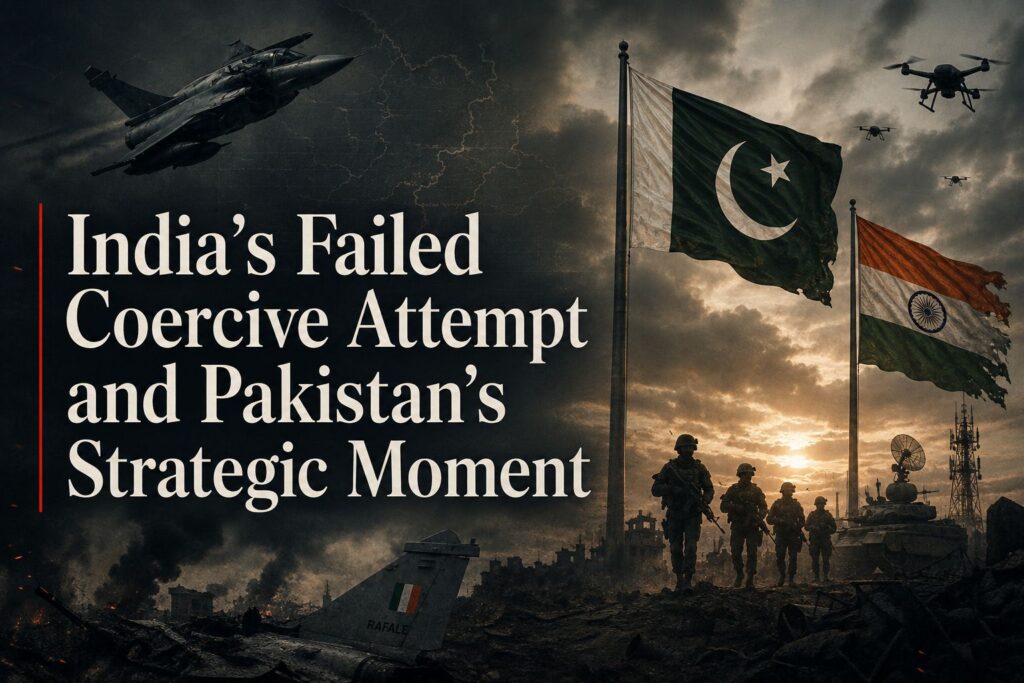
One year on, the May 2025 confrontation between India and Pakistan remains significant not because it altered borders or produced a decisive military victory, but because it disrupted a narrative. For years, the regional balance was discussed as though India’s rise and Pakistan’s relative decline were settled facts. This conflict changed that perception, revealing a landscape that is far more volatile and layered than the experts had ever anticipated.
The crisis began as another familiar cycle of escalation, but it evolved into something more consequential, a test of whether military scale automatically translates into strategic advantage. India’s leadership appeared confident that limited force could be employed without triggering a proportionate response. However, the conflict exposed the risks inherent in that assumption.
Pakistan’s strategy was not about heroics, it was a symphony of tactical synergy. What really caught observers off guard was how seamlessly they blended airpower and drones with cyber tactics and a very controlled information game. Even analysts who usually side with India had to admit that Pakistan’s level of technical coordination was impressive. It basically shaken the old assumption that there was a massive, unbridgeable gap between the two militaries.
The most damaging aspect for New Delhi was the reports of Indian aerial losses, particularly the Rafale fighter jets that had come to represent India’s technological edge. While precise battleground claims remain disputed, the strategic impact was palpable. The aura of unquestioned superiority attached to India’s most expensive defense acquisitions weakened considerably. In modern warfare, perceptions matter almost as much as confirmed numbers.
The way both sides handled the information front was just as telling as the military action itself. Pakistan remained unflappable, projecting a sense of restraint and a clear procedural script that focused on de-escalation. India, on the other hand, went the theatrical route. Their media coverage, full of flashy claims, eventually started to undermine New Delhi’s international credibility. In a world, where wars are fought on TikTok and X just as much as on the borders, the side that stays composed and coherent usually ends up winning the diplomatic argument.
That diplomatic dimension became apparent as the crisis unfolded. Pakistan maneuvered diplomatically to frame its actions as controlled, proportional retaliation rather than uncontrolled escalation during the nuclear standoff. This positioning aimed to de-escalate tensions while asserting a firm, measured response. Several international actors quietly viewed Pakistan’s signalling as more measured than expected. This subtle shift mattered because Pakistan has long struggled against an international image shaped primarily by security crises and instability.
The economic side of the conflict also highlighted some surprising facts that often get lost in the usual strategic chatter. While both countries felt the heat, India’s deep ties to global finance actually made it more vulnerable to the sudden panic of international investors and massive capital flight. Reports of billions being pulled out of Indian markets during the brief clash proved that geopolitical instability can instantly shake the foundations of a “great economic power” narrative. In contrast, during the clash, the Pakistan Stock Exchange saw a historic 9.45% single-day gain, a clear signal of renewed domestic and investor confidence in the country’s ability to manage high-stakes pressure.
This four-day military crisis proved to be a huge strategic shift. For a long time, there was this idea that India could just use its size to bully Pakistan into a corner. But this conflict flipped that script. Pakistan showed its deterrence, proving that conventional pressure will not work.
Pakistan’s timing could not have been better. With growing Middle East crisis and global powers reshuffling, Pakistan repositioned itself as a key diplomatic bridge-builder. We can clearly see that new confidence in how it is handling regional talks.
None of this suggests that Pakistan emerged without vulnerabilities. Its economic challenges remain serious, and no military success can substitute for long-term structural reforms. Nor does the conflict erase India’s larger economic and military advantages. However, the events of May 2025 demonstrated that regional power in South Asia cannot be measured through size alone.
The crisis demonstrates that modern deterrence depends upon credibility, coordination, and strategic discipline rather than solely on advanced military capabilities or political rhetoric. By challenging India’s effort to reinforce a regional hierarchy, the confrontation narrowed the perceived psychological distance between regional actors. That may ultimately prove to be the war’s most lasting consequence.