
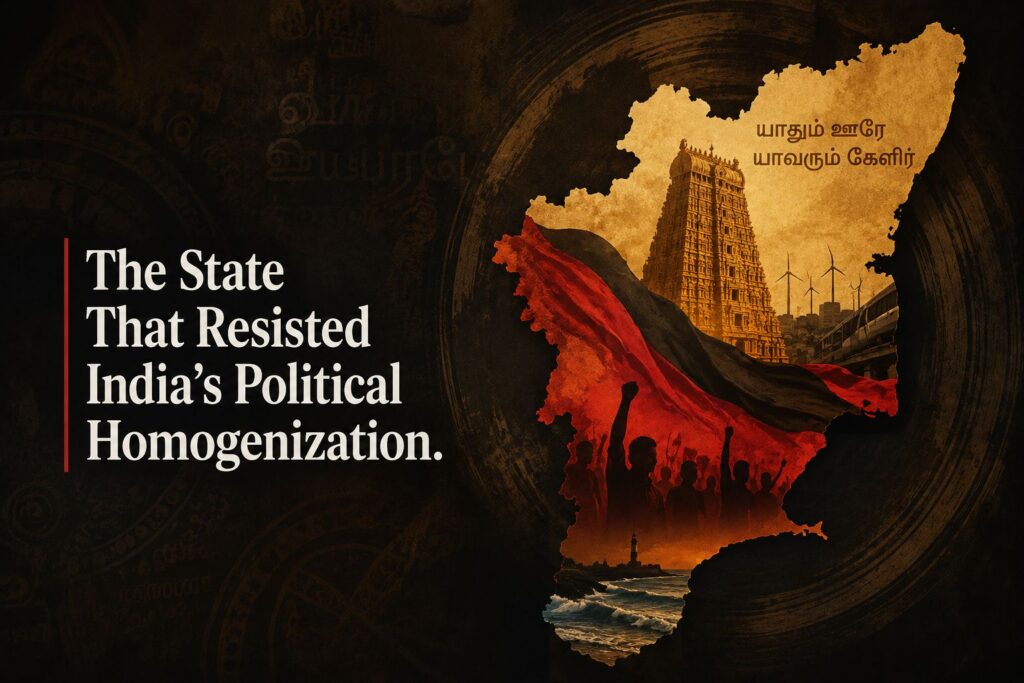
The rise of Joseph Vijay from Tamil cinema superstar to Chief Minister of Tamil Nadu is being celebrated as a dramatic political change, but its deeper significance lies elsewhere. The 2026 election was not merely the arrival of another actor-turned-politician, it was a reaffirmation of the state’s long-standing resistance to majoritarianism and centralized political homogenization.
Tamil Nadu’s political identity, for almost six decades, remained like a locked room shared by two rivals, the DMK and the AIADMK. That decades-old deadlock did not just crack, it shattered. Vijay’s Tamilaga Vettri Kazhagam (TVK) success, therefore, represent a structural shift in the state’s politics. If you look past the shock of a newcomer toppling the old guard, the real story is much more interesting. It is about how the state managed to hit the reset button on its leadership without falling into the trap of the BJP’s brand of majoritarian politics. Tamil Nadu changed the players, but it kept its core values.
The BJP has been trying to get a foothold in Tamil Nadu by pushing a “one nation” vibe and focusing on shared religious roots. But Tamil Nadu proved to be a tough nut to crack. The state’s whole identity is rooted in the Dravidian movement, this deep-seated pride in the Tamil language, focus on social justice, and a “do not mess with our autonomy” attitude. Because these values are so baked into the culture, they have basically acted as a firewall against the kind of big-picture, majoritarian politics that usually work well in the North. Interestingly, the rise of Vijay has not helped the BJP find a shortcut, if anything, it seems to have doubled down on that local defiance, making the state’s political wall even harder to climb.
Since the TVK failed to secure simple majority the Congress and the Left parties, like the CPI and CPI(M), stepped in to fill the gap. However, this was not just a routine political deal. These parties were very vocal about why they were coming to rescue TVK, they wanted to make sure the BJP did not find a “backdoor” into Tamil Nadu. It was not about sharing power, it was about efforts to preserve the state’s unique, secular identity.
This is where Vijay’s slogan of “Secular Social Justice” becomes significant. It is clear that the party is trying to take the best parts of old-school Dravidian politics and give them a fresh spin for the younger crowd. By mixing classic welfare promises with a focus on things like government transparency, jobs for young people, protecting minorities, and keeping women safe, the TVK has carved out a unique space. They have certainly branded themselves as the alternative for anyone who is fed up with the status quo but also wants a firm stand against majoritarian politics.
Tamil Nadu manifests that strong regional political cultures are capable of resisting homogenization when they provide credible alternatives. The BJP’s inability to emerge as the central beneficiary of anti-incumbency in the state depicts the limits of majoritarian politics in regions with deeply embedded linguistic and social justice traditions.
However, Vijay now faces the difficult transition from symbolism to governance. Breaking a duopoly is easier than governing a coalition. The state’s debt burden, unemployment, and administrative pressures will test whether TVK can evolve beyond personality-driven politics into a durable institutional force.
Regardless of how TVK performs, the 2026 election has already delivered one historic verdict, Tamil Nadu chose political change without abandoning its secular and pluralistic foundations. In an era when much of Indian politics is driven by majoritarian narratives, that decision may prove more consequential than Vijay’s cinematic ascent itself.