
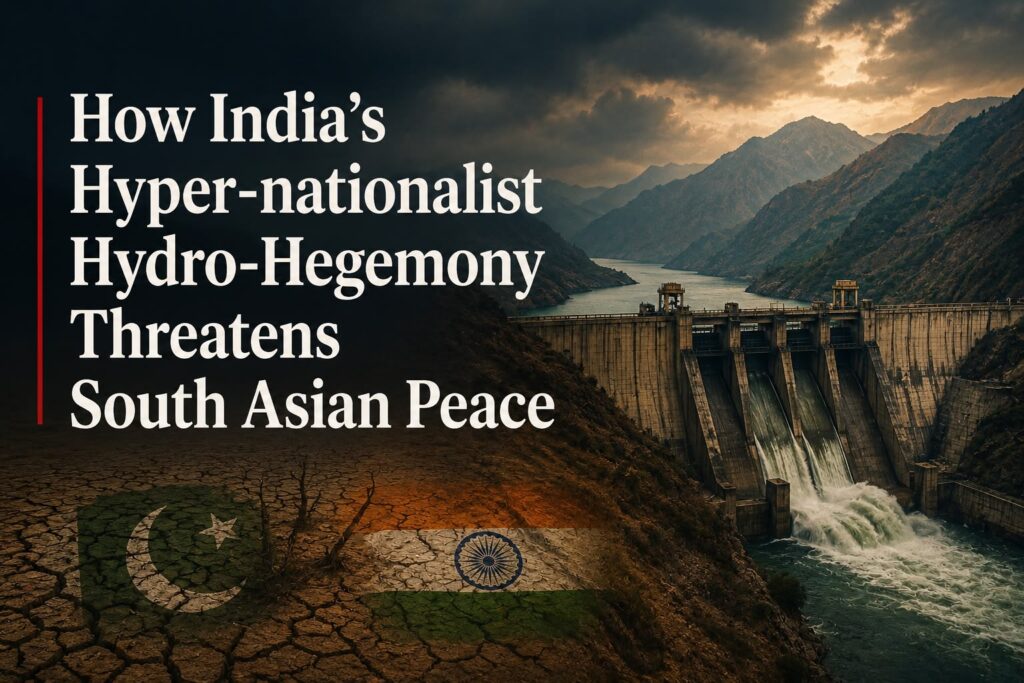
The ripples of the Indus have long been the lifeblood of South Asia, but today they are being churned into the frontlines of a perilous, high-stakes geopolitical standoff. In Islamabad, at a high-level international summit gathered to address the fracturing fate of the Indus Waters Treaty (IWT), the air was thick with a sense of existential urgency. This is no longer a standard diplomatic gridlock over structural designs, concrete volumes, or flow measurements. It is an outright battle for survival. Driven by an increasingly aggressive, majoritarian political posture from New Delhi. South Asia is actively drifting toward a catastrophic water war, one where the shared, natural arteries of a subcontinent are being systematically converted into instruments of downstream coercion.
For more than six decades, the 1960 pact stood as an extraordinary anomaly of survival. It successfully weathered active wars, deep-seated mistrust, and heavily militarized borders, serving as a testament to the power of structured international law. Yet, that fragile equilibrium was shattered when India unilaterally declared it was holding the treaty in abeyance, a diplomatic euphemism for a functional, illegal suspension, following a security incident in Pahalgam. This dramatic pivot exposed a deeply unsettling reality: New Delhi is no longer merely managing its geography; it is actively seeking to weaponize it. By attempting to arbitrarily put a binding international mechanism on hold without mutual consent, India is setting a dangerous precedent of absolute hydro-hegemony. If left unchecked by the international community, this behavior threatens to completely upend the global rules-based order governing shared transboundary resources.
This aggressive shift cannot be viewed in isolation from India’s broader domestic political landscape. Under its current ruling dispensation, New Delhi’s foreign policy has been entirely subsumed by a hyper-nationalist ideology. In this framework, regional cooperation is viewed as a weakness, and international agreements are treated as optional constraints rather than binding commitments. To satisfy a domestic electorate fed on a steady diet of muscular majoritarianism, the Indian state increasingly projects its power by bullying its neighbors and threatening their core vulnerabilities. The Indus Waters Treaty, once celebrated globally as a triumph of transboundary diplomacy, has been recast by New Delhi’s strategists as a geopolitical chokehold. By signaling a willingness to turn off the taps, India’s leadership uses the basic survival needs of millions of people downstream as a tool for political posturing, translating raw ecological dominance into a theater of nationalist pride.
At the heart of Pakistan’s defense is an undeniable geographic truth, voiced sharply by its leadership at the Islamabad summit: for 240 million people, the Indus Water Treaty is not a diplomatic bargaining chip, it is an inalienable, non-negotiable lifeline. To disrupt, divert, or accumulate unchecked control over these western rivers, the Indus, Jhelum, and Chenab, is to directly threaten the food security, economic viability, and human existence of an entire nation downstream. Pakistan’s position has never been a blanket obstruction of regional development; rather, it is an insistence on international discipline. The construction of a staggering seventeen Indian run-of-river projects on these vital waterways represents a deliberate and calculated effort to accumulate vast upstream control.
While engineered under the polite guise of lawful hydropower, these facilities feature technical specifications explicitly designed for excessive discretion and opaque operations. By building massive reservoirs capable of manipulating maximum pondage, New Delhi gains the terrifying ability to manipulate water flows at will. This grants them the unchecked power to trigger sudden, artificial droughts during critical planting seasons or release devastating, unannounced floods during monsoons, effectively holding Pakistan’s agricultural spine hostage.
This strategy of hyper-accumulation directly violates the legal boundaries upheld by the international legal order. Just weeks ago, the Permanent Court of Arbitration (PCA) in The Hague dealt a resounding blow to New Delhi’s unilateralism. In a landmark Supplemental Award, the tribunal ruled that India cannot unilaterally suspend, alter, or withdraw from its treaty obligations. More importantly, the court vindicated Pakistan’s long-standing warnings, declaring that maximum pondage on these projects must be strictly justified by real, site-specific hydrology rather than inflated, artificial engineering assumptions. Crucially, the ruling placed the burden of proof squarely on India, demanding total transparency and robust information-sharing with Pakistan.
Yet, rather than respecting the global rule of law, New Delhi has chosen the path of defiant rejection. Reflecting its hyper-nationalist disdain for external oversight, India branded the internationally recognized Court of Arbitration as illegal and its ruling null and void. This blatant disregard for neutral international adjudication is an alarming red flag for the global community. It signals a major power completely uncoupling itself from bilateral accountability, operating on the dangerous conviction that its upstream position grants it total, absolute sovereignty over a shared-resources.
This ongoing defiance is dragging the entire region toward a perilous threshold. When an upper riparian state acts with absolute impunity, fueled by an internal political need to appear unyielding, it forces a lower riparian state into a corner where defending its water rights becomes a matter of absolute national survival. By systematically dismantling the treaty’s information-sharing mechanisms and continuing construction in total opacity, New Delhi is actively escalating a technical disagreement into an existential flashpoint. In a region deeply scarred by historical rivalries and heavily armed with nuclear capabilities, the deliberate weaponization of a life-giving resource is nothing short of playing with fire.
The international community can no longer afford to view the Indus Waters Treaty as a localized, bilateral dispute that can be safely ignored. It is a vital framework for regional stability that prevents environmental distress from triggering a full-scale security crisis. Pakistan’s defense of its lifeline is not just a battle for its own fields, rivers, and citizens; it is a defense of international law against the destabilizing forces of unilateral hydro-coercion overreach. If the global community stands by silently while India chokes the lifeline of 240 million people to feed a domestic political narrative, it will signal that “might makes right” in transboundary resource management worldwide. The warning from the Islamabad summit is stark, loud, and undeniable: when water is transformed into a weapon of war, the resulting fallout will inevitably flow far beyond the banks of the Indus.