
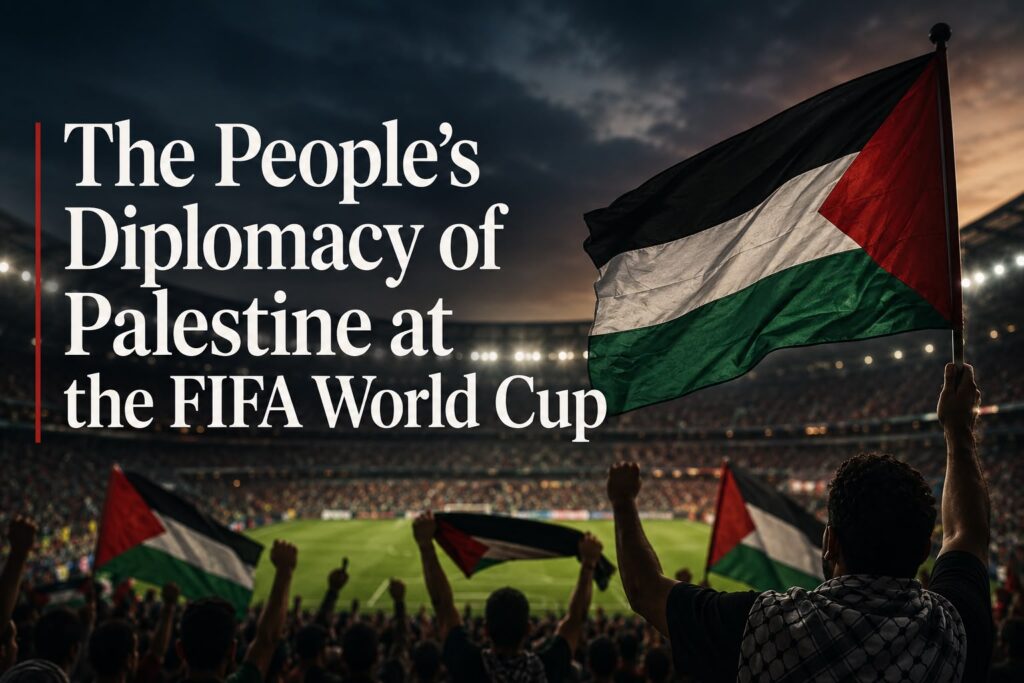
The 2026 FIFA World Cup will certainly be remembered for the amazing goals scored, the shocking upsets, and the celebration of the game in three hosting countries. But one of the most remarkable stories at the World Cup was played not on the football field. Although Palestine did not qualify for the event, it became one of the most prominent stories of the World Cup. Palestinian flags were spotted in different stadiums in the USA, Canada and Mexico, slogans demanding peace in Gaza were chanted in the stadiums, and numerous fans used the World Cup to send their political message. This showed that there is an important geopolitical trend: while governments make the foreign policy decisions through the diplomatic and military means, public opinions influence international relations through cultural events, sports and global communication. And Palestine was one of the most important stories of the World Cup in that respect.
Football has never existed in a political vacuum. While FIFA always maintained that sports and politics must remain apart, history shows a different picture. The 1936 Olympic Games in Berlin turned into a tool for Nazi propaganda before Jesse Owens used his athletic abilities to prove that Hitler was wrong about race superiority. The sporting boycott of the apartheid state of South Africa was one of the key elements of the international fight against apartheid. In recent years, footballers in Europe and North America have also made symbolic protests against racism and discrimination. As Nelson Mandela famously observed, “Sport has the power to change the world.” This ability of sport is not only its competitive nature but also the incredible capacity of sports to attract global public attention and give people an opportunity to express their moral values and political opinions.
The visibility of Palestine at the World Cup in 2026 demonstrated the impressive change in global public perception. During the 2022 World Cup held in Qatar, it was said that the numerous displays of solidarity towards Palestine occurred due to the Arab nation hosting the event. However, four years after this occasion, the mentioned explanation became increasingly irrelevant. The recurrent appearance of the flags of Palestine in the stadiums of North America showed that the solidarity toward Palestine grew past the limits of region or religion. Demonstrations were no longer confined to the Middle East but had become part of a broader international conversation involving football supporters from diverse nationalities, backgrounds and political traditions.
Thus, through this event, the world witnessed an increasingly evolving aspect of diplomacy in the twenty-first century whereby states no longer have monopoly over international narratives. Public opinion is increasingly shaped by phones, livestreaming, and social media just as much as press conferences and diplomatic messages from state officials. The hanging of every Palestinian flag on TV screens all over the world is an example of what academics refer to as “people’s diplomacy”, which refers to political communication between nations facilitated not by states but by common people. In an era where a single image can reach hundreds of millions of people within minutes, symbolic acts performed during globally televised events carry extraordinary political significance.
These developments also raise uncomfortable questions about the effectiveness of traditional public diplomacy. Israel has been expending significant efforts in public diplomacy and its various aspects such as media diplomacy for decades in order to create its image in the international arena. Public diplomacy, which is also known as hasbara, was supposed to convey the security concerns of Israel and gain support from the international community. But what we see all in the World Cup suggests that governmental information and rhetoric have come into confrontation with an absolutely decentralized flow of information. Today, public opinion is formed not through official sources but through videos, humanitarian reports, independent journalism, and personal accounts of people experiencing war. Information has become democratised, making it increasingly difficult for any government to dominate global discourse.
The other thing that came out is the growing gap between governments and their citizens. Although some Western governments, especially the United States, have kept close diplomatic and military ties with Israel, it is clear from the protests on college campuses, in the centers of cities, and even at the soccer games that people are much more sympathetic toward Palestinians than the policy-makers may care to admit. Public opinion surveys in various Western countries have demonstrated growing concern about the humanitarian aspects of the crisis, especially among young people. The World Cup became another visible reminder that foreign policy and public opinion are not always moving in the same direction.
FIFA itself saw its well-established position of political neutrality facing fresh questions. In its long history, FIFA has shown time and again that it has not hesitated to get involved with the political aspects of things, in terms of imposing bans or disciplinary measures on member nations. However, it is observed that FIFA seems unwilling to participate in the humanitarian aspect of Gaza but very willing to talk about everything else happening internationally. Whether you agree with that or not, the tournament made clear how much harder it becomes to remain politically neutral when even the fans turn their sports events into stages to voice their views regarding global affairs. The reality is that institutions may regulate players, coaches and officials, but they possess far less control over the moral convictions of hundreds of thousands of spectators.
One of the most interesting things about the Palestine’s World Cup presence is the fact that there was no official effort at all on the part of Palestine to get its message across. No effort was made by the authorities of Palestine to make people raise their Palestinian flag or put up their banners. It was all spontaneous because people felt that the plight of the Palestinians was one of humanitarian sufferings. It suggested that solidarity had evolved beyond regional identity into a broader ethical response among many people who viewed Gaza through the universal language of human suffering.
Ultimately, the 2026 FIFA World Cup demonstrated that the struggle over Palestine is no longer confined to diplomatic negotiations, military calculations or international institutions. It has entered the arena of global public conscience, where symbolism often travels faster than official statements and where ordinary citizens increasingly influence international discourse. Palestine may not have appeared on the tournament’s fixture list, but it occupied a place in the minds of millions watching around the world. In doing so, the World Cup revealed that football’s greatest power lies not merely in producing champions on the field, but in reflecting the moral questions that continue to shape the world beyond it. Some victories are measured in trophies; others are measured in the ability to move global conscience. By that measure, Palestine became one of the tournament’s most unforgettable stories.