
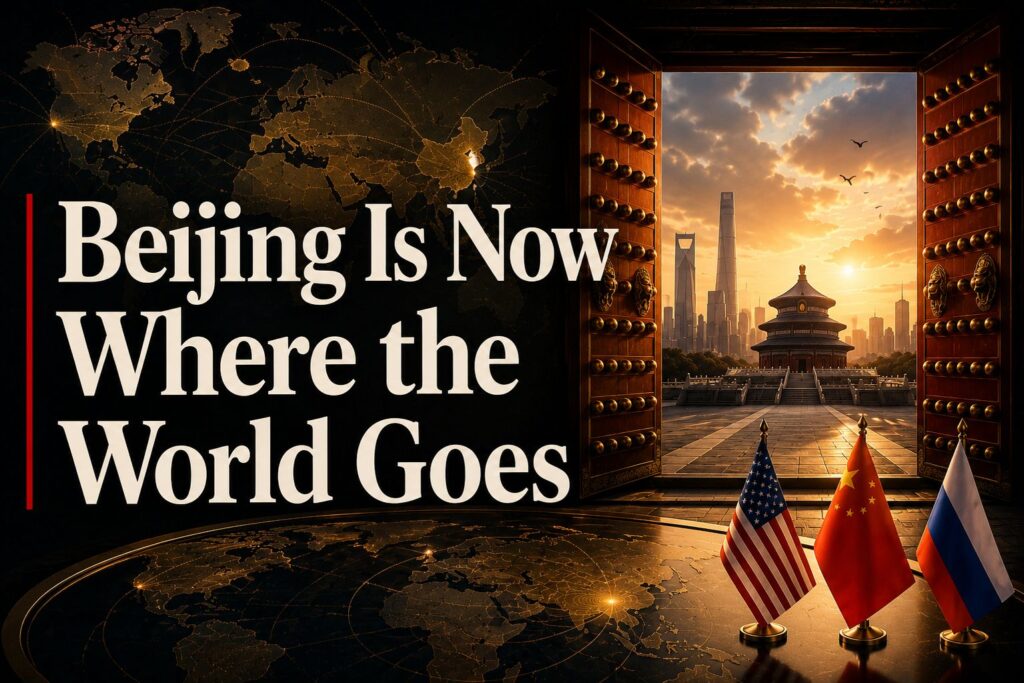
In the span of a single week, Beijing has become host to the leaders of both the US and Russia. It is an extraordinary display of how profoundly the geometry of global power is shifting. Donald Trump arrived to negotiate tariffs, technology, Iran war, and strategic competition. Putin arrives seeking a refresh of coordination with the one major power capable of cushioning Russia against Western isolation. But the real story is larger than either visit. At a time of rising global fragmentation, China is proving itself as the diplomatic force around which rival powers are forced to navigate.
For decades, Washington functioned as the gravitational center of global diplomacy. Presidents travelled abroad as representatives of an uncontested superpower, while allies and adversaries alike made their pilgrimages to the White House. Today, however, the optics are changing. The world’s most consequential diplomatic engagements are unfolding in Beijing, under Chinese protocol, timing and symbolism.
Trump’s visit illustrated this transformation vividly. The military honors, banquets in the Great Hall of the People and highly choreographed ceremonies were not merely acts of hospitality. They projected an image of parity between Washington and Beijing, perhaps even an inversion of hierarchy. The United States may still possess unmatched military reach, but China dictates the terrain on which global diplomacy is conducted.
Putin’s visit immediately after Trump’s deepens that symbolism. Ahead of his visit, the Russian president issued a formal address highlighting that Russia, China bilateral trade has reached record levels, with more than 90 per cent of settlements now conducted in rubles and yuan, effectively bypassing the US dollar. What this suggests is that Russia no longer views China simply as a useful partner, it views it as an indispensable economic lifeline, a diplomatic shield against Western isolation and a strategic rear base in an era of escalating geopolitical fragmentation. Moscow understands that any recalibration in Sino-American relations directly affects Russia’s strategic future. Whether the issue is sanctions, semiconductors, rare earths, Taiwan or Ukraine, Beijing now sits at the center of the equation.
Beijing is constructing something larger than an alliance system. China, unlike the US, does not appear interested in ideological crusades or openly declared hegemony. Its objective is subtler and arguably more durable.
This is the logic behind Beijing’s repeated emphasis on “multipolarity”. Western analysts often dismiss the term as rhetorical camouflage for Chinese ambitions. In reality, China’s strategy resembles neither classical bipolarity nor outright imperial domination. It is closer to asymmetrical multipolarity, a system with multiple power centers, but one in which China occupies the indispensable core of global manufacturing, supply chains, infrastructure financing and diplomatic mediation.
That explains why both Washington and Moscow seek engagement with Beijing, even while distrusting one another. Trump’s remarks about a possible “G2” framework unintentionally acknowledged what many policymakers already recognize privately: China is now the only state capable of competing with the United States simultaneously in economics, technology, industrial capacity and long-term geopolitical influence.
Trump left Beijing without clarity on whether he would proceed with major weapons sales to Taipei, an ambiguity that immediately fuelled speculation in Moscow and Washington alike. For Beijing, even temporary hesitation from the United States represents strategic progress. For Russia, deeper energy integration with China, including renewed discussions around the Power of Siberia 2 pipeline offers insurance against future global instability and potential conflict scenarios in East Asia.
Although critics in the West often portray this Sino-Russian relationship as a temporary marriage of expedience, such assessments ignore the reality. What binds Moscow and Beijing is not just shared opposition to the US, but a common belief that the current global order is losing both legitimacy and capacity. The wars in Ukraine and Gaza and the weaponization of sanctions have accelerated that perception across much of the Global South.
China has capitalized on this moment with remarkable discipline, but its approach is more calculated. Rather than exporting revolution or demanding ideological alignment, it has positioned itself as a stabilizing hub of necessity, one built on trade, infrastructure connectivity and a firm emphasis on state sovereignty. This is precisely why even skeptical capitals continue to deepen engagement: Beijing is no longer being “chosen” so much as accommodated. In this context, Russia’s accelerated turn toward China, now visibly reinforced by Putin’s arrival in Beijing, is not an anomaly but a structural adjustment to a shifting global economic and strategic center of gravity.
That, ultimately, is the significance of this diplomatic choreography in Beijing. It is not simply that China is rising, or even that it is balancing the United States. It is that major powers, including a sanctioned Russia, are now structuring their most consequential external relationships through Beijing. Putin’s visit, following closely on Trump’s departure, captures this new reality with unusual clarity: Washington and Moscow may remain strategic rivals, but both are now compelled to engage China as the indispensable center of global power recalibration.