
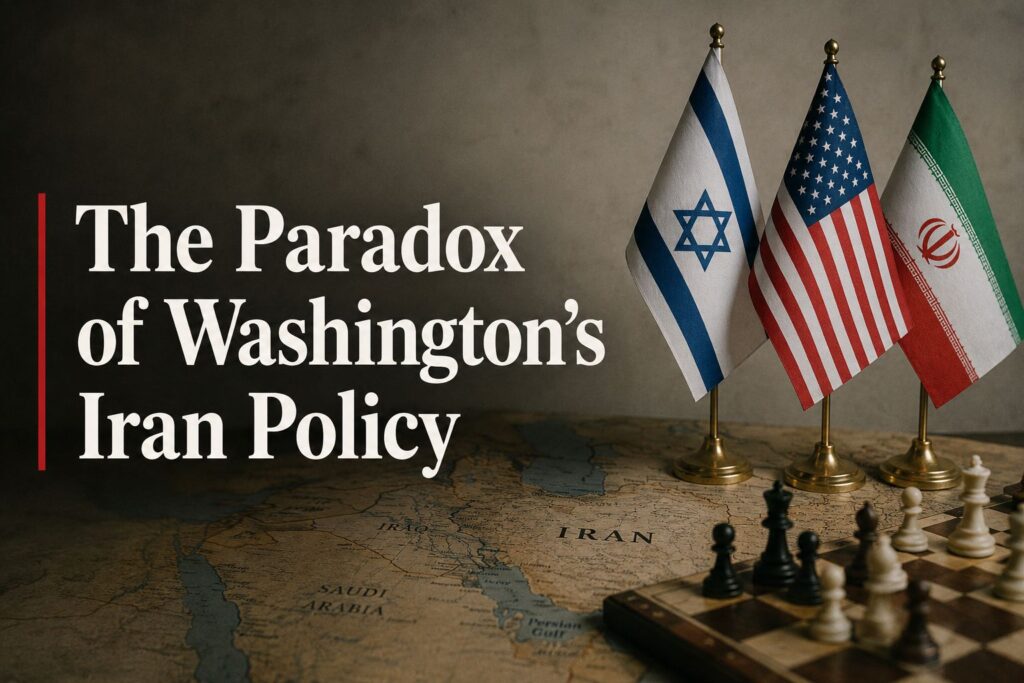
For seventeen years, Benjamin Netanyahu has predicted the imminent collapse of the Iranian state. He said sanctions would break it. Assassinations would destabilize it. Internal unrest would finish it. Military pressure would finally bring it down. But Iran remains standing, not because it is not vulnerable, but because the US and Israel have repeatedly misunderstood the nature of the Islamic Republic Iran. Former US Defense Secretary Robert Gates recognized this as early as 2009 when he warned Netanyahu that Iran was far more resilient than Israel’s leadership assumed. Nearly two decades later, that warning looks remarkably prescient.
The current Iran-US-Israel standoff exposes the same strategic illusion. What began as another attempt to coerce Iran into submission has instead evolved into a prolonged conflict with no decisive outcome in sight. Israel’s officials initially framed the confrontation as a short campaign designed to cripple Iran’s nuclear and military infrastructure within weeks. American analysts echoed similar timelines. Nearly eighty days later, the war has instead become a demonstration of limits, the limits of Israel and the US military power, the limits of economic pressure, and the limits of American coercive diplomacy.
That power failure has now produced a more interesting pattern. The US dual-track policy that tries to threaten and negotiate in the same breath, and in doing so weakens both. President Donald Trump’s formula of “deal or bombs”, no longer lands as a clear strategic line. Trump’s rhetoric of “Clock is ticking” therefore depicts that the clock does not only apply to Iran. It also reflects American urgency, a recognition that escalation without diplomatic off-ramp carries risks that neither Washington nor its regional partners can fully control. Every threat, therefore, carries an embedded signal of negotiation. Every ultimatum is also an invitation to return to talks.
A sense of directionless urgency is visible in Washington’s approach. The reported American conditions for a ceasefire, transfer of enriched uranium, restrictions on nuclear facilities, no compensation for wartime destruction, and negotiations tied permanently to the ceasefire itself, read less like a framework for peace and more like pressure tactics dressed as diplomacy. Iran’s rejection was therefore unsurprising.
Reading these developments through the lens of wider geopolitical context will make better sense. Trump-Xi meeting appears to have produced no meaningful breakthrough on Iran war. Before the meeting, many in Washington expected China might pressure Iran into accepting stricter concessions. Instead, China maintained strategic ambiguity while quietly reinforcing its partnership with Iran through energy and trade. The meeting removed one of the few remaining diplomatic expectations restraining escalation without producing any actual compromise.
Israel’s calculations have also become more complicated than its leadership anticipated. It failed to understand the difference between destroying infrastructure and dismantling political identity or strategic patience. Iran has historically absorbed punishment while avoiding outright capitulation. The assumption that sustained pressure would trigger internal collapse underestimated both the state’s ideological depth and the nationalist sentiments activated by external threats.
Today, Iran is not internationally isolated like Iraq once was. It has established political, economic, and military relationships across Asia, particularly with rival powers of the US. Russia considers Tehran as strategically useful against Western pressure. China views it as central to long-term energy security and connectivity. Even countries that do not necessarily align with Iranian ideology now view Washington’s approach as selective and destabilizing.
Amid this chaos, Pakistan’s attempt to position itself as a mediator rather than a participant should be praised. Pakistan’s Interior Minister’s recent visit to Iran manifests Pakistan’s continuous efforts to save the region from complete collapse of diplomacy. Its shuttle diplomacy may not produce immediate expected results, but it is one of the few remaining attempts to keep communication alive.
However, the deeper problem for the US and Israel is that they continue to approach Iran as problem to be solved through power and pressure rather than a regional power to be negotiated with. That misreading has shaped nearly two decades of failed expectations. Gates understood this in 2009. The current conflict suggests little has changed since then.