
By Ketty L.
The recent report from the United Nations Independent International Fact-Finding Mission lands with real weight, a turning point in holding major military powers to account. For years, Western nations, especially the United States, have operated under the assumption that international law doesn’t quite reach them. This new assessment, finding “reasonable grounds” to believe the U.S. committed war crimes in Iran, disrupts that old expectation of impunity. And it does so with devastating specifics, pointing to atrocities like the missile strike on Shajareh Tayyebeh primary school in Minab, where over 150 lives were lost, and the use of high-fragmentation weapons on a sports complex in Lamerd. These are more than just case studies in tragic loss; they are a challenge to the justification of “collateral damage.” They bring unsettling questions about the ethics of algorithm-driven warfare and the reliability of U.S. intelligence, not to mention whether the principles of international humanitarian law are being respected at all.
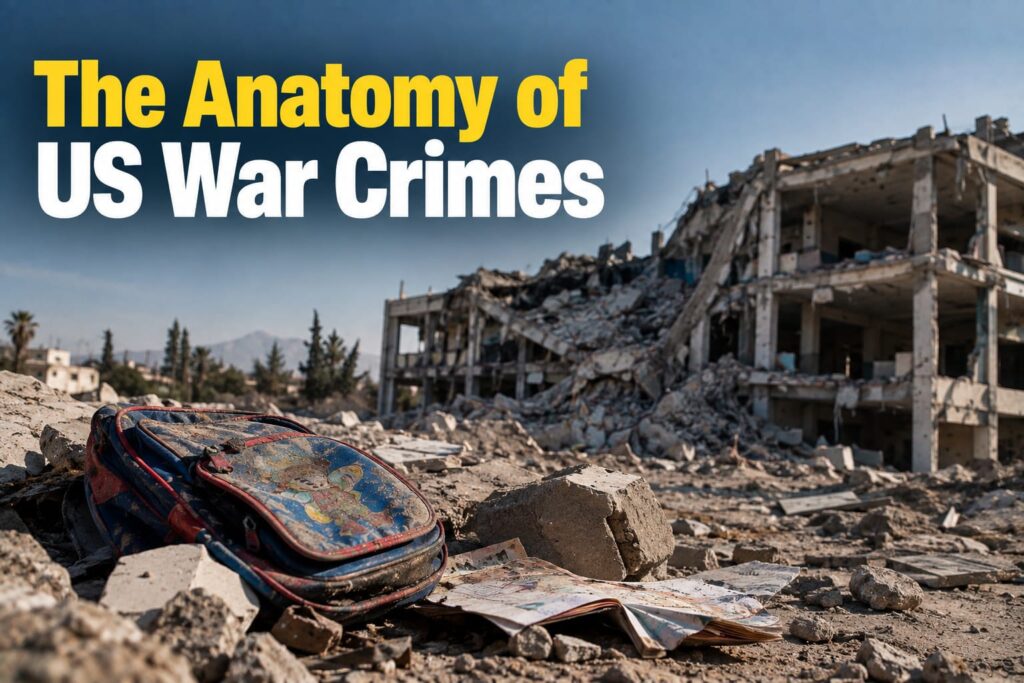
At the core of humanitarian law are three ideas: know who you are targeting, weigh how much harm you cause, and pull back if things look risky. The UN’s findings show that, in these U.S. operations, all three broke down. Take Minab, for example. A Tomahawk cruise missile smashed into a school that was just seventy-two meters from an Islamic Revolutionary Guard Corps naval site. The usual excuse, that proximity to a military site justifies the casualties, doesn’t fly here. Investigators found the school, full of children, was not accidental collateral damage; it was the actual target. How did that happen? The U.S. acted on outdated intelligence, files that wrongly marked an active school as a military compound.
That is more than a technical blunder. It is part of a disturbing shift in modern warfare, where old, unreliable databases become the basis for lethal decisions, with no real-time checks. Under the Geneva Conventions, militaries have to do everything they reasonably can to verify their targets. Firing missiles into crowded urban areas based on stale data doesn’t just fail that standard; it crosses into reckless territory. The UN’s findings make it clear: this wasn’t a one-off mistake; it was the sort of decision that turns administrative laziness into indiscriminate killing.
Under the Geneva Conventions, militaries have to do everything they reasonably can to verify their targets. Firing missiles into crowded urban areas based on stale data crosses into reckless territory.
The Lamerd incident adds another dark layer. Here, American forces fired a Precision Strike Missile rigged to scatter nearly 180,000 heavy tungsten fragments, the kind of weapon that makes entire neighborhoods unsafe. Cluster-style submunitions like these cannot tell a combatant from a child kicking a soccer ball. The effect? Urban areas get transformed into kill zones, blurring the line between legitimate targets and civilians, erasing that line almost entirely. It is hard to argue this isn’t an outright violation of the laws of war.
But southern Iran isn’t an outlier. These tragedies fit a long, uncomfortable pattern. Time and again, the U.S. has talked a big game about democracy and respecting international rules, but its military actions tell a different story, one marked by repeated civilian casualties and almost no serious prosecution of those responsible.
Draw a line back from Minab and Lamerd and you end up in My Lai. In 1968, U.S. troops slaughtered hundreds of unarmed Vietnamese civilians. It is a crime remembered worldwide, but what is less often said is how deliberate U.S. policies, the creation of “free-fire zones,” an obsession with body counts, encouraged treating entire civilian villages as enemy targets. Only one officer was ever convicted, and after less than four years of house arrest, he walked free. The message was clear: systemic violence would not be met with real justice.
The story repeats itself in Korea. In July 1950, at No Gun Ri, American troops killed hundreds of South Korean refugees, women, children, and the elderly, over several days. The incident was dismissed as rumor for decades, until journalists forced an acknowledgment. No one ever faced trial.
After 9/11, things didn’t get better. In fact, the “War on Terror” brought its own brand of lawlessness: secret renditions, torture in black sites, and the infamous torture at Abu Ghraib. Shocking images backed up survivors’ accounts. A handful of low-ranking soldiers faced the courts. Those higher up were protected by a wall of official memos and political will.
Ground operations in Iraq gave us Haditha. There, U.S. Marines killed twenty-four unarmed civilians, including children, in retaliation for a roadside bombing. Charges were brought, but, after drawn-out proceedings, not a single Marine ended up behind bars for those deaths.
If global powers demand the world follow the rules but then wave away oversight when their own militaries kill civilians, what faith can we have in the system?
Fast forward to now, and Washington’s response to the UN’s details is predictable. Once again, U.S. officials dismiss the UN’s findings as biased, refusing to actually answer the specifics. It is the same old playbook: deny, deflect, offer technical language but no accountability. This double standard is more than just hypocrisy; it eats away at the credibility of international law. If global powers demand the world follow the rules but then wave away oversight when their own militaries kill civilians, what faith can we have in the system?
Complicating things further, the UN report doesn’t let Iran off the hook either. Investigators documented crimes committed by Iranian authorities in their domestic crackdown on protests. Far from one-sided, the mission’s findings show the point of international law: it is not meant to be a tool for great powers to wield when convenient, but a universal standard.
Although this fact-finding mission lacks the power to haul anyone before a court, its work builds a case for the future. It provides an independent, evidence-based record, flight paths, impact analysis, intelligence failures, that national courts or human rights bodies can use down the line.
Adhering to international humanitarian law takes more than rhetoric; it needs real checks, real responsibility, and a willingness to admit mistakes.
At the end of the day, the tragedy in Iran forces a conversation about the way military power is exercised, especially by countries with the most advanced technology. High-tech weapons, detailed maps, and satellite-guided missiles are not enough if the intelligence is lazy or the procedures are flawed. Adhering to international humanitarian law takes more than rhetoric; it needs real checks, real responsibility, and a willingness to admit mistakes. Otherwise, legal rules meant to protect civilians will become empty words, while communities continue to suffer the deadly consequences.
About the Author
Ketty L. is a Columnist writing on politics, and international affairs.