
By Ketty L.
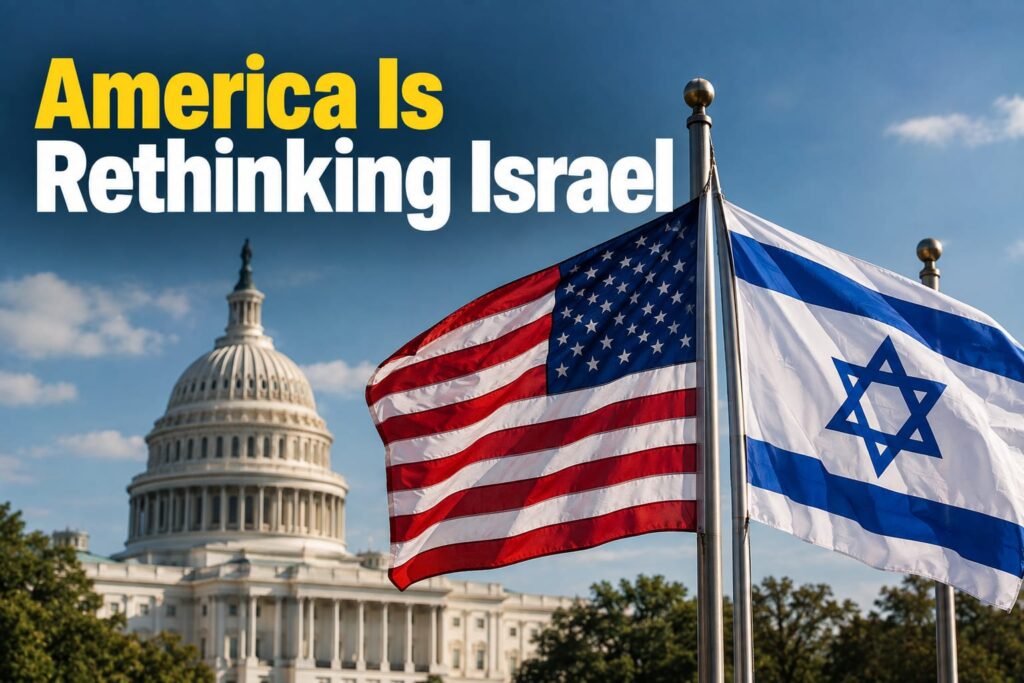
America’s political landscape is shifting in ways that not long ago would’ve seemed nearly impossible, especially when it comes to our relationship with Israel. For decades, unwavering military and diplomatic support for Israel stood as one of the last bipartisan pillars in Washington, almost untouchable, rarely questioned, and usually passed with barely a peep of dissent. That’s changing, quietly but unmistakably. We’re seeing a profound realignment as the realities of a changing American electorate, demographic upheaval, and rising economic stress start to weigh heavier than the old rules of foreign policy.
At the heart of this shift is how sharply domestic worries are now clashing with the massive sums dedicated to military support overseas. Under a ten year deal signed in 2016, the U.S. committed at least $3.8 billion a year to Israel through 2028. After fighting resumed in October 2023, that number shot up, with Brown University’s Costs of War Project putting the tally at $21.7 billion in direct aid over two years. In the past, these numbers would have sailed through Congress, justified as necessary for America’s grand strategy abroad. Now, people are paying attention. Folks on both sides of the political spectrum are asking if it still makes sense to funnel billions abroad while domestic problems, from healthcare to education to crumbling infrastructure, crank up the pressure at home.
You don’t have to look far to see how public opinion is changing. Poll after poll reveals widening divides, especially by age and party. One Gallup survey made headlines: for the first time, more Americans (46%) sided with Palestinians than with Israelis (28%), a complete flip from longstanding trends. Pew Research paints a similar picture: unfavorable views of the Israeli government have jumped past 50%, and young people consistently show greater concern for issues like civilian casualties and human rights. The old coalition that kept foreign aid to Israel practically untouchable is clearly fracturing, and lawmakers are beginning to notice just how much the risk of ignoring this shift has grown.
One Gallup survey made headlines: for the first time, more Americans (46%) sided with Palestinians than with Israelis (28%), a complete flip from longstanding trends.
That fracture has reached Congress itself. Bills to fund military aid to Israel used to pass with overwhelming support. Not anymore. In a recent vote, nearly half of House Democrats backed an amendment to block $3.3 billion in direct military aid unless conditions were set. Democratic Whip Katherine Clark put it plainly: Washington shouldn’t sign blank checks for foreign governments that don’t align with America’s laws or values. Even long time establishment figures, such as Nancy Pelosi, supported the new restrictions, underlining one reality: endless foreign wars can’t just be rubber stamped anymore.
This message isn’t just trickling up to Congress, it’s coming from the top. At an event in Los Angeles, Vice President JD Vance put the new stance bluntly: “We cannot let our Middle Eastern foreign policy be subservient to the state of Israel”. He pointed out what many Americans have been feeling for a while: that national interest comes first, and backing Israel isn’t automatic. He reminded his audience that Donald Trump had no problem breaking with Netanyahu if American interests seemed at odds with Israel’s. Vance even likened the U.S. Israel relationship to less sacred strategic partnerships, NATO, for example, insisting Washington would chart its own path when priorities don’t line up. This isn’t just talk; it’s a public shift toward a much more transactional, interest driven approach.
Vice President JD Vance put the new stance bluntly: ‘We cannot let our Middle Eastern foreign policy be subservient to the state of Israel.’
You see this tension play out in elections, too. The American Israel Public Affairs Committee (AIPAC) used to have the final word in primaries, showering millions on campaigns of favored candidates. But recently, even deep pockets can’t guarantee wins. Grassroots campaigns talking about civil rights, domestic reform, and a restrained approach to war have started to beat well funded, establishment backed opponents. When voters change their minds in a big way, even the political heavyweights can lose their grip.
And if you really want to understand where the shift is coming from, look at what’s happening in cities and states. Progressive politicians in places like New York, Chicago, and Los Angeles are channeling frustrations from working class, youth, and immigrant communities. These leaders aren’t shy about challenging old foreign policy assumptions. When they talk about real problems, housing, jobs, public safety, and tie those issues to a principled but pragmatic approach on global affairs, people pay attention. There’s a sense that the country’s resources and focus should come home, instead of drifting endlessly toward wars and alliances with fuzzy returns.
It’s not just politics, either. The broader American culture is waking up, too. More authors, scholars, and public figures are pushing back against the old taboos that made real debate risky. Years ago, even small criticism of U.S. foreign policy, or Israel’s government, could mean trouble for your career. That fear has faded. Podcasts, news sites, and even mainstream TV now air views that would have been silenced a decade ago. The influence of postcolonial scholarship and critical perspectives that once lived only in university classrooms now shapes headlines and social media feeds, encouraging Americans to take a fresh look at old alliances and the real costs of global power.
As the gulf between the old guard and new public sentiment opens ever wider, it feels like a new political era is on the horizon, one with a lot more accountability at home, and a distinctly lighter footprint abroad.
At the bottom of all this, America’s wrestling with a bigger question: Who are we, and what role should we play in the world? The old model said global dominance, and unbreakable support for foreign allies, kept us safe. More Americans are starting to believe real strength starts with rebuilding at home, fair and transparent diplomacy, and making sure our principles are more than just slogans. As the gulf between the old guard and new public sentiment opens ever wider, it feels like a new political era is on the horizon, one with a lot more accountability at home, and a distinctly lighter footprint abroad. It’s a debate we can’t afford to ignore, one that’s shaping the very future of American democracy.
About the Author
Ketty L. is a Columnist writing on politics, and international affairs.