
By Daniel Frost | Foreign Affairs Columnist
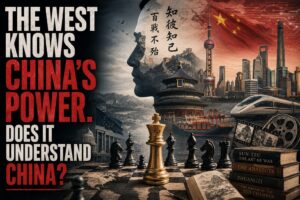
Sun Tzu wrote, know the enemy and know yourself, and in a hundred battles you will never be in peril. It’s a line quoted constantly in defense circles, and almost never actually followed when it comes to China. When Trump and Xi Jinping met in Beijing back in May 2026, the air was thick with historical dread. Xi raised the classic specter of the Thucydides Trap, that ancient Greek curse where a rising power terrifies the established hegemon and triggers an accidental war. He specifically warned that mishandling Taiwan could plunge Washington and Beijing into direct conflict. It was a sobering moment, one that laid bare the deep strategic anxiety defining our current era. Yet for all the frantic policy papers written in Washington, Brussels, and London, the West is walking into this high stakes rivalry with one hand tied behind its back. We spend billions measuring Chinese industrial capacity, naval tonnage, AI models, and supply chain logistics, while staying remarkably, dangerously illiterate about the civilization actually driving it all.
This imbalance is a glaring strategic failure. Walk into any major defense think tank or corporate boardroom today, and you’ll find shelves of data tracking Chinese factory output, rare earth mining, and patent filings. Everyone wants to reverse engineer the machinery of Chinese economic success. But step into Western universities, and the picture looks pretty bleak. According to enrollment data from the Modern Language Association, college level enrollments in Chinese dropped by more than fourteen percent in just a few short years, with graduate programs shrinking just as fast. At the exact historical moment when real China expertise matters most, the academic and cultural pipelines producing it are drying up. Geopolitical tension, visa headaches, and political crackdowns have turned sustained engagement into a bureaucratic minefield nobody wants to walk through.
The cost of this cultural illiteracy is genuinely steep. When Western leaders view Beijing purely through the narrow lens of threat assessments and GDP charts, they end up misreading how Chinese policymakers actually interpret the world. Cultural literacy doesn’t mean swallowing state propaganda or singing the praises of the Communist Party. It means recognizing that every policy, speech, and red line gets filtered through a distinct historical memory and moral vocabulary. American political discourse is deeply rooted in individual rights, legal limits, and skepticism of government overreach. Chinese political discourse, by contrast, tends to prioritize social order, collective welfare, and relational obligation. When these two worldviews collide without any real translation happening, routine diplomatic friction can turn into moral outrage and dangerous escalation surprisingly fast.
“Diplomacy conducted without understanding these foundational national myths is doomed to mistake defensive caution for aggression, and compromise for humiliation.”
Historical memory does even more heavy lifting in shaping modern behavior than most people realize. Western publics often suffer from a kind of historical amnesia, forgetting the century of humiliation when Western and Japanese imperialism tore China apart through the Opium Wars and a string of unequal treaties. In China, that trauma gets taught as foundational knowledge, something every student learns early. What an American diplomat sees as a routine defense of the rules based international order, a Chinese counterpart frequently reads through a long, deeply ingrained lens of foreign intrusion and national vulnerability. As the late Henry Kissinger often pointed out, diplomacy conducted without understanding these foundational national myths is doomed to mistake defensive caution for aggression, and compromise for humiliation.
Compounding this blindness is the lazy Western habit of flattening a civilization of 1.4 billion people into a single monolithic caricature. China is not just the Chinese Communist Party, just as Chinese history can’t be boiled down to some simplified textbook version of Confucianism. It’s a messy, vibrant mosaic shaped by Daoism, Buddhism, Legalism, popular folk traditions, Marxism, capitalism, and modern global life all at once. Take New Confucianism, for instance, a fascinating intellectual movement where philosophers like Tu Weiming wrestled with how ancient traditions could speak to modern science, democracy, and individual freedom. Tu advanced the idea of cultural China, a vast network of people connected to Chinese civilization through language, memory, and intellectual inquiry that stretches far beyond the borders of the mainland state itself.
If you actually want to understand what makes contemporary China tick, you have to look beyond official state white papers and economic statistics. The real pulse of the society shows up in its literature, art, and film instead. Writers like Nobel laureate Mo Yan transform rural history through biting satire and magical realism. Science fiction visionary Liu Cixin projects deep national anxieties onto a cosmic stage, while iconic filmmakers like Zhang Yimou explore power, family, and historical upheaval through a visual language that captivates audiences well beyond China’s borders. These creators remind us that China isn’t some uniform mass of automatons. It’s a society full of fierce internal debate, pitting nationalists against cosmopolitans, liberals against conservatives, and young people wrestling with an uncertain future just like anywhere else.
Western institutions carry a heavy share of the blame for this widening knowledge gap too. Too often, Chinese philosophy and history get ghettoized into niche area studies departments rather than treated as a vital part of global philosophy in general. News organizations rush to cover the latest security crisis or trade spat, painting a picture where official state actions represent the entirety of Chinese life. Meanwhile, rising nationalist politics on both sides actively discourage the kind of deep, patient curiosity that real cultural literacy actually requires.
Fixing this takes more than empty platitudes about cultural exchange. Western universities need to aggressively reinvest in advanced language instruction and weave Chinese intellectual history into mainstream curricula rather than sidelining it. Philanthropic foundations and publishers need to back translators who bring contemporary Chinese debates to Western readers directly. Journalists need the time and linguistic tools to actually report on societal shifts rather than just repeating press releases from foreign ministries. And crucially, governments need to learn how to protect legitimate national security interests without treating academic exchange and historical research like existential threats.
“Escaping the Thucydides Trap is going to take far more than crisis hotlines and military restraint. It demands that both sides make the hard intellectual investment to understand the historical narratives each uses to define power, order, and national destiny.”
None of this is meant to suggest that understanding Chinese culture will magically dissolve geopolitical competition or erase real strategic differences. It’s simply a matter of basic realism. You can’t successfully negotiate with an imaginary adversary. You can’t effectively deter a country you fundamentally misunderstand. And you can’t coexist peacefully with a civilization you only know through screaming headlines and threat matrices. Escaping the Thucydides Trap is going to take far more than crisis hotlines and military restraint. It demands that both sides make the hard intellectual investment to understand the historical narratives each uses to define power, order, and national destiny. For decades, the West has poured endless energy into tracking what China can build and buy. It’s long past time we put equal effort into understanding what China actually thinks it’s doing, and why.
About the author:
Daniel Frost is a Foreign affairs columnist specializing in global geopolitics, European security, and strategic policy.