
By Adam Reed | International Affairs Analyst
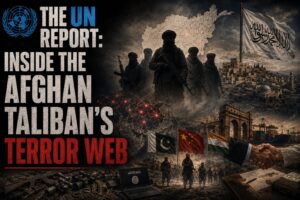
The latest UN Security Council monitoring report basically demolishes whatever diplomatic illusions were still hanging around about the de facto authorities in Kabul. For years, the Afghan Taliban leadership has run a pretty dangerous double game. They issue polite public denials from air conditioned offices while quietly keeping deep operational ties with a violent web of transnational extremist groups. The assessment from the Analytical Support and Sanctions Monitoring Team doesn’t leave much room for ambiguity here. The Afghan Taliban keep providing active, sustained support to the banned Tehrik e Taliban Pakistan, treating cross border terrorism like a convenient, deniable tool for regional leverage.
The UN document lays out a clear, unbroken pattern of Kabul propping up its militant allies despite claiming otherwise. To ease intense pressure from neighbors and put up a veneer of compliance, the regime took a few weak, surface level steps. After serious punitive actions and military strikes from Pakistan, Afghan authorities relocated roughly two thousand TTP fighters and their families away from the immediate border strip. Supreme leader Mullah Hibatullah Akhundzada even went as far as directly warning TTP leadership to stop attacking Pakistan or risk losing official Taliban backing. Those warnings fell on completely deaf ears. The TTP ignored its hosts, doubled down on its violent campaign, and pushed its operational footprint deeper into Pakistani territory, stretching its network into Balochistan, Gilgit Baltistan, and parts of Kashmir.
The UN report makes it pretty clear this isn’t just some isolated bilateral conflict either. Afghanistan under Taliban rule remains an unrepentant sanctuary for a dangerous mix of lethal groups. Al Qaeda has deepened its ideological and financial support for the TTP, providing experienced trainers, logistical know how, and tactical guidance. Meanwhile, its regional arm, Al Qaeda in the Indian Subcontinent, operates aggressively through umbrella fronts like Ittehadul Mujahideen Pakistan to carry out coordinated, high fatality attacks against security forces and civilian infrastructure.
“Attacking ISIL-K purely because it threatens their domestic hold on power, while protecting, funding, and facilitating the TTP and Al Qaeda at the same time, is a recipe for long term regional combustion.”
Even more troubling is how deeply these groups, with seemingly different regional agendas, are actually coordinating with each other. The report reveals alarming intelligence that ISIL-K and the banned Baloch Liberation Army share sophisticated facilitation networks for logistics, communication, and transport. On top of that, BLA militants have been documented receiving specialized combat training alongside TTP fighters directly from Al Qaeda instructors entrenched deep inside Afghan territory. Farther north, near the Chinese border, the Eastern Turkistan Islamic Movement remains actively embedded in the Wakhan corridor, posing a direct and persistent security threat to Beijing. Meanwhile, ISIL-K keeps mounting bloody, asymmetric challenges to regional security and to the Taliban regime itself, despite facing sporadic crackdowns from Kabul.
This messy, volatile security picture gets made worse by cynical geopolitical maneuvering too, most notably from New Delhi. For decades, India has campaigned aggressively on global stages, presenting itself as a fierce, uncompromising opponent of cross border terrorism. Indian diplomats routinely lecture international forums about zero tolerance for terror and demand total diplomatic isolation for states accused of harboring militant networks. Yet when it comes to Afghanistan, New Delhi has quietly dropped its own moral high ground and adopted a completely contradictory playbook instead.
India has actively cultivated a cozy, pragmatic relationship with the Taliban regime, orchestrating a quiet diplomatic rapprochement behind the scenes. High level Indian officials and delegations have held repeated backchannel and open talks with Taliban leaders in Kabul, offering economic aid, medical infrastructure projects, and alternative trade access through Iran’s Chabahar port. The strategic calculation behind this sudden warmth is pretty transparent. Indian planners see the Taliban as a convenient counterweight against Pakistan. They’re hoping to carve out a foothold and establish a proxy front on Pakistan’s western flank, keeping Islamabad permanently distracted, economically strained, and strategically boxed in.
The hypocrisy in this strategy is glaring. India willingly shakes hands, shares tea, and cuts deals with a regime the UN explicitly accuses of harboring, training, and backing cross border terrorist groups. By embracing Kabul, New Delhi effectively legitimizes a government functioning as the central clearinghouse for regional terror export. India can’t credibly complain about cross border violence on international platforms while bankrolling, courting, and normalizing the very protectors and paymasters of those exact same terror outfits right next door. This double standard exposes an opportunistic foreign policy where anti terror principles get casually dropped the moment a cynical proxy advantage shows up.
The consequences of these games go well beyond bilateral rivalries or diplomatic friction too. Afghanistan has effectively turned into an open air supermarket for advanced military hardware. Billions of dollars worth of sophisticated weaponry, night vision goggles, thermal imagers, sniper rifles, and encrypted communication gear left behind during the chaotic Western withdrawal are now funneling directly into the hands of militants. Groups like the TTP, AQIS, and ISIL-K are using this modern technological upgrade to launch increasingly sophisticated, night capable assaults across international borders.
“The message to the Taliban needs to be crystal clear and non negotiable: end all state support for foreign and regional terrorist groups, dismantle every militant training camp, and honor international commitments.”
This rapid spread makes these groups a real danger to every single country in the region. China worries intensely about Uighur militant staging grounds in the Wakhan corridor. Central Asian republics watch nervously as ISIL-K sleeper cells expand their recruitment networks northward. Iran eyes its eastern frontier with growing anxiety, worried about water disputes and refugee flows getting tangled up with militant infiltration. The Taliban regime may claim it holds absolute control over the country, but its deep structural reliance on these extremist networks for ideological legitimacy and muscle creates real, violent divisions inside its own ruling ranks.
The UN monitoring report proves pretty conclusively that lukewarm warnings, empty promises, and cosmetic gestures from Kabul are never going to bring sustainable peace. The Taliban can’t pick and choose which terrorist groups to fight based on political convenience. Attacking ISIL-K purely because it threatens their domestic hold on power, while protecting, funding, and facilitating the TTP and Al Qaeda at the same time, is a recipe for long term regional combustion.
Afghanistan’s neighbors and the broader international community need to present a unified, unyielding front here. Regional powers can’t let their own narrow geopolitical rivalries, competitive balancing acts, or proxy ambitions undermine collective security. A comprehensive, multilateral approach is genuinely needed to tackle the Afghan crisis. The message to the Taliban needs to be crystal clear and non negotiable, end all state support for foreign and regional terrorist groups, dismantle every militant training camp, and honor international commitments to basic civilized state behavior. If Kabul actually cooperates, it can get integrated into regional trade and economic networks. If it keeps sheltering and exporting terror outfits instead, it needs to face total diplomatic quarantine and economic isolation from all its neighbors. Without decisive, collective action, Afghan soil is going to remain a dangerous engine of regional violence for years to come.
About the author:
Adam Reed is an International affairs analyst focusing on geopolitics, defense strategy, and global security trends.