
By Adam Reed | International Affairs Analyst
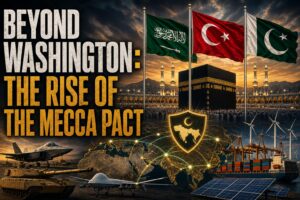
The signing of the Mecca Joint Defence Agreement between Saudi Arabia, Türkiye, and Pakistan on August 7, 2026 marks a genuine tectonic shift. For the first time in modern history, three heavyweights of the Muslim world have bypassed Washington and Tel Aviv entirely to architect their own security matrix. This isn’t just diplomatic reshuffling. It’s a calculated insurance policy taken out by states that have realized the old security umbrella is leaking badly.
Back in 2006, as Lebanon burned, Condoleezza Rice famously described the carnage as the painful birth pangs of a new Middle East, a region she imagined would permanently revolve around American aircraft carriers and unquestioned Israeli supremacy. It was an imperial blueprint built on hierarchy, intimidation, and the assumption that Arab capitals would forever accept being managed from outside. But history has a sharp sense of irony. The child has finally arrived, and it bears zero resemblance to the one American strategists ordered.
To understand why this pact matters, look at the sheer asymmetry of capabilities being brought to the table. Riyadh brings staggering financial capital and critical geography. Türkiye contributes an advanced, battle tested defense industry, world class drone technology, and one of NATO’s most formidable standing armies. Pakistan supplies what the other two desperately lack, a massive, experienced standing military and the Islamic world’s only operational nuclear deterrent. This division of labor is genuinely potent. Saudi money, Turkish technology, and Pakistani muscle create a tripartite axis that simply can’t be ignored or wished away by Western policy circles.
“Saudi money, Turkish technology, and Pakistani muscle create a tripartite axis that simply can’t be ignored or wished away by Western policy circles.”
Dismissing this as a mere photo op or toothless piece of parchment misses the entire plot. States don’t casually pool sovereign military assets, nuclear proximity, and industrial defense capacity unless the threat environment has fundamentally deteriorated. The old postwar arrangement was straightforward. The United States provided the architecture, the Gulf provided the oil, and Israel got unbridled strategic license to police the neighborhood. But permanent war in Gaza, Lebanon, and across West Asia has taught regional capitals a terrifying lesson. Dependence on an external hegemon doesn’t guarantee protection. Importing security from Washington increasingly means importing Washington and Tel Aviv’s endless wars, economic shocks, and geopolitical volatility right along with it.
Israel wanted a fragmented, intimidated region it could dominate from a position of unchallenged military hegemony. Instead, its relentless escalations have frightened neighboring states into unprecedented coordination with each other. The pyromaniac has finally succeeded in making the entire neighborhood invest in fire hoses together.
Critics who rush to point out the operational hurdles or the lack of an automated Article Five mechanism are missing the forest for the trees here. Alliances are rarely born fully formed with integrated command structures on day one. They evolve through shared necessity over time. And the argument that this pact is really just authoritarian regime survival dressed up in geopolitical language ignores how basically every major international security architecture in history has begun. Sovereignty for states doesn’t automatically translate into liberation for citizens, true, but the geopolitical reality remains unchanged either way. Regional powers are no longer asking permission from the old architect sitting in Washington.
What makes the Mecca Pact genuinely significant is its potential to reach beyond traditional military containment and reshape the economic and energy geography of the entire Eurasian landmass. Energy diplomacy today isn’t just about who owns the oil wells anymore. It’s about infrastructure security, maritime chokepoints, cyber resilience, and reliable supply chains. Large energy investments require long time horizons and massive capital that can’t easily get relocated away from drone strikes and missile threats. If Saudi, Turkish, and Pakistani security cooperation extends to protecting critical infrastructure, ports, and transit corridors, it dramatically lowers the risk calculus for multi billion dollar investments across the board.
Consider the geoeconomic chessboard here. Türkiye sits at the critical crossroads between Europe, Central Asia, and the Middle East, hungry to control energy transportation routes running through its territory. Saudi Arabia is aggressively transforming its economy and diversifying into clean energy, signing major renewable energy agreements with Ankara earlier this year. Pakistan offers a massive South Asian market and serves as a vital intersection point where Chinese capital, flowing through the China Pakistan Economic Corridor, already hums with real activity.
“The real fault line here isn’t Sunni versus Shia anymore. It’s regional autonomy versus externally managed insecurity.”
Connecting these dots creates a genuinely powerful alternative network. For decades, regional connectivity has been stifled by artificial fault lines and external divide and conquer strategies. By establishing an independent security umbrella, these nations can start insulating their trade routes, electricity grids, and renewable energy corridors from outside sabotage or sanctions. Iran faces a stark choice here too. Rather than viewing the pact through a paranoid sectarian lens, Tehran’s smartest move is probably to engage with these emerging infrastructure networks before it finds itself entirely bypassed by a new web of regional connectivity forming without it.
The tired label of calling this a Sunni NATO completely misunderstands the fluid nature of modern statecraft. Pakistan can’t afford to alienate its neighbors or fracture its own internal social fabric by buying into archaic sectarian divides. Türkiye maintains a famously independent foreign policy, weaving overlapping webs stretching from Eurasia to NATO. Saudi Arabia has painfully learned through its costly adventures in Yemen that endless confrontation is a luxury it can no longer afford. The real fault line here isn’t Sunni versus Shia anymore. It’s regional autonomy versus externally managed insecurity.
History will probably record August 7, 2026 as the moment the old imperial monopoly on regional order finally began to fracture. The Mecca Pact has its imperfections, certainly, and it leaves plenty of internal domestic contradictions untouched within its member states. But it represents a genuine psychological and strategic break from the past. Washington is standing outside the delivery room, Israel is nervously checking the paternity test, and a new Middle East is screaming its first independent breaths. The old architects can complain all they want, but the building is already being remodeled without them.
About the author:
Adam Reed is an International affairs analyst focusing on geopolitics, defense strategy, and global security trends.