
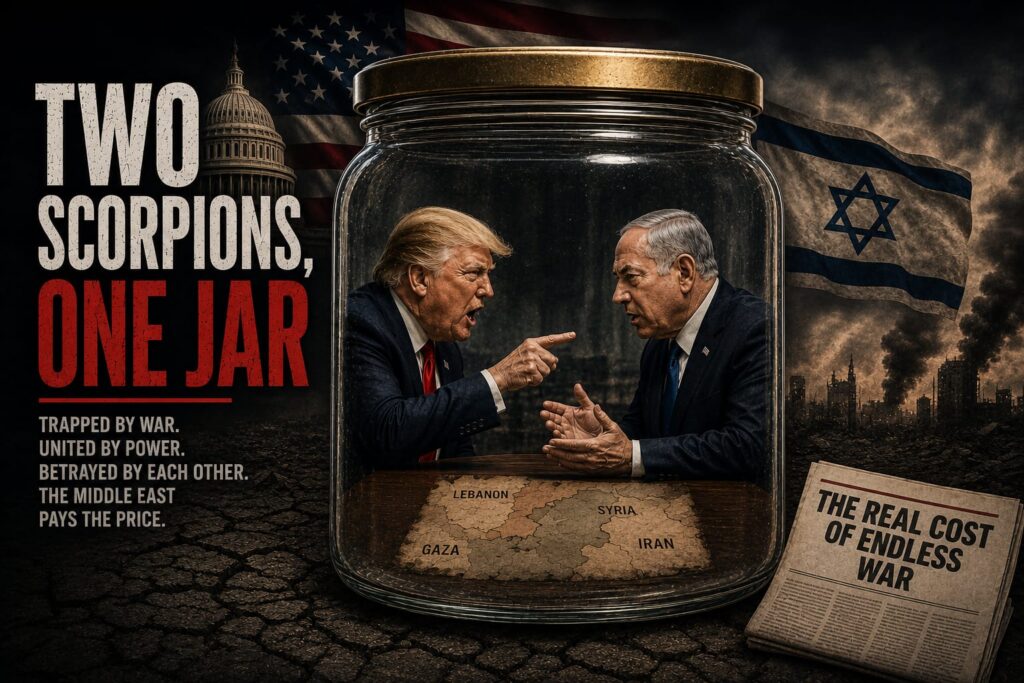
The structural reality of the modern alliance between Washington and Jerusalem has shed its polite, diplomatic pretenses, exposing a raw, transactional dynamic between two deeply compromised leaders. There is an ancient parable about two scorpions trapped inside a single glass jar. Neither can escape, neither harbors a shred of trust for the other, and sooner or later, a fatal strike is delivered. The sting does not come from a place of pure malice or ideological conviction; it occurs because the confined space of the jar has become entirely unlivable. Today, Donald Trump and Benjamin Netanyahu find themselves locked inside that very jar. The glass holding them together is the heavy wreckage of a volatile Middle East that their shared, hyper-aggressive policies have fundamentally destabilized.
For nearly a year, both men marched in seemingly flawless, locked steps. It was a union built on a perfect matching of political appetites: one man’s insatiable desire for media spectacle combined with the other’s legendary talent for branding catastrophic military maneuvers as historic deliverances. Netanyahu successfully sold Trump on a highly seductive illusion, the comforting premise that the state of Iran could be permanently shattered through a brief, high-tech, and surgical military campaign that would carry no real, long-term costs for the United States. Trump, a leader who has built an entire political brand on supreme confidence and a distinct lack of strategic self-doubt, eagerly bought into the pitch. But the reality on the ground shattered the illusion. The war arrived, yet Iran did not collapse under the weight of the strikes. When the massive geopolitical and economic bills for this conflict finally came due, they were delivered directly to the doorstep of the White House, leaving Trump holding the check.
The intellectual verdict on this relationship has been laid bare by realist scholars who study the deep mechanisms of American foreign policy. John Mearsheimer of the University of Chicago, a leading analyst of Washington’s strategic deference to Israeli interests, has summarized the failure with characteristic coldness. In Mearsheimer’s view, Netanyahu effectively manipulated Trump into believing that a war against Tehran would be a short, decisive, and easily contained triumph. Trump was simply foolish enough to swallow the promise whole. Mearsheimer’s broader, long-standing critique is even more severe: it highlights a system where the domestic pro-Israel lobbying apparatus exerts such immense gravity over American politicians that even a self-proclaimed master dealmaker like Trump finds himself repeatedly dancing to a tune written entirely in Jerusalem.
This underlying friction finally exploded into full public view during a recent, highly volatile phone exchange regarding Israel’s sudden escalation of hostilities in Lebanon. The absolute profanity used in that conversation tore away whatever polite fictions remained in the relationship. During an expletive-laden fifteen-minute call, the details of which were later confirmed by Trump himself on a prominent podcast, the US President completely lost his temper. Infuriated that Netanyahu’s aggressive bombing campaigns inside Beirut were actively sabotaging Washington’s delicate, back-channel negotiations to secure a broader peace framework with Iran, Trump unleashed an unprecedented barrage of insults. He explicitly called Netanyahu “f-cking crazy” and launched into a brutal reminder of who holds the real power in the relationship. Trump yelled that Netanyahu would currently be sitting inside a criminal prison cell on pending domestic corruption charges were it not for the absolute shielding and legal cover provided by American executive power. He warned the Israeli leader that his destructive methods had backfired so spectacularly that the entire global community now despised him and isolated Israel.
This is not the respectful dialogue of a historic, values-based international alliance. It is the raw, unvarnished language of an angry landlord screaming at a reckless tenant who has just lit the apartment building on fire and still has the audacity to ask for a positive recommendation letter. Netanyahu, a political survivor who has made a career out of outlasting his critics, absorbed the verbal humiliation in complete silence. American officials familiar with the raw transcripts of the call noted that the legendary warrior-statesman was entirely steamrolled by Trump’s fury, offering little more than a quiet, submissive agreement to turn his troops back from a planned assault on the Lebanese capital. While Netanyahu’s office quickly released a standard, sterile public relations statement insisting that Israel’s core military objectives remained unchanged, the illusion of a partnership of equals was permanently dead.
Columbia University economist and global policy analyst Jeffrey Sachs notes that this explosive dynamic is simply the latest, most dangerous chapter in a decades-long American effort to achieve total regional hegemony in the Middle East. Sachs connects the current war directly to the infamous “Clean Break” doctrine first drawn up by neo-conservative strategists in 1996. That blueprint explicitly envisioned using the raw military might of the United States as an aggressive enforcement tool to systematically topple independent regimes across the region to ensure total Israeli dominance. In this calculated game, Donald Trump is not a respected ideological partner; he is a highly specific, transactional instrument wielded by an embattled prime minister who is running out of options to escape his own judicial reckonings at home.
Even within Israel’s fracturing domestic consensus, the rot is becoming impossible to ignore. Haaretz commentator Gideon Levy has repeatedly sounded the alarm, warning that the Israeli public is blindly following Netanyahu down a dark, reckless path toward a systemic national reckoning that it refuses to consciously imagine. Levy observes that the historic lifeline connecting Washington and Jerusalem is rapidly stretching toward its absolute breaking point. Mainstream American commentators like Thomas Friedman have openly echoed this deep anxiety. Friedman has admitted to the profound discomfort of wanting to see hostile regional regimes countered, while simultaneously feeling a deep sense of dread over the fact that a military victory would only serve to validate and protect two deeply flawed, anti-democratic leaders who are facing active criminal indictments within their own domestic systems.
Ultimately, the partnership relies entirely on the cold, clinical logic of real estate and short-term political survival. As Phyllis Bennis of the Institute for Policy Studies has noted, this is a purely mercenary transaction. Trump is a second-term president with no future re-election campaigns to worry about, focused solely on manufacturing a dramatic foreign policy legacy to scrub his historical record. Netanyahu is a desperate political operator facing a fast-approaching national election and a looming courtroom date that he has spent a decade trying to evade. Neither man possesses the capacity to generate a genuine political victory through standard, effective governance. Therefore, they are forced to artificially manufacture the illusion of strength through the continuous application of high-stakes regional warfare.
Both leaders remain fundamentally disposable to the very hardline political coalitions that elevated them to power. Netanyahu’s ultimate insurance policies are AIPAC, the extreme religious right in Jerusalem, and the hawkish Zionist voting bloc within the United States Senate. Trump’s survival depends entirely on the massive financial checkbooks of deep-pocketed mega-donors like Miriam Adelson and the unyielding loyalty of his populist MAGA base. Each man knows that a single strategic misstep or compromise would result in them being instantly thrown to those fanatical bases as a political sacrifice. This is why the scorpion metaphor fits so perfectly. The two individuals who need each other the most to maintain their grip on power are simultaneously the two actors most capable of delivering a lethal, backstabbing sting. Trump has proven he will humiliate Netanyahu the second a conflict stops serving his domestic poll numbers, and Netanyahu will actively defy White House orders the moment his fragile governing coalition threatens to collapse. When the final strike is delivered, it will not be based on high principle. It will be an act of raw, desperate self-preservation carried out inside a glass jar built on a foundation of human suffering, while the broader region is left to disintegrate in the background.