
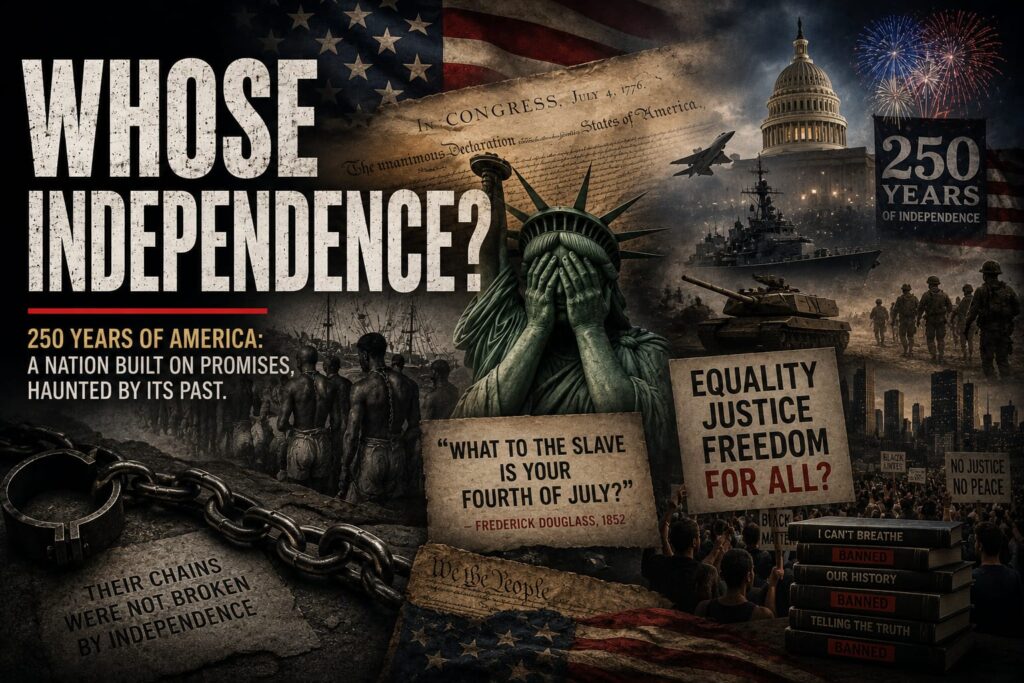
The United States marks its semi-quincentennial under a heavy blanket of historical irony and deep domestic fracture. As the nation hits the 250-year milestone, the standard mythology of an exceptional republic built on universal liberty, equality, and democracy is completely falling apart. The original founding narrative presents the Revolutionary War as a clean, moral crusade to banish the distant tyranny of British colonial rule. Yet, a closer look at 1776 reveals that the celebrated triumph of independence was never just about resisting taxation without representation. It was also fundamentally about securing and preserving the right to retain human slaves, a reality that left millions entirely excluded from the promises of the Declaration of Independence. This original, systemic contradiction set up a trajectory where the nation’s proudest celebrations have frequently masked serious historical crimes.
This deep-seated paradox was famously laid bare in 1852 by Frederick Douglass, a prominent African-American intellectual and abolitionist, during a historic Independence Day oration in Rochester, New York. Addressing a predominantly white audience, Douglass delivered a blistering critique that still carries immense weight today. He directly asked what the Fourth of July meant to the American slave, answering that it was a day that revealed the constant injustice and cruelty of which they were the daily victim. To the enslaved, Douglass declared, the national celebration was an outright sham, the boasted liberty an unholy license, and the national greatness mere swelling vanity. He called the sounds of rejoicing heartless, the shouting of liberty a hollow mockery, and the national prayers a thin veil to cover up shocking, bloody practices.
The historical timeline confirms that the abolition of this system required an incredibly bloody civil war that claimed up to 750,000 lives, followed by a brief, hopeful period of Reconstruction that was quickly crushed by a violent white supremacist backlash. A full century separated the Emancipation Proclamation of 1865 from the Voting Rights Act of 1965, a landmark achievement of the civil rights movement that is currently being systematically rolled back by conservative legal assaults and state-level voter restrictions. This structural retrenchment underlines the thesis of Princeton historian Eddie Glaude’s recent book, America, USA: How Race Shadows the Nation’s Anniversaries, which opens with the brutally honest admission of a scholar disillusioned by how deeply racial hierarchy continues to define the American story.
Beyond its domestic failures, the United States has consistently exported immense violence abroad, a reality that famously led Martin Luther King Jr. to label his own country “the greatest purveyor of violence in the world today” during his 1967 Riverside Church speech. King warned that a nation continuing year after year to spend more money on military defense than on programs of social uplift was rapidly approaching spiritual death. Decades later, that warning has manifested in an astronomical annual military budget that has surged past $1.5 trillion when factoring in supplementary war funds, intelligence operations, and recent military misadventures. This bloated war machine drains vital public resources while driving a hyper-militarized foreign policy that has left a trail of imperial disasters across the globe, from the total destruction of Vietnam to the chaotic, long-term destabilization of the Middle East.
The structural violence of the American empire is comprehensively documented in Chalmers Johnson’s Blowback trilogy, which provides an unsparing analysis of how Washington’s pursuit of global hegemony has consistently produced catastrophic unintended consequences. This imperial expansion did not start in the twentieth century; it began at the nation’s inception with the systematic genocide and forced displacement of Native Americans, followed closely by wars of conquest that sliced off half of Mexico’s sovereign territory. The historical record includes the atomic destruction of Hiroshima and Nagasaki, the installation and funding of brutal military dictatorships throughout Latin America and Asia, and a relentless institutional effort to crush popular, sovereign independence movements that refused to align with Western corporate interests.
Domestically, the trajectory of progress is visibly reversing as an open political war is waged against diversity, equity, inclusion, reproductive rights, and the fundamental right to peaceful protest. State legislatures across the country are actively banning books, restricting academic freedom, and making a critical, honest examination of American history effectively illegal in public classrooms. The celebrated institutions of higher education that once served as global benchmarks for free thought are now being targeted by political interference and administrative crackdowns designed to silence dissent against current foreign policy objectives. This aggressive suppression of speech represents a coordinated attempt by dominant political structures to police historical memory and preserve a sanitized, inaccurate version of the national past.
As Howard Zinn meticulously demonstrated in A People’s History of the United States, any genuine progress achieved in America has never been a gift from the ruling elite; it has always been clawed back through relentless, bottom-up resistance by ordinary workers, women, and racial minorities. The tragedy of the current moment is that the hard-won victories of the twentieth century are being rapidly dismantled by a deeply reactionary political apparatus. With some of its worst, most exclusionary instincts on display within the highest levels of government, the nation appears to have reached a peak of malevolence both at home and abroad. Given the systemic erosion of civil liberties and the steady militarization of domestic law enforcement, it is impossible to predict whether even darker periods of authoritarian control lie immediately ahead.
Ultimately, the 250th anniversary of the United States offers very little ground for genuine, uncritical celebration. While a select political elite and hyper-nationalist factions prepare to stage elaborate public spectacles of patriotism, the reality for millions of marginalized citizens remains one of economic precarity, systemic racism, and a profound loss of bodily autonomy. The grand rhetoric of the founding fathers serves primarily as an ideological shield to distract from the stark reality of deep class division, racial oppression, and endless foreign conflict. On this milestone anniversary, the most rational and patriotic act is not to indulge in empty nationalist myths, but to look closely at the nation’s unvarnished history. For those who recognize the immense gap between America’s boasted ideals and its bloody practices, the only honest response to this milestone is to echo Douglass’s enduring sentiment: this anniversary belongs to the architects of power, not to the victims of its hubris.