
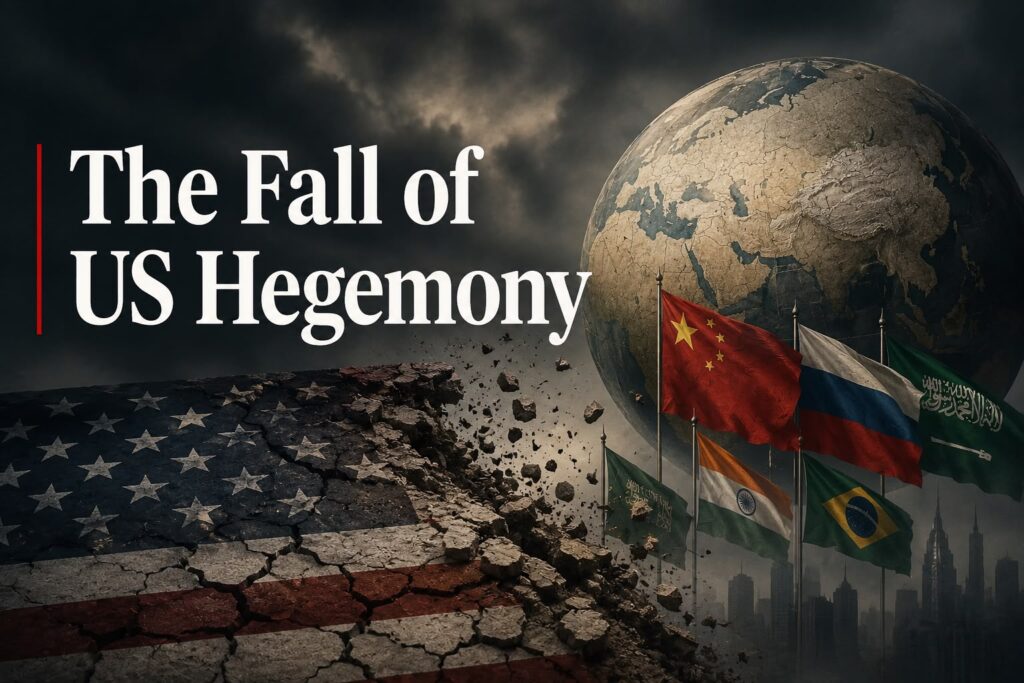
The end of US hegemony is not an abstract discussion anymore that can be found only at university seminars and think tanks. The erosion of US supremacy is one of the major geopolitical facts of the twenty-first century. During almost eighty years following World War II, the United States had been building the international order through its unmatched military power, economic domination, technological inventions, and alliance system. With the collapse of the Soviet Union in 1991, many analysts proclaimed the arrival of the “unipolar moment”, and political scientist Charles Krauthammer believed that no one could challenge the US supremacy. However, barely thirty years later, the world is a very different place where the rise of China, the revival of regional powers, repeated military miscalculations, and growing domestic political divisions have gradually eroded Washington’s ability to dictate global affairs. America remains the world’s most powerful state, but the era of uncontested American hegemony is increasingly giving way to a more fragmented and multipolar international order.
American hegemony was based on unparalleled economic might. By the end of the Second World War, the country represented almost 50 percent of total worldwide industrial output and had the biggest gold reserves in the world. Organizations such as the International Monetary Fund, the World Bank, and the Bretton Woods system of international currency relations were formed primarily under American guidance. The US dollar became the reserve currency of the world, representing almost 58 percent of all foreign exchange reserves of the world, according to the figures provided by the IMF. Nevertheless, economic might is gradually eroding. As per the data from the World Bank, China has overtaken the US and become the second-biggest economy in nominal terms and even the biggest economy when calculated at purchasing power parity. China’s share in worldwide manufacturing is already more than 30 percent, which is higher than the share of the US, Japan, and Germany taken together. This shift represents not simply economic competition but a redistribution of global influence that directly challenges decades of American predominance.
Similarly, military dominance, which was once seen as the clear strength of America, has been put in question in recent years. The USA has continued to outspend other nations, spending about $900 billion per year on defense according to the Stockholm International Peace Research Institute (SIPRI). However, high spending on its military forces has not been followed by successful strategies. The conflicts in Afghanistan and Iraq provide a perfect example of that. Spending $2.3 trillion in Afghanistan for two decades, the USA finally had to leave Afghanistan in 2021, resulting in the return of the Taliban to power. Moreover, the invasion of Iraq in 2003 only destabilized the region and made Iran gain even more power. Former US Defense Secretary Robert Gates once admitted, “We have never once gotten it right” when referring to many American military interventions. Such experiences have damaged perceptions of American strategic judgment even among close allies.
The emergence of China may very well be the most defining challenge to US hegemonic dominance. Deng Xiaoping’s policy of “Reform and Opening Up” launched in 1978 transformed China from an isolated economy into the world’s manufacturing powerhouse. Today, China is America’s largest trading competitor, the leading exporter globally, and a technological rival in sectors ranging from artificial intelligence to electric vehicles and 5G telecommunications. The Belt and Road Initiative, which involves over 150 countries, has made China extend its diplomatic and economic influence throughout Asia, Africa, Latin America, and even Europe. Rather than confronting isolated regional competitors, Washington now faces a systemic challenger capable of competing across economic, technological, and diplomatic fronts simultaneously.
Moreover, the digital age has had a profound effect on the balance of power in the world. Technological leadership is no longer monopolized by Silicon Valley alone. Firms from China, including Huawei, BYD, Tencent, and CATL, are some of the top innovators worldwide in fields of telecommunication, electric cars, renewable energy, and batteries. The field of artificial intelligence is another battleground of competition and geopolitical significance. America is still ahead in terms of research universities, semiconductor chip design, and venture capital investments, but technological superiority is now dispersed. Control over innovation has become as strategically important as control over territory or military bases.
The alliance structure that has been one of America’s greatest strategic advantages is also under strain. European allies are beginning to doubt the reliability of America after its sudden change in positions regarding climate agreements, trade deals, and security commitments. In the Middle East region, some of the allies of the United States are forging closer links not only with China but also pragmatically dealing with Russia at the same time. The ability of China to successfully mediate the peace between Saudi Arabia and Iran in 2023 is a good example of diplomatic achievement in the region controlled by America for so many years. Another example is the BRICS expansion, which includes Saudi Arabia, Iran, Egypt, Ethiopia, and the UAE, reflecting a broader desire among emerging powers to diversify international partnerships beyond Washington.
However, weakening of American hegemony does not mean the collapse of America. The US is still the largest military power, owns the best education system, attracts huge investment from around the world, and retains its dominance in the international finance network through the dollar. America also serves as a home for some of the world’s biggest tech firms and leads the world in science and innovation. The real transformation lies not in America’s disappearance but in the emergence of credible alternatives capable of limiting Washington’s freedom of action.
Ultimately, the story of American hegemony is evolving from one of unrivalled dominance to one of competitive coexistence. The international system is becoming increasingly multipolar, where influence is shared among several major centers of power rather than concentrated in a single capital. History rarely preserves permanent supremacy. As former US National Security Advisor Zbigniew Brzezinski once observed, “Power is increasingly dispersed.” The defining challenge of the coming decades will not be whether American influence disappears altogether, but whether the United States successfully adapts to a world where leadership must increasingly be negotiated rather than assumed.