
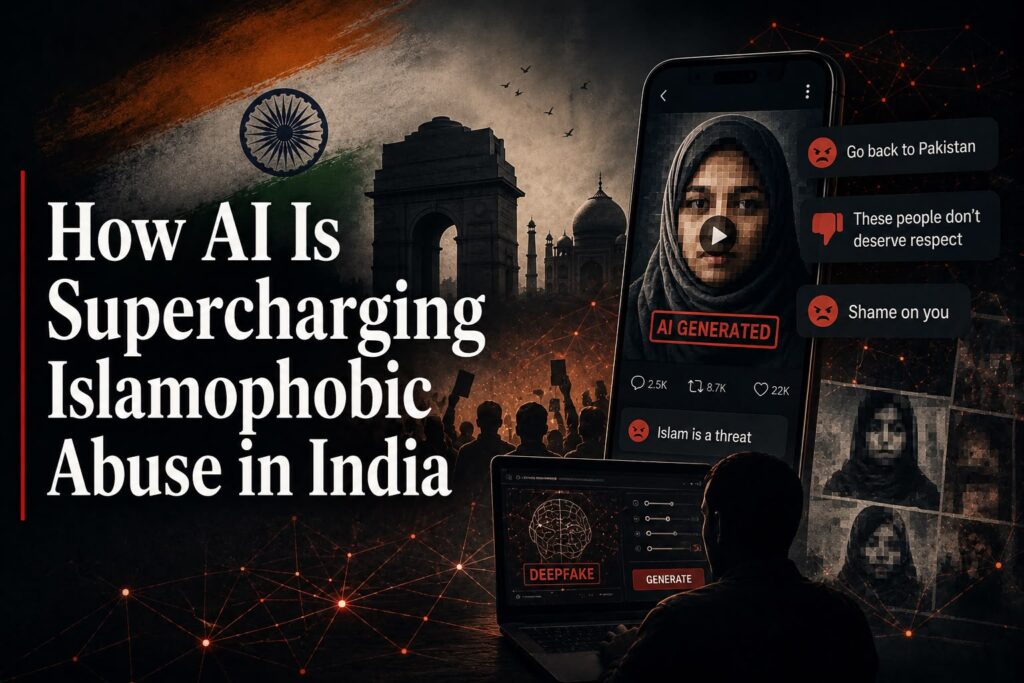
The emergence of artificial intelligence was celebrated as the beginning of a technological revolution that would revolutionize medicine, education, governance, and scientific research. However, just like every transformative technology in history, artificial intelligence also bears a sinister side. One such dark reality about the use of AI in India includes the increasing deployment of the technology for the creation of fake videos of Muslim women, deepfake pornography, and hate speech targeting Muslim women on the Internet. While the earlier form involved the manipulation of pictures and anonymous trolling, what is happening today with the rise of AI technology is far more advanced and can ruin someone’s reputation in a matter of hours. The technology may be new, but the prejudice driving it is not. AI has become a powerful amplifier of existing social divisions, turning Islamophobia and misogyny into highly scalable digital weapons.
The recent investigation conducted by Al Jazeera, which was based on research by the Centre for the Study of Organized Hate (CSOH) in Washington, shows the scary magnitude of this trend. The researchers analyzed 1,326 images and videos generated using artificial intelligence software and posted from 297 open social media accounts from May 2023 to May 2025. These images and videos showed how Muslim women are being sexualized and received more than 6.7 million interactions on X, Facebook, and Instagram. This data proves that this is not just an isolated phenomenon performed by a few internet trolls. It has become an organized ecosystem where hateful content is rewarded by algorithms, amplified through coordinated networks and consumed by millions.
The experience of Kashmiri model Samreen Ayoub illustrates how devastating these attacks can be. AI-generated videos stitched together ordinary university photographs, fabricated narration and false headlines to portray her as a Muslim woman involved in prostitution. The video even misidentified her own brother as her alleged pimp. The realism of generative AI meant that anyone watching the clip could easily mistake fiction for fact. As Ayoub herself observed, even her own parents might have believed it. Her case demonstrates that the greatest danger of deepfakes lies not merely in technological sophistication but in their ability to manufacture credibility.
The consequences extend far beyond digital embarrassment. Ayoub described the campaign as a “digital lynching” after dozens of accounts simultaneously circulated the fabricated video. Abusive phone calls followed, brands stopped approaching her for modelling assignments, and her professional reputation suffered lasting damage. Digital violence increasingly produces real-world consequences. A manipulated image uploaded in seconds can erase years of personal and professional effort. As legal expert Apar Gupta aptly remarked, “Even if the image is fake, it creates a permanent scarlet letter for women.”
The targeting of Muslim women through technology is not without precedent. The country has already seen cases such as “Sulli Deals” and “Bulli Bai,” which occurred in 2021 and 2022. In these incidents, photographs of well-known Muslim women, including journalists, activists, and students, were uploaded on fake online “auction” websites. These cases created uproar and led to criminal investigations, resulting in arrests. However, the advent of generative AI technology has made the problem much more severe. What once required editing skills now requires little more than uploading a photograph into freely available AI software capable of producing realistic fake videos or explicit images within minutes.
Experts argue that AI has fundamentally altered the economics of online harassment. Zenith Khan, co-author of the CSOH study, noted that “Generative AI has made the transformation of sexual fantasy into imagery possible at speed and at no cost.” Deepfake applications are becoming cheaper, faster and more accessible every year. According to global cybersecurity firm Sumsub, deepfake incidents worldwide have increased dramatically over the past few years as generative AI tools became publicly available. This technological accessibility means that organized harassment campaigns no longer require sophisticated technical expertise. Hatred has effectively been automated.
Researchers also argue that the abuse cannot be understood merely as misogyny. Rather, it has become more intertwined with issues of gender, religion, and politics. The CSOH survey revealed visual themes in which Muslim women dressed in their religious outfits appear in explicitly sexualized or degrading settings, often accompanied by images of “saviours” who are Hindu males. On the other hand, Muslim men were shown to be violent, abusive, and morally corrupt. Such imagery reinforces communal stereotypes while weaponizing women’s bodies as symbols of collective humiliation.
Media anthropologist Sahana Udupa describes this phenomenon as the “pornification of politics,” where memes, humour and sexual imagery are deployed not merely for entertainment but as political instruments. The objective extends beyond insulting individual women. It seeks to degrade an entire community by attacking what many societies perceive as symbols of family honor and social dignity. Researcher Soma Basu similarly argues that Muslim women’s bodies have increasingly become symbolic battlegrounds within India’s polarized political environment.
In most cases, however, the psychological implications are immense. Activist Afreen Fatima, previously victimized in the Sulli Deals episode, stated that the emergence of AI technology only escalated an already existing climate of fear. According to Fatima, she had been subjected to rape threats and other forms of harassment for years after opposing the Citizenship (Amendment) Act. With the probability of being victimized through deepfake pornography that would be made using her pictures, there is a “fear psychosis”. Online abuse impacts behavior in real life. Women start avoiding socializing in public spaces and on social media due to the risk of online threats turning into actual violence.
The debate ultimately raises broader questions about the ethical governance of artificial intelligence. In global summits on AI, states always talk about innovation, economy, and digitization. But very few talks go into how these technologies can be used against vulnerable groups of people in countries like India. As philosopher Hannah Arendt once cautioned, “The ideal subject of totalitarian rule is not the convinced Nazi or the convinced Communist, but people for whom the distinction between fact and fiction no longer exists.” Generative AI threatens precisely that distinction by making fabricated realities appear indistinguishable from authentic ones.
In conclusion, the weaponization of artificial intelligence against Muslim women in India is not merely a technological issue, but a cautionary tale on how quickly hate can adapt in step with technological developments. Deepfakes, false narratives, and sexually explicit content created by AI are no longer just an individual form of harassment on the internet but tools of intimidation aimed primarily at women in marginalized groups. As artificial intelligence makes such content cheaper, faster and more convincing to produce, Indian cyberspace risks becoming an increasingly hostile environment where misogyny and anti-Muslim hatred feed off each other, turning social media into a theatre of harassment rather than public discourse. Unless governments, technology companies and law enforcement respond with urgency and accountability, AI will continue to empower those who seek to silence, intimidate and dehumanize vulnerable women, making digital spaces a mirror of some of India’s deepest prejudices and fantasies rather than a platform for inclusion and dignity.