
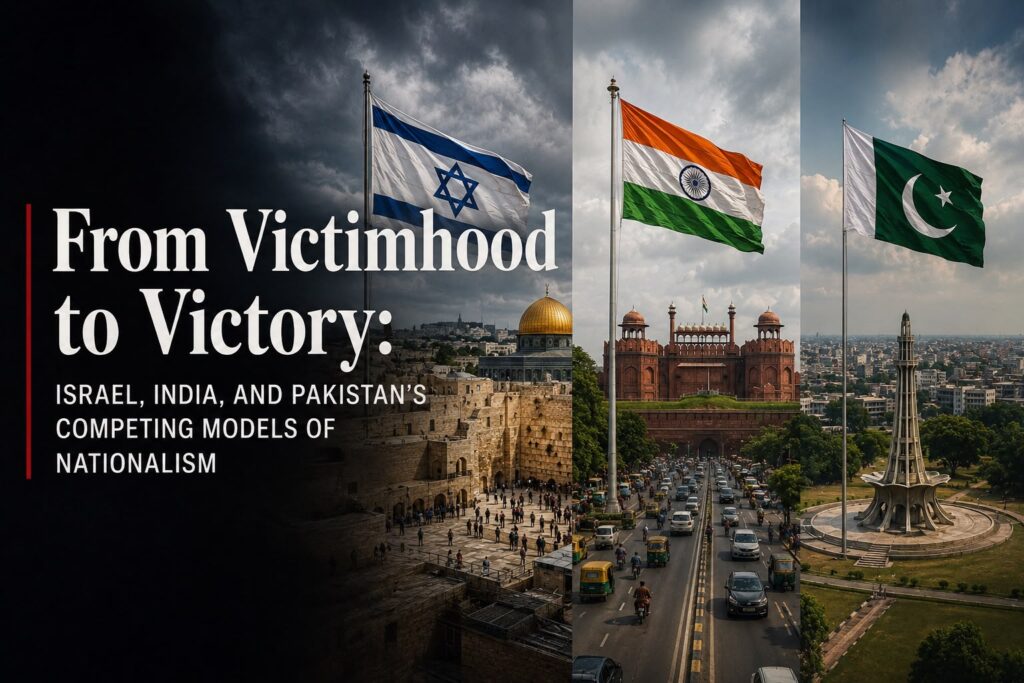
Since the early years of the twenty-first century, there has been an increasing tendency for nationalism to be associated not with the accomplishments of nations, but rather with their perceived sufferings. Politicians all around the world have realized that the trauma of the past can be converted into political power and used as a means of garnering support at home, silencing opposition, and justifying difficult actions on the political stage. Jie-Hyun Lim, a South Korean historian, calls this approach “victimhood nationalism,” a political culture in which collective suffering becomes the foundation of national identity and a source of moral authority. Yet recent developments in West and South Asia suggest that another model may be emerging, one that seeks to derive legitimacy from strategic achievements rather than historical grievances. The contrasting trajectories of Israel, India, and Pakistan offer a revealing case study of these competing forms of nationalism.
Victimhood nationalism is not a product of the modern age. Nations have long commemorated wars, occupations, and collective tragedies. What makes the current form different is how political elites keep invoking historical scars in order to justify their actions in the present day. According to Lilie Chouliaraki’s book Wronged: The Weaponization of Victimhood, politicians keep positioning themselves as perpetual victims since victimhood evokes sympathy, protects them from blame, and attracts more followers than success. In an era dominated by social media, emotional narratives often travel faster than nuanced historical debate, making grievance one of the most powerful political currencies.
No other country reflects this trend better than Israel. The Holocaust is considered to be one of the biggest tragedies in history, with about six million Jews killed during the Second World War. There is no doubt that this tragedy has influenced Israel’s state identity and its resolve to make sure such persecution will not happen again. Nevertheless, there are many scholars who claim that remembrance has turned from commemoration into an essential element of statecraft. Israeli leaders frequently frame criticism of military operations or settlement policies through the lens of historical anti-Semitism, portraying contemporary security challenges as extensions of centuries-old persecution. Such discourse often influences international discussion, particularly as the humanitarian consequences of the war in Gaza have drawn unprecedented global scrutiny. According to Gaza health authorities, tens of thousands of Palestinians have been killed since October 2023, while the United Nations has repeatedly warned of catastrophic humanitarian conditions. UN Secretary-General António Guterres has described Gaza as “a killing field,” illustrating the scale of international concern.
However, this kind of story is not without its critics, especially in the Jewish communities. Notable Jewish thinkers like Noam Chomsky, Judith Butler, Ilan Pappe, Avi Shlaim, and Norman Finkelstein, among others, have claimed that a critique of the Israeli government’s policies is not tantamount to anti-Jewish sentiments. These scholars show that debate about the policies of Israel does indeed exist even among Jewish scholars who are well acquainted with the historical implications of the Holocaust. Despite this, political exploitation of historical trauma remains a dominant feature of politics in Israel, both domestically and internationally.
A similar pattern has become increasingly visible in India under the ideology of Hindutva. The narrative followed by certain factions of Hindu nationalism often characterizes the history of centuries-long Muslim rule in India as continuous civilizational oppression, which continues even today through the existence of Pakistan. Such an interpretation has become essential in the context of India’s domestic politics and has implications for issues related to citizenship, religion, and security. In the aftermath of the attack in Pahalgam in 2025, India’s government accused Pakistan of sponsoring terrorism even when there was no conclusive evidence available in the public domain. The ensuing warlike exchanges took place at a swift pace before international diplomacy helped defuse the situation. Prime Minister Narendra Modi’s televised statement expressing astonishment that “Pakistan attacked us instead” reflected more than wartime frustration; it reinforced a narrative portraying India as a nation repeatedly forced into defensive action.
However, historians warn about taking overly simple approaches to the history of medieval times. As demonstrated by the works of American historian Richard M. Eaton, in his book ‘Temple Desecration and Indo-Muslim States’, there were nearly eighty incidents of desecration of temples in India under Muslim rulers over a period of several centuries, a historical fact worth noting, but a fact different enough from general statements made regarding the systematic destruction of thousands of temples. In this case, we see how it is important not to confuse political rhetoric with history.
Pakistan seems to be trying out a new storyline. After it conflicted with India in May 2025, Pakistan portrayed the results of the situation as a demonstration of its military prowess and its ability to rise to the occasion. Shortly thereafter, the diplomatic efforts of Islamabad during the heightened tension between the US and Iran served to boost its profile in the region. It is yet to be determined whether all these moves will end up redefining the position of Pakistan in the world, but they indicate an attempt to anchor national confidence in contemporary achievements rather than inherited grievances. For a country that spent decades confronting terrorism, political instability, and negative international perceptions, projecting diplomatic relevance represents a significant strategic objective.
There are many examples from history to support both strategies. In the aftermath of the American Civil War, partisans of the defeated Confederate States crafted the “Lost Cause” legend, which turned military defeat into a mythology of noble suffering that shaped southern American politics for generations to come. Post-independence Zimbabwe was justified in its focus on the crimes committed during the period of colonialism. But under President Robert Mugabe, the anti-colonial language grew to be an ideological tool protecting him from critique amid economic ruin and hyperinflation in his country. Legitimate historical grievances gradually evolved into permanent political justification.
In contrast, South Korea offers a different case study. The period from 1910 to 1945, when Japan colonized South Korea, was a time of immense pain for Koreans. However, the current image of South Korea was created by means of industrialization, technological advancements, and education. Today, corporations like Samsung, Hyundai, and LG are recognized globally, while South Korea consistently ranks among the world’s leading innovators according to the Global Innovation Index. National pride increasingly derives from economic transformation, technological achievement, and cultural influence rather than perpetual emphasis on colonial trauma alone.
Political scholars have long contended that a successful state inevitably evolves from a nation based on memory to a state that derives legitimacy based on performance. It is ultimately the ability of states to provide security, development, prosperity, diplomatic clout, and economic opportunities that will be assessed by their citizens, rather than just their skill in commemorating the pain and suffering of their past.
The contrasting experiences of Israel, India, and Pakistan, therefore, illuminate a broader transformation in contemporary geopolitics. Israel and India are turning to the past experience of victimhood as one of the main political instruments, and Pakistan seems ready to reinvent itself in terms of its recent military and diplomatic successes. However, Pakistan’s success does not depend solely on symbolic gains but will be determined by the country’s ability to convert its current success into sustained economic and institutional development and constructive regional policy. Ultimately, history may remember nations less for the tragedies they inherited than for what they built after those tragedies. Victimhood can inspire resilience, but achievement remains the more enduring foundation upon which lasting national confidence and international respect are built.