
If military intervention proves to be a politically risky approach while diplomacy fails to offer adequate leverage, hegemonies resort to economic sanctions as their primary weapon. Portraying sanctions as a non-military form of coercion, these economic measures are meant to change the behavior of states by cutting them off from global markets, banking facilities, and technology. In the last forty years, sanctions have emerged as one of the most common instruments of statecraft in international politics. However, a key question about the effectiveness of sanctions still remains unanswered: Do sanctions really work?
The answer, however, is dependent upon the definition of success. If the purpose is simply causing economic harm to a country, then sanctions are quite powerful in achieving this objective. They can limit the conduct of trade, deny access to finances, decrease the income of governments and slow down economic growth. Yet when it comes to the purposes of making governments abandon strategic decisions, ousting regimes or bringing about major behavioral change, the data points to a different conclusion.
Sanctions against Iran are a good example of how sanctions have been used over the years. After the revolution in 1979, there was a gradual imposition of several forms of sanctions against Iran by the U.S., which grew even stronger due to Iran’s nuclear activities in the region. The result is one of the most advanced sets of sanctions anywhere around the world, from almost complete financial sanctions to energy sanctions. However, all these years, the fundamental system in Tehran has stayed the same.
Sanctions have become harsh in their latest round. With further restrictions and maritime inspections imposed in 2026, Iran’s export of crude oil dropped to about 209,000 barrels a day in May 2026, based on shipping data. This is one of the lowest figures since the sanctions period that occurred during the late 2010s. Despite the harsh conditions, however, Iran still manages to channel its exports through middlemen purchasers, discounted prices, and other shipping routes, especially for Asian countries.
The economic cost may be clear, yet the political reality is still very much the same. Regardless of sanctions or periods of political isolation, Iran has not changed its position on regional security or its overall military strategy.
A similar history is evident in Cuba as well. The US embargo, which has been enforced for more than six decades, has produced cumulative estimated losses of above $164 billion, based on estimates made by the Cuban government. The embargo, although tightened occasionally and with periodic briefings of dialogue, has failed to accomplish its primary political goal: restructuring the Cuban government system. Latest trade statistics have revealed a decline of more than 35 percent in Cuba’s imports of fuel and crude products in the year 2025. Nevertheless, the political structure continues to remain robust amidst these difficulties.
Russia is arguably the most significant case study of sanctions in the current era. After the outbreak of the Russian-Ukrainian conflict in 2022, the West has levied over 20,000 individual sanctions on Russia, which has thus become the most heavily sanctioned nation in recent history. Early forecasts predicted deep recession and political destabilization.
Rather, Russia was able to adapt itself with the help of trade diversion and economic adjustment. According to the data provided by the International Monetary Fund, the economy of Russia grew by 3.6 percent in 2023 and by 4.1 percent in 2024, and even the revised figures for 2025-2026 reveal that there will be growth of 1-2 percent per year. Despite continued restrictions on finance, technology imports, and energy exports. Moscow has significantly redirected exports toward China, India, and other non-Western markets, while building parallel payment and logistics systems to reduce reliance on Western infrastructure.
Sanctions have undoubtedly resulted in sustained structural costs for Russia, especially in terms of its technological capabilities and financial flows, but sanctions have not caused Russia to abandon its basic goals in Ukraine.
North Korea still stands out as the best example of the ability of states to withstand sanctions regimes. Having been under the harshest sanctions regime for more than two decades, North Korea continues to develop and enhance its strategic capacity. As assessed by recent defense and intelligence reports, North Korea has developed at least 50 nuclear warheads by 2025 in addition to other missile developments. Sanctions, although they have economically isolated the country completely, have largely failed in their main objective of denuclearization.
Another country that fits perfectly into this paradigm is Venezuela. From 2013 to 2021, the Venezuelan economy collapsed by around 75 percent, arguably one of the greatest peacetime contractions experienced by an economy in modern times. Nonetheless, economic devastation did not translate into political transition, underscoring the limits of coercive economic pressure in politically consolidated systems.
A common structure is apparent in all of these cases. Sanctions are very useful in creating economic pressure; however, they are much less successful when it comes to predicting political consequences. The major explanation for this is adaptation. The countries affected by sanctions have increasingly diversified their trade routes and financial connections.
The above tendency has become even more pronounced since the mid-2020s in the context of a fragmented world economy. The emergence of China as a second economic center has dramatically weakened the effectiveness of sanctions as a tool of international pressure. Increasing amounts of energy resources from Russia and Iran travel to Asia at discounted prices. while alternative payment systems reduce dependence on Western-controlled financial institutions.
Equally crucial is the domestic political impact. Far from being detrimental to domestic politics, sanctions actually tend to bolster regime solidarity by giving the ruling class an opportunity to paint domestic hardships as acts of external coercion. Sanctions actually bolster the legitimacy of the regime against which they are imposed, at least in certain situations.
This does not diminish the importance of sanctions altogether; sanctions may hinder technology transfer, limit access to sophisticated weapons, raise transaction costs, and convey international displeasure. On rare occasions, particularly in cases with clear goals, finite time horizons, and strong international support, sanctions have facilitated agreements.
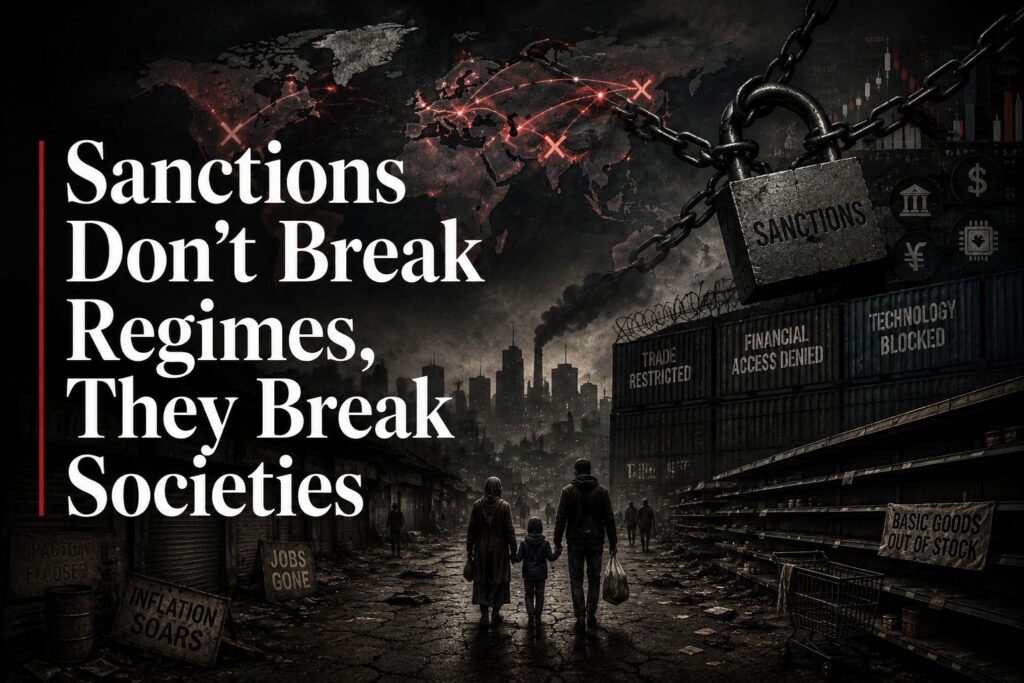
Sanctions should be thus viewed not as a tool for forcing political reforms, but as an instrument of constant economic pressure, which proves to be very conditional in terms of effectiveness. Designed to penalize governments, these measures affect the population in a way that leads to inflation, shortage of goods, and increased unemployment rates and, at the same time, regimes can find ways to sustain themselves and their control over the population and resources. This inevitably results in an ongoing discrepancy when there are social and economic difficulties among the population despite the absence of political changes within the country.