
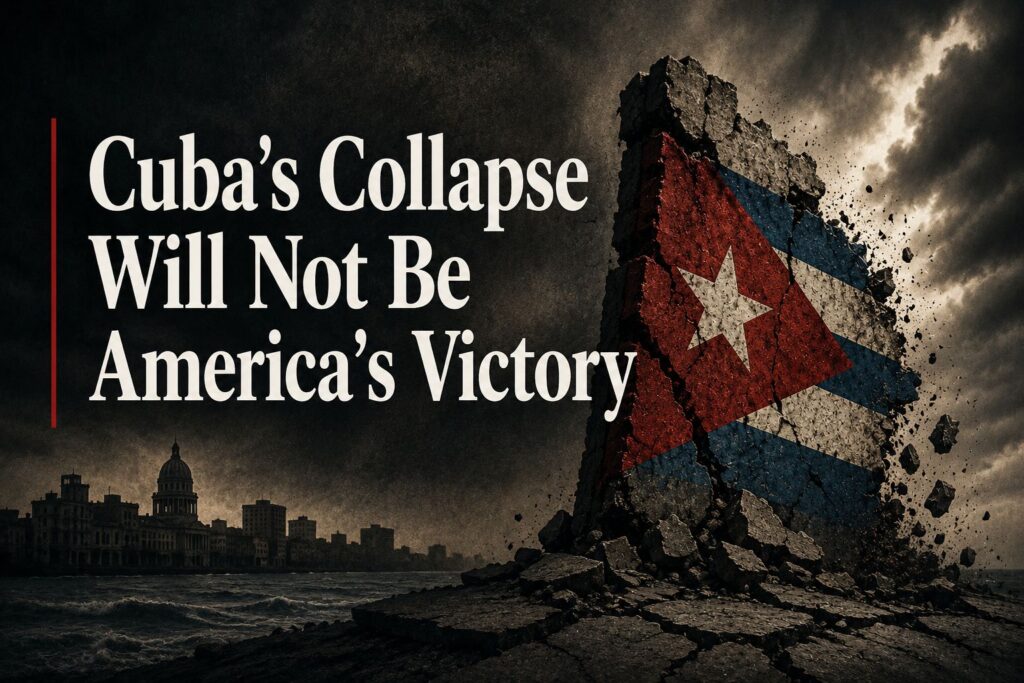
Cuba has been an interesting phenomenon in American politics for many years now as a vestige of the Cold War era ruled under a communist regime which Washington had long expected to crumble any day now. With the current situation in Cuba perhaps being its worst since the end of the Soviet era, expectations that the Cuban government will soon be at the end of its tether seem to have come back stronger than ever before. This is because Cuba is now experiencing shortages of electricity, a stagnant economy, mass exodus, and growing international isolation. There is, however, a risk in associating Cuba’s troubles with American triumphs.
The gravity of the present scenario cannot be overstated. Some parts of Cuba are facing long power cuts, with reports suggesting that some areas face cuts of more than 12 hours a day. Lack of fuel is affecting transportation and manufacturing processes, whereas lack of food has become a part of people’s everyday lives. In addition to its tough economic conditions post-COVID-19, the nation is struggling with shortage of energy resources as well as foreign reserves.
The demographic impact has been equally as remarkable. Since the beginning of the pandemic, approximately 10 percent of the total population of Cuba has fled the country, marking one of the greatest exoduses to leave the country since the start of the Cuban Revolution. Doctors, nurses, professors, and entire families are leaving Cuba in search of better living conditions. For Cubans, the burning issue is not ideology but mere survival.
In light of all this, the current US administration has become more and more aggressive towards the Cuban capital. Raul Castro’s indictment, claims against confiscated assets, and signals from the American military establishment in the region have strengthened the belief that the US is shifting from applying pressure to adopting a regime change policy. The point is that Washington wants to take advantage of Cuba’s vulnerability.
This kind of mindset might appear politically popular especially among parts of the Cuban exile community who have been patiently waiting for the demise of the revolutionary government. However, history provides plenty of justifications to tread carefully.
One of the myths that continue to exist in international politics is the belief that the fall of a despised regime will inevitably lead to stability, prosperity, or democracy. Nothing could be further from the truth. Governments undertake functions without which the country simply cannot survive. They keep order, run utilities, allocate resources, give health care, enforce borders, and ensure that society does not tear itself apart. When the system disintegrates too quickly, the chaos unleashed may prove hard to handle.
This is especially true when considering Cuba. This is an island nation located only about 93 miles off the coast of Florida. Any breakdown in its system of governance will certainly lead to more migration from the Cuban population into the U.S. The U.S. government has found itself dealing with migration issues in various regions recently. Another one emerging from Cuba will certainly complicate matters further.
Migration is not the only issue. Economic turmoil can lead to secondary problems, such as increased crime rates, deteriorating public services, the scarcity of medical supplies and food products, and the establishment of alternative power groups. The Cuban health care system, though long in decline, continues to be a vital part of the state’s infrastructure. Failure may impact millions of individuals, especially the elderly and weak.
Also, there is the matter of what might happen after such a breakdown occurs. Supporters of regime change are more concerned about changing leadership and pay significantly less attention to what will come afterward. There needs to be functional political infrastructure, financial resources, social agreement, and governmental capability for any political transition to take place successfully. The Cuban regime is lacking in all four aspects today.
However, the current crisis should not only be perceived within the context of outside pressure and geopolitical rivalries. Cuba’s leadership should also take considerable blame for the state of its current affairs. For decades, poor management and inefficiency, lack of private initiative, and unwillingness to implement reforms have played a large part in making life tough for Cuban people. The system of economy which was initially intended to ensure social justice and development has proved ineffective.
But recognizing this problem does not necessarily justify the use of policy measures designed to speed up the process of state disintegration. The pain that is evident in Cuba is not endured by the political elite. It is endured by families coping with power cuts, pensioners enduring shortages, workers dealing with limited prospects, and youth for whom emigration is now their only hope.
The importance of this difference arises from the tendency of humanitarian crises to outlive the political considerations which led to their creation. States and politics can adapt, evolve, and be changed through negotiations, but social scars resulting from instability may take generations to heal.
In Washington, there is a temptation to view the present vulnerabilities of Cuba as confirmation that history is finally on America’s side. However, strategic victory cannot be gauged by the vulnerability of the opponent alone. Victory must bring about a more stable, prosperous, and secure world, and this is one area where the Cuban collapse would represent extreme risk.
American politicians have traditionally seen Cuba as a challenge to their ideology. Today, however, they may find themselves seeing it as an opportunity in geopolitics. A failed state ninety miles away from Florida is no triumph; it is an ominous message. What is at stake is not whether this regime can endure forever but whether the U.S. government has truly thought through the implications if it does not. The lessons of history show that overthrowing regimes is easier than dealing with what comes afterwards. For the Cuban people, that distinction could determine whether the current crisis becomes a difficult transition or a national tragedy.