
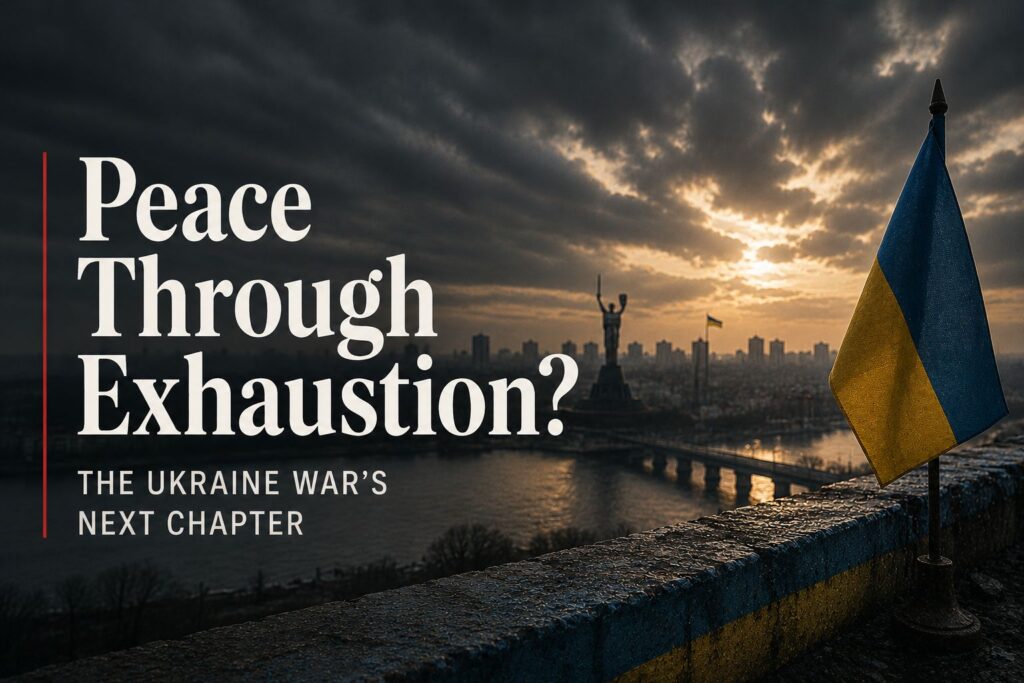
The latest signals from Moscow suggest that the question of Ukraine’s future is no longer framed solely in terms of battlefield momentum, but in terms of whether a negotiated settlement remains structurally possible at all. Vladimir Putin’s recent remarks, welcoming elements of proposed US ideas while insisting that Ukraine must accept “compromises,” reflect a gradual shift in tone: from outright battlefield determinism toward conditional diplomacy shaped by realities on the ground.
But the burning question remains unchanged. After more than four years of war, what are the actual prospects for peace in Ukraine, and what kind of peace is still possible?
It is far from simple. The war dragged on as a brutal conflict of attrition with little change to frontlines. Massive costs in lives and resources did not lead to much progress either. CSIS says that both Russia and Ukraine suffered around 1.8 to 2 million military casualties, killed, wounded, or missing, making it the bloodiest European war since WWII. With over a million casualties for Russia alone, this highlights the immense human toll for very small territorial gains.
On the territorial dimension, open-source battlefield assessments indicate that Russia controls roughly one-fifth of Ukraine’s internationally recognized territory, including most of Luhansk and significant parts of Donetsk, Zaporizhzhia, and Kherson regions. Ukraine, meanwhile, retains control over key cities and western supply corridors, ensuring that neither side has achieved decisive strategic dominance.
This military stalemate is reflected in the broader operational reality on the ground. A recent analysis suggests that Russian advances in 2025-2026 have slowed to minimal territorial gains relative to the scale of mobilization, reinforcing the assessment that the conflict is now primarily one of attrition rather than manoeuvre.
Diplomatic positions have also gotten tougher. Ukraine still demands the return of its territory according to recognized borders, and Western governments back this up strongly. Russia disagrees though; they say any solution needs to consider the current new territorial situation. They also insist on addressing NATO expansion and Ukraine’s closer ties with the West, which they have objected to for a long time.
These positions remain fundamentally incompatible. Diplomacy, however, has not disappeared, it has fragmented into indirect channels, competing peace proposals, and intermittent engagement between global powers. Putin’s reference to US President Donald Trump’s reported proposals illustrates this dynamic: diplomacy is being shaped not by direct negotiations between Kyiv and Moscow, but by external actors attempting to structure a framework both sides might reluctantly accept.
The core obstacle to peace lies in sequencing. For Ukraine and its Western partners, Russian withdrawal is a precondition for negotiations. For Moscow, withdrawal would mean abandoning territories secured through prolonged warfare without guarantees regarding Ukraine’s future security alignment. This creates a structural deadlock in which compromise is interpreted by both sides as strategic vulnerability rather than diplomatic progress.
Historical examples show that long wars usually end because both sides get tired and decide to accept some realities on the ground. Take the Korean War armistice, Cyprus’s split, and various Middle Eastern ceasefire deals. In each case, politics stepped in after a military deadlock, not a total win.
In Ukraine’s case, external factors make things more complicated. NATO partners keep giving Ukraine military and financial support. At the same time, Russia pivoted its economy towards wartime production and non-Western energy markets. Even with Western sanctions, Russia’s economy has not crashed like anticipated by West. According to the IMF, Russia is still growing, but it is uneven due to defense spending and redirected exports.
At the same time, Ukraine’s war effort remains structurally dependent on Western funding and weapons transfers, with billions in annual support required to sustain fiscal stability and military operations. This asymmetry does not determine the outcome of negotiations, but it does shape perceptions of endurance and leverage on both sides.
The humanitarian and economic costs make this crisis more urgent. Ukraine faces major damage to its infrastructure, mass displacement, and declining industrial output. Russia suffers too, dealing with long-term demographic issues, heavy military losses, and tough structural problems from sanctions and separation from Western markets. Still, neither side seems ready or able to make the needed political concessions.
In this context, Putin’s message makes sense. By mixing offers to negotiate with claims of gaining ground, Moscow tries to paint a picture, that time is on Russia’s side. This might or might not turn out to be true, but it manifests they do not expect quick victories. Instead, they anticipate winning through gradually changing ground realities.
The hope for peace in Ukraine, therefore relies less on matching words than on both sides facing a stalemate that hurts them enough to actually stick politically. Right now, things are not there yet. Fighting continues, outside help is strong, and Kyiv and Moscow still describe their goals in ways that clash.
However, the gradual shift in discourse, from absolute victory to conditional compromise, suggests that the architecture of a future settlement is not entirely absent. It is still being formed, indirectly, through the slow and costly recognition that neither military escalation nor diplomatic isolation has yet produced a decisive outcome.
The ultimate truth? If peace happens, it will not come as a grand resolution. More likely, it will be from both sides being totally exhausted and formalizing that into an agreement. Whether or not they reach this point will affect not just Ukraine’s future, but also stability across the entire European security order.